NRDC and NCISM partner to boost traditional medicine patents
Source:PIB ↗
ఇది ఎందుకు ముఖ్యం
India faces a paradox where it files a high number of patents but struggles with low commercialization rates. This MoU is a prime example of institutional convergence to address this gap specifically within the traditional medicine sector. It provides a real-world case study for GS3 answers on how the government is actively facilitating IP protection and technology transfer to turn indigenous knowledge into economic and healthcare assets.
సారాంశం
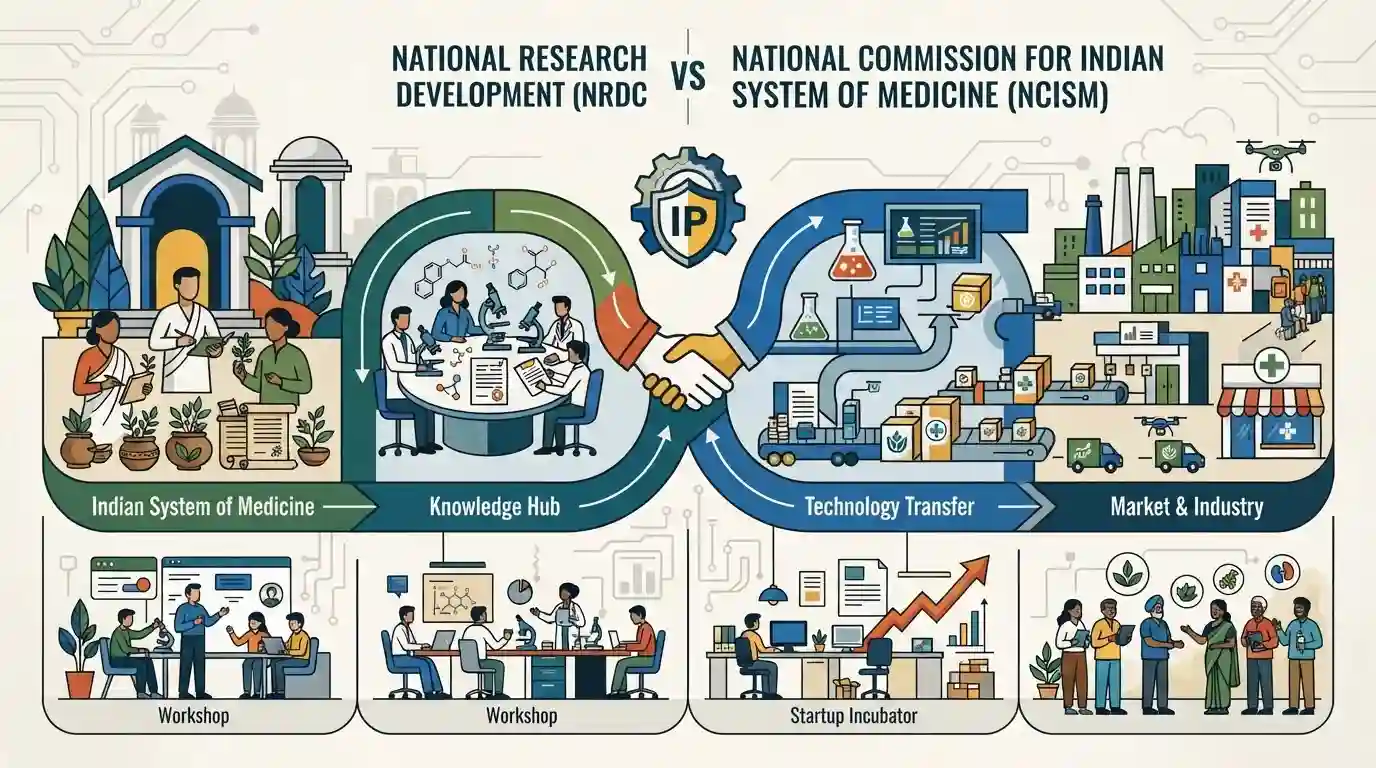
The National Research Development Corporation (NRDC) and the National Commission for Indian System of Medicine (NCISM) have signed a Memorandum of Understanding (MoU) to promote innovation, intellectual property (IP) management, and technology commercialization in the Indian System of Medicine. This inter-ministerial collaboration seeks to bridge the gap between traditional medicine research and industry. NRDC will provide expertise to help NCISM-affiliated institutions protect their IP and transfer technologies to the market. The initiative also focuses on capacity building, encouraging start-ups, and fostering entrepreneurship in indigenous healthcare systems like Ayurveda, Unani, and Siddha.
ముఖ్య అంశాలు
- Institutional Synergy: The MoU links the technical and commercialization expertise of NRDC (Ministry of Science & Technology) with the regulatory and educational framework of NCISM (Ministry of Ayush).
- IP Management: NRDC will assist NCISM and its affiliated institutions in identifying, protecting, and managing intellectual property rights (IPR) for innovations in Ayurveda, Unani, Siddha, and Sowa-Rigpa.
- Commercialization Focus: A major goal is to bridge the gap between academia and industry by facilitating technology transfer, ensuring that lab research translates into marketable traditional medicine products.
- Ecosystem Development: The partnership aims to organize capacity-building programs on IPR and foster a culture of start-ups, incubation, and entrepreneurship within the Indian System of Medicine.
- Protecting Traditional Knowledge: The initiative supports India's broader objective of safeguarding indigenous medical knowledge from biopiracy while economically leveraging genuine domestic innovations.
ముఖ్యమైన పదాలు
National Commission for Indian System of Medicine (NCISM)

A statutory body under the Ministry of Ayush that regulates medical education, professional standards, and practice in traditional Indian medicine systems, including Ayurveda, Unani, Siddha, and Sowa-Rigpa.
UPSC context
GS Paper II (Governance & Health); tests understanding of regulatory bodies, medical education reforms, and traditional healthcare systems in India.
National Research Development Corporation (NRDC)
A Section 8 Central Public Sector Enterprise under DSIR that promotes, develops, and commercializes technologies, patents, and inventions originating from national R&D institutions.
UPSC context
GS Paper III (Science & Technology); tests knowledge of commercialization of indigenous research and technology transfer mechanisms in India.
NCISM Act, 2020
Parliamentary legislation that established the NCISM, replacing the Central Council of Indian Medicine (CCIM) to reform traditional medical education and healthcare delivery across India.
UPSC context
GS Paper II (Government Policies & Interventions); tests understanding of legislative acts reformulating health administrative and educational frameworks.
Ministry of Ayush
The nodal Union Ministry in India responsible for policy formulation, education, research, regulation, and promotion of traditional and alternative medicine systems.
UPSC context
GS Paper II (Issues Relating to Health); tests knowledge of governmental ministries, policies, and alternative medicine promotion in public health.
Department of Scientific and Industrial Research (DSIR)
A department under the Ministry of Science and Technology tasked with promoting industrial research, technology development, and the utilization of indigenous technology.
UPSC context
GS Paper III (Science & Technology); tests awareness of government bodies fostering industrial R&D, innovation, and industry-academia collaboration.
ప్రిలిమ్స్ ఉచ్చు
The NCISM regulates education and clinical practice across all traditional Indian medicine systems, including Ayurveda, Siddha, and Homoeopathy.
Homoeopathy is regulated by a completely separate statutory body, the National Commission for Homoeopathy (NCH), not by the NCISM.
అనుసంధానమైన స్థిర భావనలు
What is the legal status and regulatory scope of NCISM?
- Statutory Origin: Established under the NCISM Act, 2020, to replace the older, five-decade-old Central Council of Indian Medicine (CCIM).
- Regulatory Jurisdiction: Oversees education, clinical practice, and institutional standards for Ayurveda, Unani, Siddha, and Sowa-Rigpa systems.
- Nodal Ministry: Functions as an autonomous statutory regulatory body operating under the Ministry of Ayush.
How does the Traditional Knowledge Digital Library (TKDL) prevent biopiracy?
- Prior Art Database: Acts as an intellectual property repository to prevent foreign patent offices from granting patents on Indian traditional knowledge.
- Institutional Collaboration: Developed as a highly successful joint initiative between CSIR and the Ministry of Ayush in 2001.
- Linguistic Translation: Translates traditional texts using the Traditional Knowledge Resource Classification into five international languages to break language barriers.
అంతర-అంశ నమూనాలు
Traditional medicine and global patent regimes
Connects TKDL prior-art data with WIPO treaties to protect indigenous traditional knowledge against international biopiracy and corporate patent squatting.
Public R&D commercialization bottlenecks
Links NRDC's technology-transfer mandate with India's broader industrial policy, highlighting structural gaps in translating public sector lab R&D into commercial products.

Analysis of TKDL's defensive patenting and NCISM's exclusion of Homoeopathy will likely form a multi-statement Prelims question on IPR.
అనుసంధాన PYQలు · 2
అనుసంధాన PYQలు · 2
- 2019MainsGS3
How is the Government of India protecting traditional knowledge of medicine from patenting by pharmaceutical companies?
- 2024MainsGS3
What is the present world scenario of intellectual property rights with respect to life materials? Although, India is second in the world to file patents, still only a few have been commercialized. Explain the reasons behind this less commercialization.
