India defends agricultural tariffs at WTO trade policy review
Source:PIB ↗
Why It Matters
Understanding India's trade policy positions and its relationship with the WTO is a recurring theme in the UPSC Civil Services Examination. This article provides vital talking points on agricultural tariffs, anti-dumping rules (Lesser Duty Rule), fisheries subsidies, and India's stance on WTO reforms (development-oriented and preserving policy space), which are critical for Mains GS-2 (International Relations) and GS-3 (Economy/Agriculture), as well as Prelims conceptual questions.
Summary
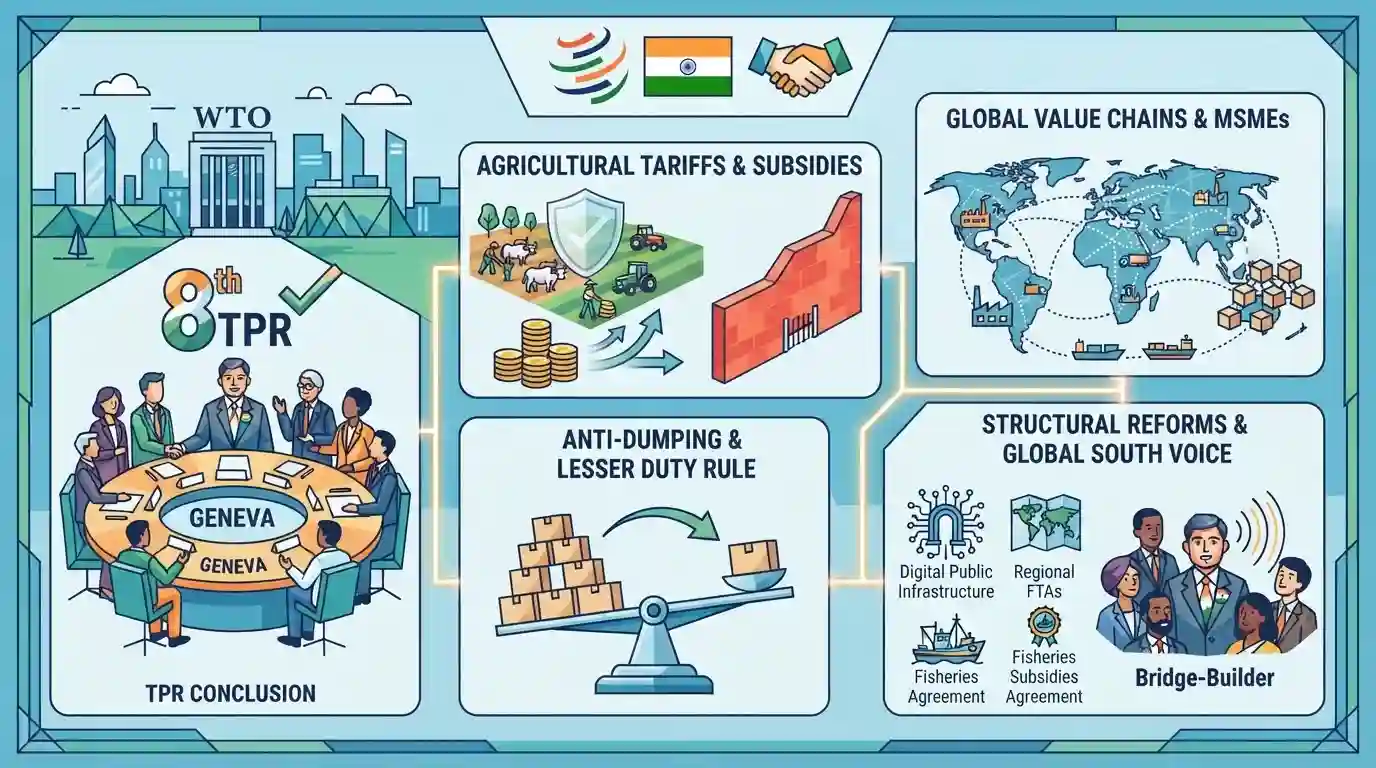
India successfully concluded its Eighth Trade Policy Review (TPR) at the World Trade Organization (WTO) in Geneva. Led by Commerce Secretary Rajesh Agarwal, the Indian delegation reaffirmed its commitment to a transparent, open, and rules-based trade regime. India defended its agricultural tariffs to protect small farmers, justified industrial tariffs for supply chain resilience, and highlighted key structural reforms, including Digital Public Infrastructure (DPI), regional FTAs, and the adoption of the Fisheries Subsidies Agreement. India called for development-centric WTO reforms that preserve policy space for developing countries, with international representatives hailing India as a crucial 'bridge-builder' and leading voice for the Global South.
Key Points
- India concluded its Eighth Trade Policy Review (TPR) at the WTO in Geneva (held on July 21 and 23, 2026), receiving 1,094 written questions from 44 members and active participation from 68 members.
- India defended its agricultural tariff structure as essential for protecting the livelihoods of millions of small, low-income, and resource-poor farmers, while stating industrial tariffs promote domestic manufacturing and supply chain resilience.
- The delegation reaffirmed adherence to WTO rules on Sanitary and Phytosanitary (SPS) measures, technical regulations, and transparent trade remedies, noting that Quality Control Orders (QCOs) fulfill legitimate public policy objectives and that India continues to apply the 'Lesser Duty Rule' in its anti-dumping framework.
- Members welcomed India's acceptance of the WTO Agreement on Fisheries Subsidies and appreciated domestic initiatives like Digital Public Infrastructure (DPI), customs modernization, and MSME integration into Global Value Chains (GVCs).
- On WTO reforms, India emphasized a development-oriented approach that preserves necessary policy space for developing countries, enhances the organization's credibility, and respects existing mandates.
- The Review highlighted India's dual role as a leading voice of the Global South and a 'bridge-builder' capable of fostering consensus amidst geopolitical and economic uncertainties.
Important Terms
WTO Agreement on Fisheries Subsidies

A multilateral WTO treaty targeting marine conservation by prohibiting government subsidies for illegal, unreported, and unregulated fishing, overfished stocks, and unregulated high-seas fishing, while excluding aquaculture and inland fisheries.
UPSC context
GS Paper II/III: Multilateral pacts, ocean governance, environmental sustainability, and artisanal fisher livelihoods.
Lesser Duty Rule
A trade remedy principle capping anti-dumping or countervailing duties at either the dumping/subsidy margin or the injury margin, whichever is lower, ensuring duties restore fair competition without being unnecessarily punitive.
UPSC context
GS Paper III: Indian Economy, external sector, trade remedies, and the Directorate General of Trade Remedies.
Quality Control Orders (QCOs)
Mandatory regulatory directives issued under India's BIS Act, 2016, requiring goods to meet specific quality standards before being manufactured, sold, or imported, serving as non-tariff trade measures.
UPSC context
GS Paper III: Industrial growth, MSME challenges, and WTO Technical Barriers to Trade agreements.
Trade Policy Review Body
A specialized WTO administrative organ, composed of the General Council, that conducts periodic transparency reviews of member nations' trade regimes to monitor compliance with multilateral agreements.
UPSC context
GS Paper II: Structure, mandate, and transparency mechanisms of international organizations affecting global trade.
World Trade Organization (WTO)
An intergovernmental organization established on January 1, 1995, under the Marrakesh Agreement, that regulates and facilitates international trade rules, reduces trade barriers, and resolves disputes.
UPSC context
GS Paper II: Multilateral global institutions, international trade architecture, and their impact on India.
Prelims Trap
The WTO Agreement on Fisheries Subsidies restricts government subsidies across all fishing sectors, including inland freshwater fisheries and commercial aquaculture.
The agreement’s disciplines apply exclusively to marine wild capture fishing and maritime activities; inland freshwater fisheries and aquaculture are explicitly excluded.
Static Concepts Connected
What is the WTO's Trade Policy Review Mechanism (TPRM)?
- Origin and mandate: Established under Annex 3 of the Marrakesh Agreement (1994) to ensure systemic transparency in member countries' trade policies.
- Review frequency: The top four global traders are reviewed every 3 years; the next 16 (including India) undergo review every 5 years.
- Legal character: It is a non-confrontational peer-review mechanism and cannot be used for dispute settlement enforcement or creating new trade commitments.
What is the 'Lesser Duty Rule' (LDR) in anti-dumping investigations?
- Core rule: An optional WTO provision where anti-dumping duty is capped below the dumping margin if a lower amount removes domestic injury.
- India's application: Implemented by DGTR, capping duties at the lesser of the dumping margin or the injury margin.
- Injury margin: Calculated as the difference between the domestic non-injurious price and the landed value of imports.
Cross-Topic Patterns
WTO Fisheries Agreement + Marine Ecology
Connects WTO subsidy prohibitions on IUU fishing with SDG 14 and India’s Blue Economy framework, balancing global marine conservation with domestic artisanal fisherfolk protection.
DPI + Global Trade Governance
Integrates domestic Digital Public Infrastructure (DPI) and customs modernization with WTO e-commerce debates, projecting India’s digital stack as a model for Global South trade facilitation.

India's dual stance of protecting agri-tariffs while ratifying the Fisheries Agreement will likely frame a 2026 WTO development-space question.
Linked PYQs · 4
Linked PYQs · 4
- 2014MainsGS2
WTO is an important international institution where decisions taken affect countries in a profound manner. What is the mandate of WTO and how binding are their decisions ? Critically analyse India's stand on the latest round of talks on Food security.
- 2016MainsGS2
The broader aims and objectives of WTO are to manage and promote international trade in the era of globalization. But the Doha round of negotiations seem doomed due to differences between the developed and the developing countries." Discuss in the Indian perspective.
- 2023MainsGS3
What are the direct and indirect subsidies provided to farm sector in India? Discuss the issues raised by the World Trade Organization (WTO) in relation to agricultural subsidies.
- 2015PrelimsGS1
The terms 'Agreement on Agriculture', 'Agreement on the Application of Sanitary and Phytosanitary Measures' and 'Peace Clause' appear in the news frequently in the context of the affairs of the
