India develops first indigenous expendable turbojet engine
Source:PIB ↗
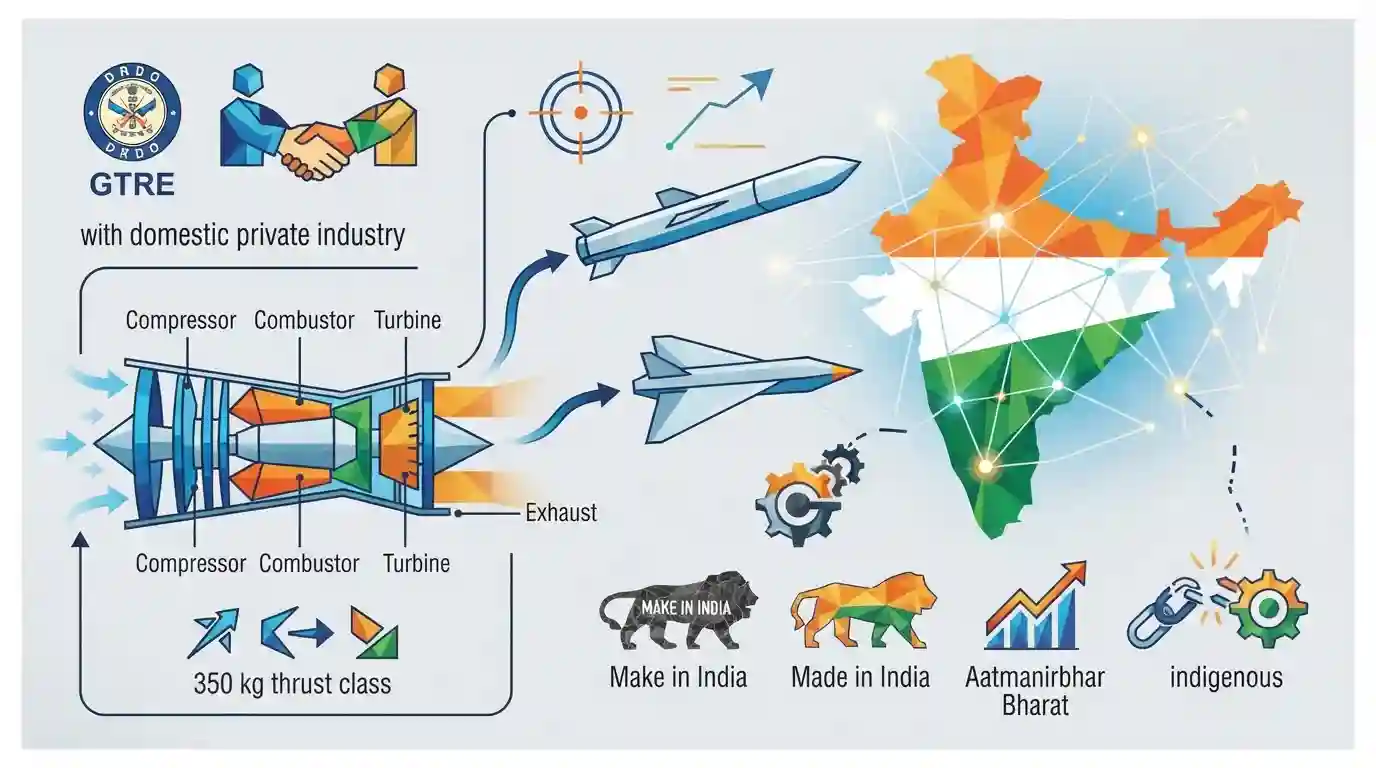
Why It Matters
Mastery over jet engine manufacturing is limited to a few nations globally due to extreme metallurgical and precision engineering challenges. Developing a domestic expendable turbojet engine is crucial for securing supply chains for India's cruise missile and drone programs, directly impacting strategic autonomy and defense preparedness.
Summary
India has achieved a significant milestone in defense technology with the successful development of its first indigenous Expendable Turbo Jet Engine in the 350 kg thrust class. Designed and developed by DRDO's Gas Turbine Research Establishment (GTRE) in partnership with the domestic private industry, the engine is meant to power single-use aerospace platforms like cruise missiles and target drones. This technological breakthrough demonstrates India's growing capability in complex aerospace propulsion systems, substantially advancing the goals of 'Make in India' and self-reliance (Aatmanirbhar Bharat) in critical defense manufacturing by eliminating dependency on foreign imports.
Key Points
- DRDO's Gas Turbine Research Establishment (GTRE) has successfully developed India's first indigenous Expendable Turbo Jet Engine of the 350 kg thrust class.
- The engine has been manufactured in collaboration with private sector partners (such as Azad Engineering), reflecting successful public-private synergy in defense R&D.
- This class of expendable engine is specifically designed for single-use strategic aerospace platforms, primarily powering cruise missiles, target drones, and unmanned aerial vehicles (UAVs).
- Mastering this complex propulsion technology reduces India's reliance on foreign original equipment manufacturers (OEMs) for critical missile components.
- The breakthrough represents a major milestone for 'Aatmanirbhar Bharat' in defense, bolstering the domestic aerospace manufacturing ecosystem and ensuring strategic autonomy.
Important Terms
Defence Research and Development Organisation (DRDO)

India's premier military research and development agency, established in 1958 under the Ministry of Defence, dedicated to achieving self-reliance in critical defence technologies and systems.
UPSC context
GS Paper III (Science & Technology); tests understanding of India's defence R&D infrastructure and strategic capabilities.
Gas Turbine Research Establishment (GTRE)
A pioneering laboratory of the Defence Research and Development Organisation (DRDO) based in Bengaluru, specializing in the design, development, and testing of gas-turbine engines for military aerospace applications.
UPSC context
GS Paper III (Science & Technology); tests knowledge of specific state agencies driving indigenous aerospace propulsion technologies and defense self-reliance.
Azad Engineering
A Hyderabad-based private precision manufacturing and aerospace company selected by DRDO as the industry partner to manufacture, assemble, and deliver the 350 kg thrust class Expendable Turbo Jet Engine.
UPSC context
GS Paper III (Economy & Security); highlights the growing role of Public-Private Partnerships (PPP) in indigenous defence manufacturing.
Aatmanirbhar Bharat
India's flagship self-reliance initiative launched in 2020, aimed at making the country a global manufacturing hub and reducing import dependence across strategic sectors like defence.
UPSC context
GS Paper III (Indian Economy, Indigenisation of Technology); tests policy comprehension regarding economic resilience and strategic sovereignty.
Make in India
A national initiative launched in 2014 designed to facilitate investment, foster innovation, enhance skill development, protect intellectual property, and build best-in-class manufacturing infrastructure in India.
UPSC context
GS Paper III (Indian Economy & Industrial Policy); tests knowledge of policy-led domestic manufacturing growth and defense indigenization.
Prelims Trap
The newly developed 350 kg thrust engine is a reusable turbofan system intended for long-range, multi-mission heavy transport aircraft.
It is a single-use (expendable) turbojet designed for lightweight tactical platforms, whereas turbofans are used for long-range, fuel-efficient subsonic missions.
Static Concepts Connected
What are the technical differences between Turbojet, Turbofan, Ramjet, and Scramjet engines?
- Turbojet bypass: Passes 100% of intake air through the combustion chamber; highly compact and optimized for high-speed, single-use expendable platforms.
- Turbofan bypass: Diverts a fraction of air around the engine core; provides higher fuel efficiency, making it ideal for subsonic, long-endurance flights.
- Ramjet vs Scramjet: Uses forward speed to compress air without moving parts; Ramjet slows air to subsonic for combustion, while Scramjet maintains supersonic combustion speeds.
Cross-Topic Patterns
Propulsion technology and MTCR restrictions
Developing indigenous engines enables India to bypass strict MTCR export/import controls on rocket and jet propulsion systems, boosting self-reliance in tactical cruise missile technologies.
Defense R&D corporatisation and private investment
GTRE's partnership with private industry marks a shift from public-sector monopoly to a dual-use aerospace industrial complex, accelerating manufacturing and prototype turnaround times.

Prelims 2026 will likely test differences between turbojet, turbofan, and ramjet propulsion systems mapped to specific Indian missiles.
Linked PYQs · 3
Linked PYQs · 3
- 2014MainsGS3
Foreign Direct Investment (FDI) in the defence sector is now set to be liberalized. What influence this is expected to have on Indian defence and economy in the short and long run?
- 2023PrelimsGS1
Consider the following statements: 1. Ballistic missiles are jet-propelled at subsonic speeds throughout their flights, while cruise missiles are rocket-powered only in the initial phase of flight. 2. Agni-V is a medium-range supersonic cruise missile, while BrahMos is a solid-fuelled intercontinental ballistic missile. Which of the statements given above is/are correct?
- 2026PrelimsGS1
Which of the following items of defence hardware is/are manufactured in India ? 1. Su-30 MKI Fighter Jets 2. T-90 MK-III Tanks 3. Akula Class Submarine Select the answer using the code given below :
