DRDO successfully tests indigenous Kusha LRSAM system
Source:PIB ↗
Why It Matters
The 'Kusha' LRSAM is a pivotal development in India's defense indigenization, acting as an indigenous equivalent to advanced imported systems like the S-400. It directly addresses UPSC syllabus topics related to the indigenization of technology, defense modernization, and internal security mechanisms against evolving aerial threats such as UAVs.
Summary
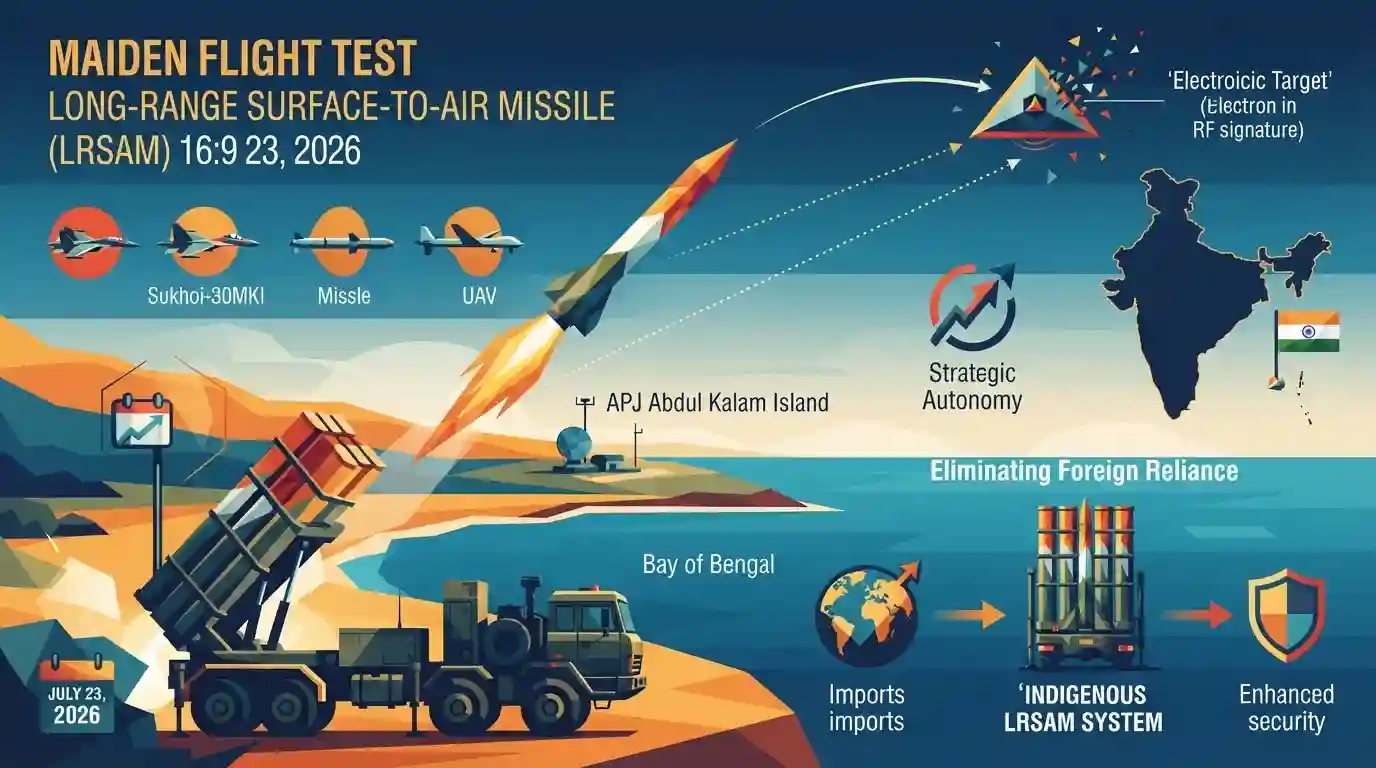
The Defence Research and Development Organisation (DRDO) successfully completed the maiden flight test of the indigenous 'Kusha' Long-Range Surface-to-Air Missile (LRSAM) from APJ Abdul Kalam Island on July 23, 2026. Equipped with active RF seekers, the missile successfully intercepted a high-speed, high-altitude electronic target, proving its capability to neutralize diverse aerial threats including fighter jets, missiles, and UAVs. This breakthrough significantly enhances India's air defense capabilities and strategic autonomy, eliminating reliance on foreign imports and elevating India into an elite group of nations with indigenous long-range SAM technology.
Key Points
- DRDO successfully conducted the maiden flight test of the Kusha Long-Range Surface-to-Air Missile (LRSAM) off the coast of Odisha.
- The indigenous air defense system is capable of neutralizing fighter jets, missiles, UAVs, and large enemy aircraft across wide ranges and altitudes.
- The test demonstrated precise tracking and interception of a high-speed, high-altitude electronic target using an active RF seeker.
- The successful development of Kusha eliminates India's import dependency for long-range surface-to-air systems, marking a milestone in defense self-reliance (Atmanirbharta).
- India now joins a select group of nations possessing indigenous capabilities to manufacture and deploy advanced long-range SAM systems.
Important Terms
Kusha Long-Range Surface-to-Air Missile (LRSAM)

India's indigenous air defence system developed by DRDO to neutralise long-range aerial threats like jets and missiles up to 350–400 km away, providing a multi-layered shield.
UPSC context
GS Paper III (S&T/Defence); tests knowledge of national security networks and self-reliance in critical defence technologies.
Defence Research and Development Organisation (DRDO)
India's premier military research and development agency under the Ministry of Defence, responsible for creating cutting-edge indigenous technologies, platforms, and weapon systems for the armed forces.
UPSC context
GS Paper III (S&T/Indigenisation); essential for studying the institutional frameworks of defence manufacturing and R&D in India.
APJ Abdul Kalam Island
A key missile-testing facility formerly known as Wheeler Island, located off the Odisha coast, hosting India's Integrated Test Range for launching strategic missiles.
UPSC context
GS Paper I (Geography) & GS Paper III (Defence); regularly tested in geographical mapping and defence test site questions.
Indigenisation of Technology
The process of designing, developing, and manufacturing technology and defense hardware domestically to reduce import dependence and achieve strategic autonomy.
UPSC context
GS Paper III (S&T/Indigenisation); vital for essays and mains answers on self-reliance and economic sovereignty.
Prelims Trap
Mission Sudarshan Chakra is an exclusive military air-defence shield designed solely to protect frontline bases and active combat zones.
The initiative is specifically designed with an expanded 'civilian coverage layer' protecting critical public infrastructure like railways, hospitals, and nuclear reactors, rather than being strictly military.
Static Concepts Connected
What is the Integrated Air Command and Control System (IACCS)?
- Definition: An automated command and control system of the IAF that integrates all military and civil radars into a single network.
- Function: Consolidates data to establish a comprehensive Recognised Air Picture (RAP) across Indian airspace.
- Operational Impact: Reduces sensor-to-shooter loop time and prevents friendly fire incidents through automated threat prioritization.
How do Active RF (Radio Frequency) Seekers function in missile guidance?
- Mechanism: A terminal guidance system where the missile carries its own radar transmitter and receiver to track the target.
- Advantage: Provides a true 'fire-and-forget' capability, freeing the launching platform to engage other targets immediately.
- Comparison: Contrasts with semi-active guidance which requires ground-based radars to continuously illuminate the target until impact.
Cross-Topic Patterns
Defense Indigenisation + Strategic Autonomy
Replacing imports of long-range SAMs with indigenous platforms like Kusha shields India's defense procurement from foreign sanctions and supply-chain vulnerabilities, bolstering strategic autonomy.
Critical Infrastructure Security + AI
Integrating AI-enabled air shields (Sudarshan Chakra) with civilian infrastructure highlights the shifting definition of national security from pure border defense to holistic domestic resilience.

DRDO's Project Kusha and Mission Sudarshan Chakra's dual military-civilian application are highly likely for a 2026 S&T question.
Linked PYQs · 3
Linked PYQs · 3
- 2026PrelimsGS1
Consider the following statements about Mission Sudarshan Chakra of India : 1. It aims to enhance India's air defence, ballistic missile defence and aerial offensive capabilities. 2. This Mission is being designed to enhance rapid, precise, and powerful defence responses, reinforcing India's strategic autonomy. 3. One of the aims of this Mission is to cover all public places of India by an expanded nationwide security shield by 2035. Which of the statements given above is/are correct ?
- 2021MainsGS3
How is S-400 air defence system technically superior to any other system presently available in the world?
- 2023MainsGS3
The use of unmanned aerial vehicles (UAVs) by our adversaries across the borders to ferry arms/ammunitions, drugs, etc., is a serious threat to the internal security. Comment on the measures being taken to tackle this threat.
