PM SVANidhi scheme expands coverage for street vendors
Source:PIB ↗
ఇది ఎందుకు ముఖ్యం
It provides concrete data and policy examples of how targeted microfinance interventions can formalize the informal sector, build credit histories for the unbanked, and alleviate urban poverty—core themes in GS2 (Welfare Schemes) and GS3 (Inclusive Growth/Economy).
సారాంశం
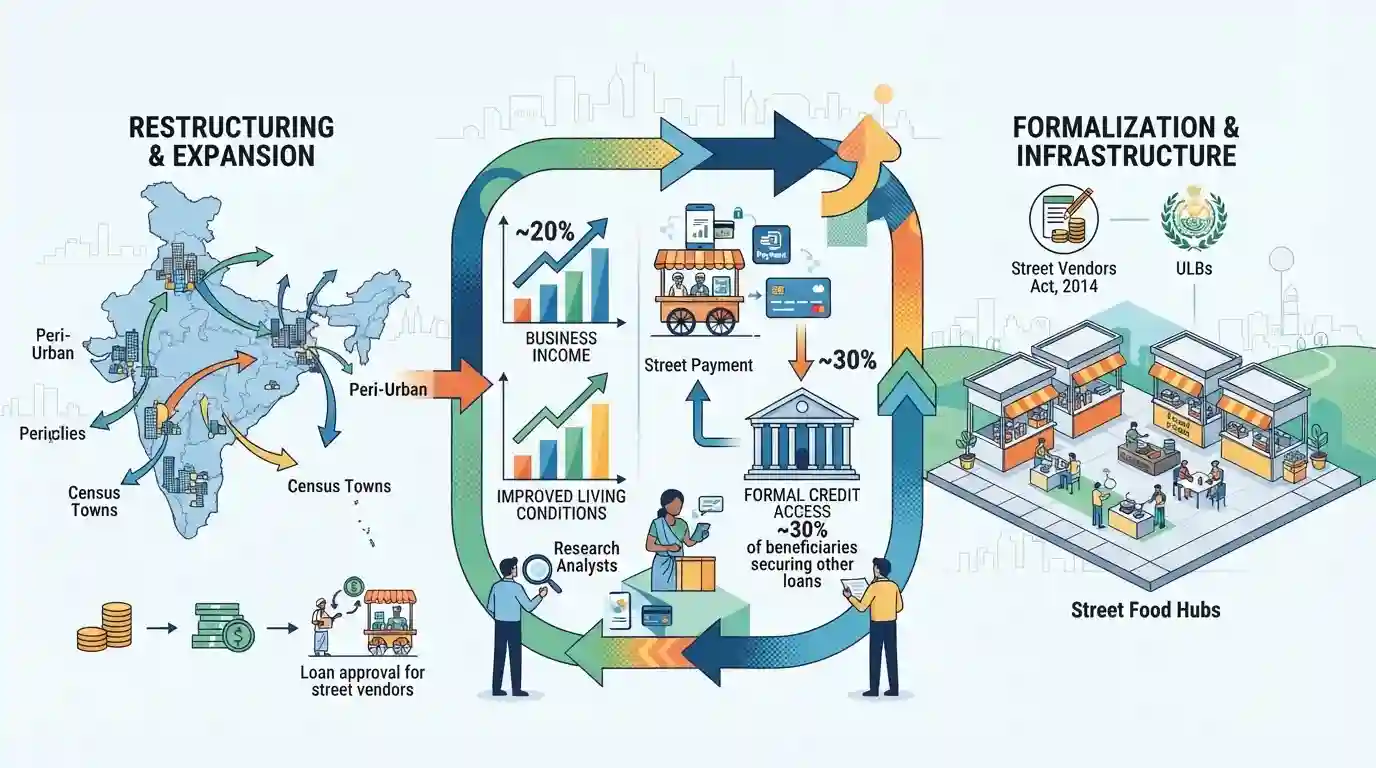
The Government of India's PM-SVANidhi scheme, a micro-credit initiative for street vendors, has been restructured and geographically expanded to include peri-urban and census towns. Impact assessments by the Indian School of Business (ISB) demonstrate significant positive outcomes, including a ~20% increase in business income and improved living conditions. Crucially, the scheme has facilitated financial inclusion; about 30% of beneficiaries have built sufficient credit history to secure other formal loans. To further deepen digital financial inclusion, a UPI-linked RuPay Credit Card was introduced in 2026 for compliant borrowers. The scheme also focuses on formalizing street vending infrastructure through the development of 'Street Food Hubs', with implementation led by Urban Local Bodies (ULBs) under the Street Vendors Act, 2014.
ముఖ్య అంశాలు
- The PM-SVANidhi scheme has been geographically expanded beyond statutory urban areas to include street vendors from census towns and peri-urban areas.
- Impact assessment studies by ISB Hyderabad (2023 and 2025) indicate an approximate 20% growth in average annualized business income for beneficiaries.
- About 30% of borrowers accessed additional non-scheme loans, highlighting PM-SVANidhi's role in building credit histories for the unbanked and formalizing their businesses.
- A UPI-linked RuPay Credit Card was launched in January 2026 specifically for beneficiaries who successfully repaid their second loan tranche, furthering digital financial inclusion.
- The initiative integrates with the Street Vendors Act, 2014, placing implementation responsibility on States/UTs and ULBs, and includes infrastructure upgrades like Street Food Hubs.
ముఖ్యమైన పదాలు
PM-SVANidhi Scheme

A central sector micro-credit scheme launched in 2020 by the Ministry of Housing and Urban Affairs, providing collateral-free working capital loans of up to ₹50,000 to urban street vendors.
UPSC context
GS Paper II & III: Welfare schemes, financial inclusion, urban poverty, and informal sector empowerment.
Street Vendors (Protection of Livelihood and Regulation of Street Vending) Act, 2014
An Indian parliament act enacted to regulate street vending in public spaces, protect vendors' rights, prevent arbitrary evictions, and establish Town Vending Committees (TVCs) for local governance.
UPSC context
GS Paper II: Governance, social justice, and statutory regulatory bodies for vulnerable sections of society.
Urban Local Bodies (ULBs)
Constitutionally recognized municipal governance institutions (like Corporations and Councils) established under the 74th Amendment Act to administer, manage, and implement welfare and development schemes in urban areas.
UPSC context
GS Paper II: Devolution of powers and finances, local self-government, and urban planning challenges.
Atmanirbhar Bharat
A comprehensive nationwide campaign launched in 2020 focusing on five key pillars—Economy, Infrastructure, System, Demography, and Demand—to foster self-reliance, local manufacturing, and post-pandemic economic resilience.
UPSC context
GS Paper III: Indian Economy, industrial growth, self-reliance, and manufacturing sector policies.
UPI-linked RuPay Credit Card
A modern financial instrument combining the RuPay credit network with Unified Payments Interface (UPI) technology, allowing users to make seamless digital transactions directly from a credit limit.
UPSC context
GS Paper III: Financial inclusion, digital public infrastructure (DPI), and fintech innovations in the informal economy.
ప్రిలిమ్స్ ఉచ్చు
Urban Local Bodies (ULBs) or Town Vending Committees (TVCs) exclusively issue Letters of Recommendation for all eligible areas under the scheme.
Under the restructured guidelines, Block Development Offices (BDOs)—not ULBs or TVCs—are responsible for issuing Letters of Recommendation in census towns and peri-urban areas.
అనుసంధానమైన స్థిర భావనలు
What is the difference between Statutory Towns and Census Towns in India?
- Statutory Towns: Administered by municipal bodies, corporations, cantonment boards, or notified town area committees established under state statutes.
- Census Towns: Must have at least 5,000 residents, 75% male main workers in non-agricultural work, and a density of 400+ people/sq km.
What are the core mandates of the Street Vendors Act, 2014?
- Town Vending Committees: Mandates setting up TVCs in each local authority, ensuring at least 40% representation from street vendors.
- Protection from eviction: Protects registered vendors from arbitrary eviction and mandates participatory surveys before declaring any no-vending zones.
అంతర-అంశ నమూనాలు
Peri-urban governance + Administrative silos
Rapid growth in peri-urban areas blurs rural-urban lines, forcing urban welfare schemes to employ block-level rural machinery (BDOs) to target informal workers.
Financial inclusion + Alternative credit scoring
Graduated micro-loans coupled with digital UPI transactions generate a transaction history, enabling commercial banks to evaluate risk for historically unbanked workers.

Expect a multi-statement question on PM-SVANidhi's expansion, testing the administrative shift to BDOs and the UPI-linked credit framework.
అనుసంధాన PYQలు · 4
అనుసంధాన PYQలు · 4
- 2020MainsGS2
Micro-Finance as an anti-poverty vaccine, is aimed at asset creation and income security of the rural poor in India". Evaluate the role of the Self Help Groups in achieving the twin objectives along with empowering women in rural India.
- 2022MainsGS3
Is inclusive growth possible under market economy ? State the significance of financial inclusion in achieving economic growth in India.
- 2016PrelimsGS1
Pradhan Mantri MUDRA Yojana is aimed at
- 2015PrelimsGS1
'Pradhan Mantri Jan-Dhan Yojana' has been launched for
