National framework targets seismic resilience of urban buildings
Source:PIB ↗
આ શા માટે મહત્વનું છે
It connects disaster management (earthquake resilience) with governance (the constitutional mandate of ULBs under the 12th Schedule). It is highly relevant for GS3 questions on disaster preparedness and GS2 questions evaluating the functions and capacities of local bodies.
સારાંશ
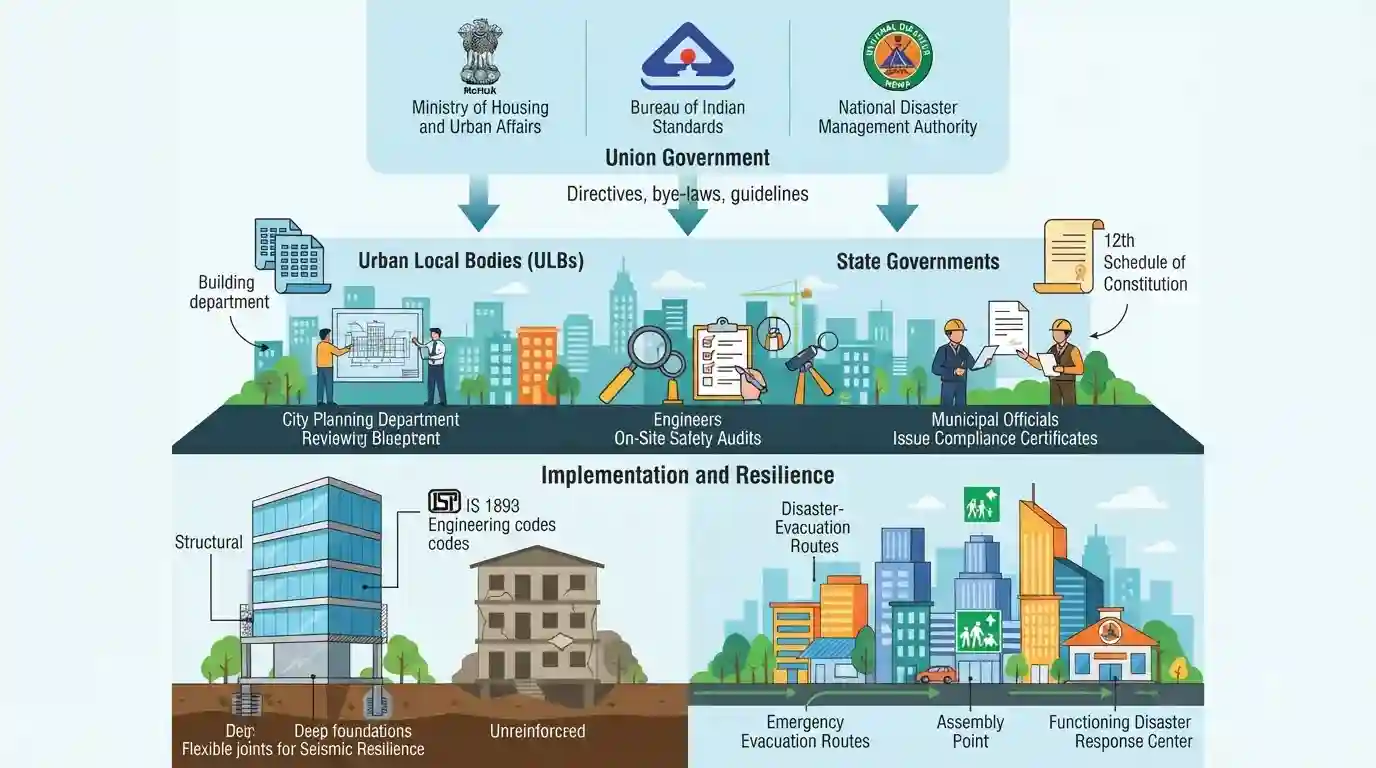
The article outlines India's institutional and regulatory framework for ensuring the structural safety and seismic resilience of buildings. While the Union Government—through the Ministry of Housing and Urban Affairs (MoHUA), the Bureau of Indian Standards (BIS), and the National Disaster Management Authority (NDMA)—provides model building bye-laws, engineering codes (such as IS 1893), and disaster management guidelines, the actual enforcement falls under the jurisdiction of Urban Local Bodies (ULBs). Empowered by the 12th Schedule of the Constitution, these local entities and state governments bear the responsibility of conducting periodic safety audits, overseeing building plan approvals, and enforcing compliance to mitigate earthquake-related hazards and build resilient urban infrastructure.
મુખ્ય મુદ્દા
- Urban planning and building bye-law enforcement are constitutional functions delegated to Urban Local Bodies (ULBs) under the 12th Schedule of the Constitution.
- MoHUA’s Model Building Bye-laws (MBBL) - 2016 feature a dedicated Chapter 6 on structural safety, setting a template for States to ensure seismic resilience.
- The Bureau of Indian Standards (BIS) prescribes technical standards for earthquake-resistant design, most notably IS 1893 and IS 4326:2013.
- NDMA guidelines advocate proactive disaster risk reduction, specifically targeting the strengthening and retrofitting of critical and lifeline infrastructure against earthquakes.
- The regulatory landscape reflects a federal division of responsibilities: the Union Government creates model codes and guidelines, while States/UTs and ULBs are responsible for enforcement, building inspections, and periodic structural safety audits.
મહત્વપૂર્ણ શબ્દો
12th Schedule of the Constitution of India

Added by the 74th Amendment Act, this schedule lists 18 functional items, such as urban planning and building regulations, entrusted to Urban Local Bodies as institutions of self-government.
UPSC context
GS-2 (Local Governance). Tests knowledge of constitutional devolution of powers to urban municipalities.
Model Building Bye-laws (MBBL) - 2016
A comprehensive regulatory framework issued by the Ministry of Housing and Urban Affairs to guide states and local bodies in formulating building regulations, emphasizing structural safety and disaster resilience.
UPSC context
GS-3 (Disaster Management & Infrastructure). Highlights regulatory tools for urban earthquake preparedness.
IS 1893
The primary Indian Standard code formulated by the Bureau of Indian Standards that specifies the design criteria and seismic hazard mapping for constructing earthquake-resistant structures.
UPSC context
GS-3 (Disaster Management). Tests awareness of technical and engineering standards for mitigating seismic vulnerability.
National Disaster Management Authority (NDMA)
The apex statutory body headed by the Prime Minister, established under the Disaster Management Act, 2005, to formulate national policies, plans, and guidelines for comprehensive disaster management.
UPSC context
GS-3 (Disaster Management). Core institutional framework topic for crisis response and mitigation.
Urban Local Bodies (ULBs)
Constitutionally mandated local self-government institutions in urban areas, empowered to execute municipal functions including building plan approvals, enforcing safety bye-laws, and urban planning.
UPSC context
GS-2 (Governance). Essential for understanding the decentralized implementation of urban policies and disaster resilience.
Bureau of Indian Standards (BIS)
The National Standards Body of India responsible for harmonizing standard markings and quality certifications, including critical engineering safety codes like earthquake-resistant construction.
UPSC context
GS-2 (Statutory Bodies) & GS-3. Important for governance of quality and infrastructure safety.
પ્રિલિમ્સ ટ્રેપ
According to the Bureau of Indian Standards, India is divided into five distinct seismic hazard zones, starting from Zone I.
The Bureau of Indian Standards (BIS) merged Zone I with Zone II. Therefore, there are only four active seismic zones in India (II to V), not five.
સંલગ્ન સ્થિર ખ્યાલો
What is the constitutional and federal structure of urban construction regulation in India?
- Constitutional Devolution: Under Article 243W, the 12th Schedule lists Entry 2 (land-use/construction) and Entry 7 (fire services) as devolved municipal functions.
- Federal Division: The Central government can only issue advisory templates (like MoHUA's Model Building Bye-laws); enforcement laws must be enacted by individual State Legislatures.
- Disaster Management Act: The 2005 Act vests execution powers in State and District Disaster Management Authorities (SDMAs/DDMAs), leaving enforcement decentralized.
How does the BIS classify India's seismic hazard zones?
- Four Active Zones: India is divided into four zones: Zone II (low), Zone III (moderate), Zone IV (high), and Zone V (highest seismic intensity).
- Absence of Zone I: Zone I is completely omitted from the active classification system as no part of India is considered entirely safe from seismic activity.
- Zone V Coverage: Covers the entire Northeast, parts of Jammu & Kashmir, Ladakh, Himachal Pradesh, Uttarakhand, Gujarat's Rann of Kutch, and Andaman & Nicobar.
આંતર-વિષય પેટર્ન
ULB capacity + Fiscal decentralization
Weak municipal revenue streams under the 74th Amendment directly impair the capacity of ULBs to hire specialized structural engineers required for enforcing MBBL-2016 safety codes.
Infrastructure resilience + Logistics corridors
Integrating IS 1893 seismic standards into PM Gati Shakti infrastructure planning prevents multi-modal logistics corridors from suffering systemic collapses during high-intensity earthquakes.

2026 GS-I/II may combine the 12th Schedule municipal entries with the engineering metrics of India's four active BIS seismic zones.
સંલગ્ન PYQ · 5
સંલગ્ન PYQ · 5
- 2021MainsGS3
Discuss about the vulnerability of India to earthquake related hazards. Give examples including the salient features of major disasters caused by earthquakes in different parts of India during the last three decades.
- 2024MainsGS3
What is disaster resilience? How is it determined? Describe various elements of a resilience framework. Also mention the global targets of Sendai Framework for Disaster Risk Reduction (2015–2030).
- 2019MainsGS3
Vulnerability is an essential element for defining disaster impacts and its threat to people. How and in what ways can vulnerability to disasters be characterized? Discuss different types of vulnerability with reference to disasters.
- 2024MainsGS2
Analyse the role of local bodies in providing good governance at local level and bring out the pros and cons merging the rural local bodies with the urban local bodies.
- 2024PrelimsGS1
Which of the following statements are correct about the Constitution of India? 1. Powers of the Municipalities are given in Part IX A of the Constitution. 2. Emergency provisions are given in Part XVIII of the Constitution. 3. Provisions related to the amendment of the Constitution are given in Part XX of the Constitution. Select the answer using the code given below :
