Competition Commission Approves NCR Atleos and Brinks Acquisition
Source:PIB ↗
Why It Matters
This article is relevant for understanding the regulatory role of the Competition Commission of India (CCI) in overseeing corporate acquisitions and preventing market monopolies. It also sheds light on the backend operations of the banking sector, specifically the ecosystem of ATM manufacturing, White Label ATMs (WLAs), and cash replenishment services which are critical for financial inclusion and last-mile banking connectivity.
Summary
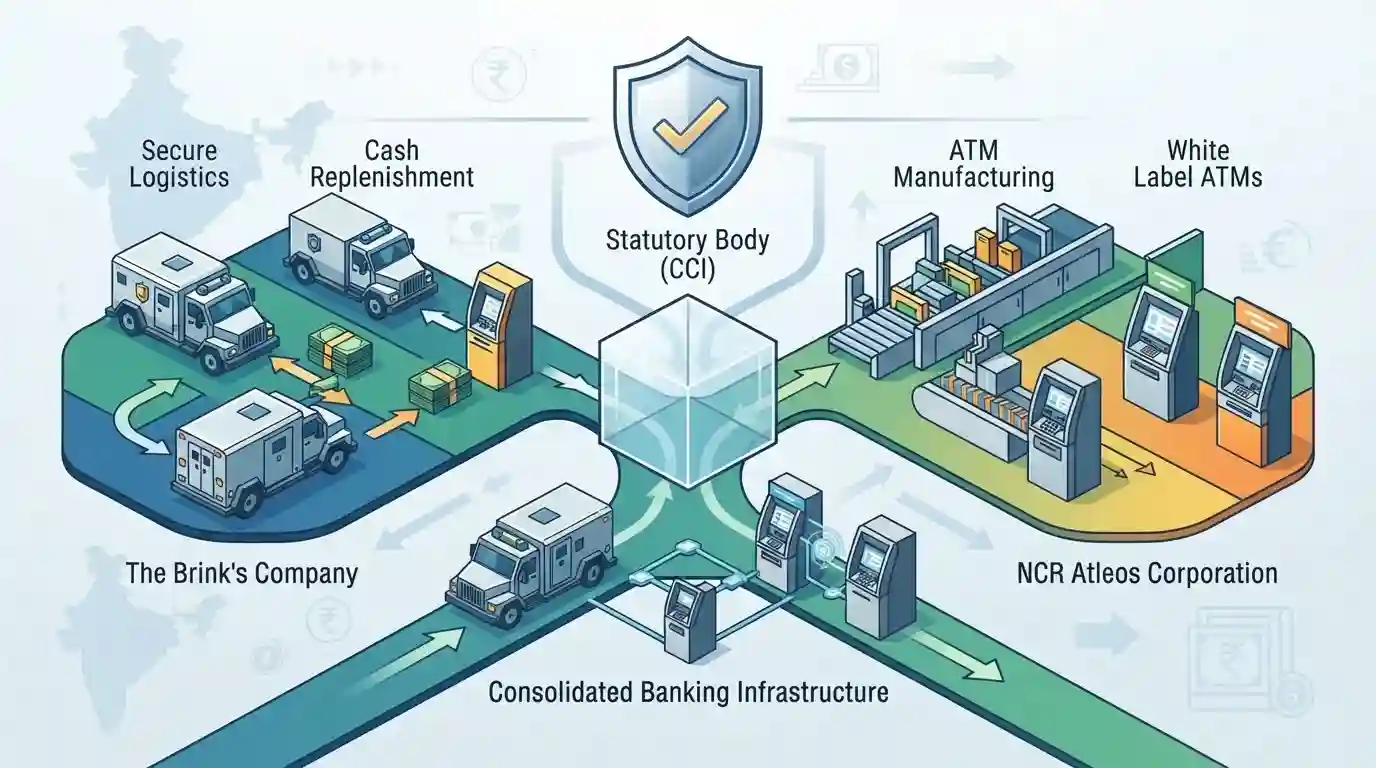
The Competition Commission of India (CCI) has approved the acquisition of a 100% equity stake in NCR Atleos Corporation by The Brink's Company. The Brink's Company operates globally in secure logistics and payment solutions, specializing in ATM cash replenishment in India. Meanwhile, NCR Atleos Corporation focuses on self-service banking, manufacturing ATMs, and operating White Label ATMs (WLAs) in the Indian market. The approval highlights the CCI's regulatory role in overseeing mergers and acquisitions (M&A) to ensure fair market competition, while the deal itself represents a significant consolidation in India's banking infrastructure and financial services ecosystem.
Key Points
- The Competition Commission of India (CCI) has approved the 100% equity acquisition of NCR Atleos Corporation by The Brink's Company.
- The Brink's Company is a global secure logistics provider, known in India primarily for its ATM cash replenishment services.
- NCR Atleos Corporation provides ATM hardware, software, and managed services, and operates White Label ATMs in India.
- The acquisition integrates complementary services within the ATM and banking infrastructure sector, ranging from hardware manufacturing to cash logistics.
Important Terms
Competition Commission of India (CCI)

A statutory body established under the Competition Act, 2002, responsible for enforcing competition laws, preventing anti-competitive practices, and regulating mergers and acquisitions to maintain fair market competition in India.
UPSC context
GS Paper II (Statutory Bodies) and GS Paper III (Indian Economy); tests regulatory framework, market competition, and corporate governance.
White Label ATMs (WLAs)
Automated Teller Machines set up, owned, and operated by non-banking financial entities authorized by the RBI under the Payment and Settlement Systems Act, 2007, to improve financial inclusion in rural and semi-urban areas.
UPSC context
GS Paper III (Indian Economy & Financial Sector); tests concepts of financial inclusion, banking infrastructure, and RBI's retail payment regulations.
The Brink's Company
A US-based multinational cash management and secure logistics firm specializing in secure transit, digital retail solutions, and ATM cash replenishment services.
UPSC context
GS Paper III (Indian Economy); tests understanding of global consolidation, financial services infrastructure, and corporate operations in India's banking sector.
NCR Atleos Corporation
A global financial technology corporation specialized in ATM software, self-service banking solutions, ATM hardware manufacturing, and managed financial services.
UPSC context
GS Paper III (Indian Economy); tests knowledge of international fintech mergers, banking infrastructure supply chains, and their domestic impacts.
Prelims Trap
Foreign Direct Investment (FDI) in White Label ATM operations requires prior RBI or government approval if it exceeds 49%.
Under current consolidated FDI policy, up to 100% FDI is permitted under the automatic route for White Label ATM operations.
Static Concepts Connected
What differentiates White Label, Brown Label, and Orange Label ATMs in India?
- White Label: Owned and operated by non-banking entities; they do not display any specific bank's branding.
- Brown Label: Owned/leased by a service provider, but cash handling and banking network are branded under a sponsor bank.
- Other Labels: Orange ATMs are used for share transactions; Green for agricultural transactions; Yellow for e-commerce.
What is the Appreciable Adverse Effect on Competition (AAEC) under the Competition Act, 2002?
- Statutory Standard: It is the primary test used by the CCI to determine if a merger/acquisition will significantly harm market competition.
- Key Factors: CCI assesses barriers to entry, level of concentration, and countervailing buyer power in the relevant market.
- Remedial Power: If AAEC is found, CCI can reject the combination or propose structural modifications before approval.
Cross-Topic Patterns
Financial inclusion vs market concentration
Consolidations in payment infrastructures like WLAs improve efficiency but risk creating regional monopolies in rural, underbanked pockets, impacting financial inclusion.
Extraterritorial reach of competition law
Global mergers require CCI clearance if asset or turnover thresholds are met in India, demonstrating India's extraterritorial regulatory jurisdiction over multinational transactions.

2026 Prelims may test classification criteria of White/Brown label ATMs alongside the automatic FDI limits in payment infrastructure.
Linked PYQs · 3
Linked PYQs · 3
- 2023MainsGS2
Discuss the role of the Competition Commission of India in containing the abuse of dominant position by the Multi-National Corporations in India. Refer to the recent decisions.
- 2018PrelimsGS1
Which one of the following links all the ATMs in India?
- 2016MainsGS3
Justify the need for FDI for the development of the Indian economy. Why there is gap between MOUs signed and actual FDIs? Suggest remedial steps to be taken for increasing actual FDIs in India.
