AAROH Report on Scientific Mine Closure and Repurposing Practices
Source:PIB ↗
কেন এটি গুরুত্বপূর্ণ
This article covers the critical intersection of economic development, resource mining, and environmental protection. It provides key fodder points for Mains answers on how India is managing its energy transition sustainably. Notable frameworks like RECLAIM and SUVIKALP, the 'Coal NEER' circular economy project, and Indo-German technical collaborations are highly useful for GS3 (Environment & Economy), GS1 (Geography), and Essay papers. Additionally, the role of the Coal Controller Organisation (CCO) is a proven area of Prelims interest.
সারসংক্ষেপ
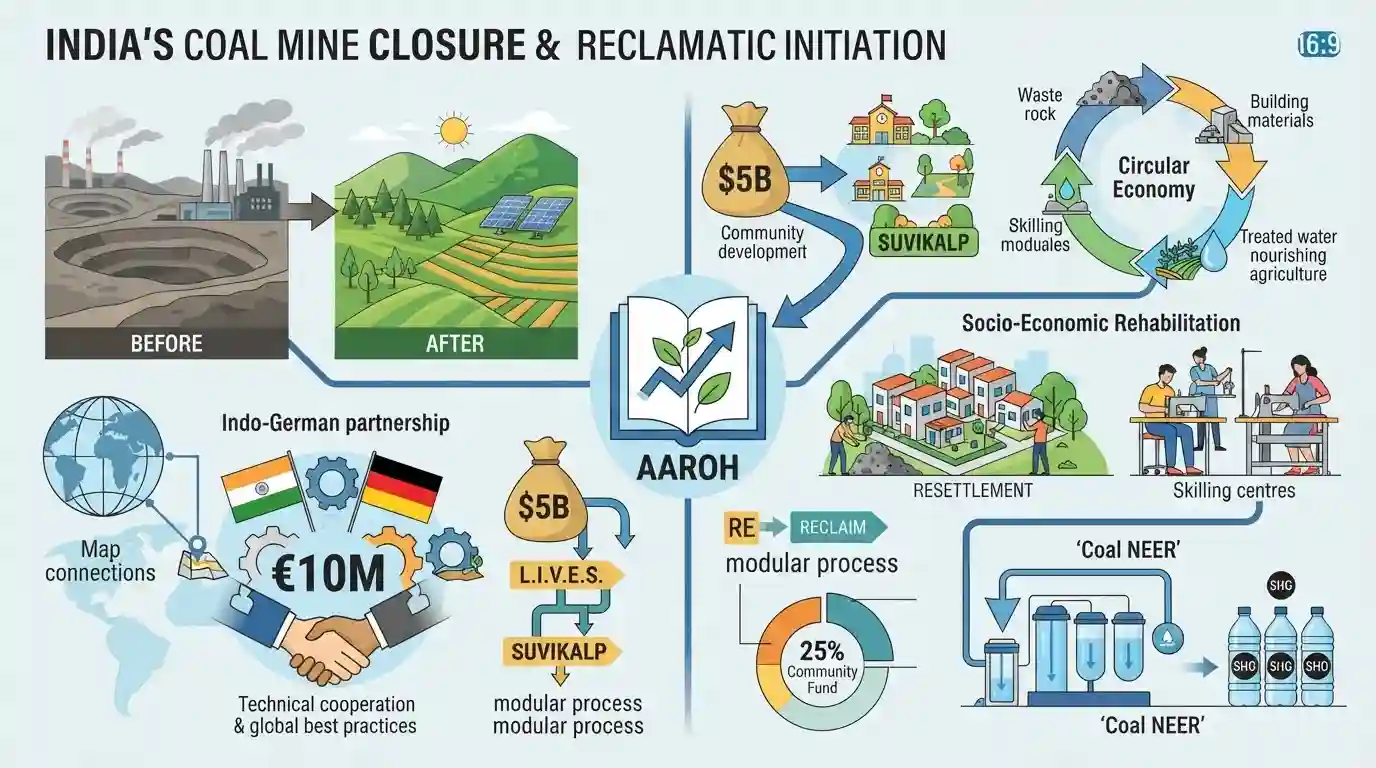
The Ministry of Coal has released 'AAROH', India's first comprehensive report documenting the successful ecological restoration and scientific closure of 42 coal mines. Highlighting a paradigm shift from regulatory enforcement to structured, community-centric reclamation, the initiative is backed by a USD 5 billion corpus and the 'Mine Closure Guidelines, 2025', which earmark 25% of closure funds directly for regional community development. Supported by frameworks like RECLAIM, L.I.V.E.S., and the SUVIKALP tool, the ministry has also entered into a EUR 10 million technical cooperation agreement with Germany's GIZ and the EU to adopt global best practices. Additionally, 'Coal NEER' water purification plants were launched to turn mine discharge into bottled drinking water managed by local SHGs, while tripartite MoUs were signed to establish technical textile and apparel manufacturing skilling centres to economically rehabilitate families under the Jharia Master Plan.
মূল বিষয়
- The Coal Controller Organisation (CCO), under the Ministry of Coal, released 'AAROH', India's first-ever comprehensive documentation on scientific mine closure and repurposing practices.
- AAROH details the environmental and ecological restoration of 42 closed coal mines, with India setting a target to scientifically reclaim 147 more mines over the next 2-3 years.
- The Ministry of Coal has instituted a dedicated corpus of over USD 5 billion (~₹40,000 crore) for progressive mine closures and released the 'Mine Closure Guidelines, 2025', which earmark 25% of closure costs for community development (worth ~₹10,000 crore over the next decade).
- Several strategic digital and policy frameworks have been established, including the RECLAIM, L.I.V.E.S., and A.R.T.H.A. frameworks, along with the digital SUVIKALP Mine Repurposing Tool and District Collector-led Mine Closure Advisory Committees.
- India and Germany (via GIZ and BMZ, co-financed by the EU) signed a EUR 10 million technical cooperation agreement till 2030 to share best practices on closed and 'to-be-closed' coal mines under the Team Europe framework.
- Under the 'Waste to Wealth' vision, 'Coal NEER' plants have been set up by Coal India Limited subsidiaries to purify discharged mine water using RO, UV, and CDI technologies, marketing bottled drinking water via local Self Help Groups (SHGs).
- Tripartite MoUs were signed between BCCL, JRDA, Hindalco, and Rajdhani Universal Fabrics to construct an apparel skilling centre and a plug-and-play technical textile manufacturing ecosystem for families rehabilitated under the Jharia Master Plan.
গুরুত্বপূর্ণ শব্দ
AAROH (Annual Report on Mine Closure)

India's first comprehensive report documenting the scientific closure, ecological restoration, and land repurposing of 42 exhausted coal mines. It highlights the transition toward structured, community-centric reclamation and sustainable post-mining development.
UPSC context
GS-3 (Environment). Highlights India’s evolving "Just Transition" approach and statutory accountability in sustainable post-mining land management.
Mine Closure Guidelines, 2025
An updated Ministry of Coal policy framework integrating community engagement, ecological restoration, and socio-economic transformation into mine closure planning. It notably earmarks closure funds directly for regional community development.
UPSC context
GS-3 (Environment), GS-2 (Governance). Crucial for understanding statutory mechanisms enforcing environmental stewardship and socioeconomic accountability in mining.
RECLAIM Framework
Standing for Rejuvenation, Engagement, Community Livelihoods, and Mine-closure, this framework guides community participation, livelihood revitalization, and local governance integration to ensure an inclusive transition for coal-dependent communities.
UPSC context
GS-2 (Governance), GS-3 (Inclusive Growth). Important model for grassroots participation and Just Transition strategies in fossil-fuel regions.
Coal NEER
A "Waste to Wealth" initiative utilizing reverse osmosis to convert treated mine discharge into safe, bottled drinking water. The purification plants are operated by local women's Self-Help Groups, boosting employment.
UPSC context
GS-3 (Environment), GS-1 (Women Empowerment). Exemplifies circular economy principles, water conservation, and community-led resource management.
SUVIKALP Tool
An interactive digital decision-support tool launched by the Ministry of Coal to assist policymakers in evaluating post-mining land-use options, such as solar farms or eco-tourism, for exhausted mine sites.
UPSC context
GS-3 (Technology, Environment). Showcases digital innovation for optimized resource planning and post-mining land repurposing.
Revised Jharia Master Plan
A 2025 Cabinet-approved framework with a ₹5,940 crore outlay addressing underground coal fires and land subsidence in Dhanbad. It prioritizes safe resettlement, infrastructure, and sustainable livelihoods for affected families.
UPSC context
GS-1 (Geography), GS-3 (Disaster Management). Addresses one of India’s longest-running socio-environmental crises via targeted economic rehabilitation.
প্রিলিমস ফাঁদ
The AAROH report on the ecological restoration and scientific closure of mines is published by the Ministry of Environment, Forest and Climate Change.
AAROH is released by the Ministry of Coal (via the Coal Controller Organisation), not MoEFCC, despite dealing primarily with ecological restoration.
সংযুক্ত স্থির ধারণা
What causes the century-old underground fires in the Jharia coalfield?
- Unscientific mining: Historical open-cast and underground mining without proper backfilling exposed coal seams to oxygen.
- Spontaneous combustion: Auto-oxidation of coal when exposed to air leads to self-heating and eventually unquenchable underground fires.
- Jharia Master Plan: A socio-economic framework aimed at relocating families from fire and subsidence-prone areas to safe settlements.
What is the role of District Mineral Foundations (DMF) in India?
- Statutory Status: Established under the Mines and Minerals (Development and Regulation) Amendment Act, 2015 as non-profit trusts.
- Core Objective: To work for the interest and benefit of persons and areas affected by mining related operations.
- Funding mechanism: Funded by mandatory contributions from mining lease holders, implemented via Pradhan Mantri Khanij Kshetra Kalyan Yojana.
আন্তঃবিষয় প্যাটার্ন
Just Transition & Climate Finance
The Indo-German GIZ agreement highlights how India's domestic coal phase-down aligns with global climate frameworks, linking mine closure to international 'Just Transition' financing.
Waste-to-Wealth + SHG Livelihoods
'Coal NEER' converts mine discharge into marketable water via local SHGs, bridging environmental remediation (GS3) with rural women's empowerment (GS1/GS2).

Expect a 2026 Prelims pair-matching question on 'Just Transition' tools (SUVIKALP, AAROH, RECLAIM) and their associated ministries.
সংযুক্ত PYQ · 3
সংযুক্ত PYQ · 3
- 2025MainsGS3
Mineral resources are fundamental to the country's economy and these are exploited by mining. Why is mining considered an environmental hazard? Explain the remedial measures required to reduce the environmental hazard due to mining.
- 2017MainsGS1
In spite of adverse environmental impact, coal mining is still inevitable for development." Discuss.
- 2022PrelimsGS1
In India, what is the role of the Coal Controller's Organization (CCO)? 1. CCO is the major source of Coal Statistics in Government of India. 2. It monitors progress of development of Captive Coal/Lignite blocks. 3. It hears any objection to the Government's notification relating to acquisition of coal-bearing areas. 4. It ensures that coal mining companies deliver the coal to end users in the prescribed time. Select the correct answer using the code given below:
