India Panama Maritime Partnership and Logistics Cooperation
Source:PIB ↗
ఇది ఎందుకు ముఖ్యం
Panama controls the Panama Canal, one of the world's most critical maritime chokepoints. Securing a deep maritime and digital logistics partnership with Panama enables India to enhance its supply chain resilience, expand trade routes to the Americas, and project its digital public infrastructure (DPI) and smart logistics solutions globally.
సారాంశం
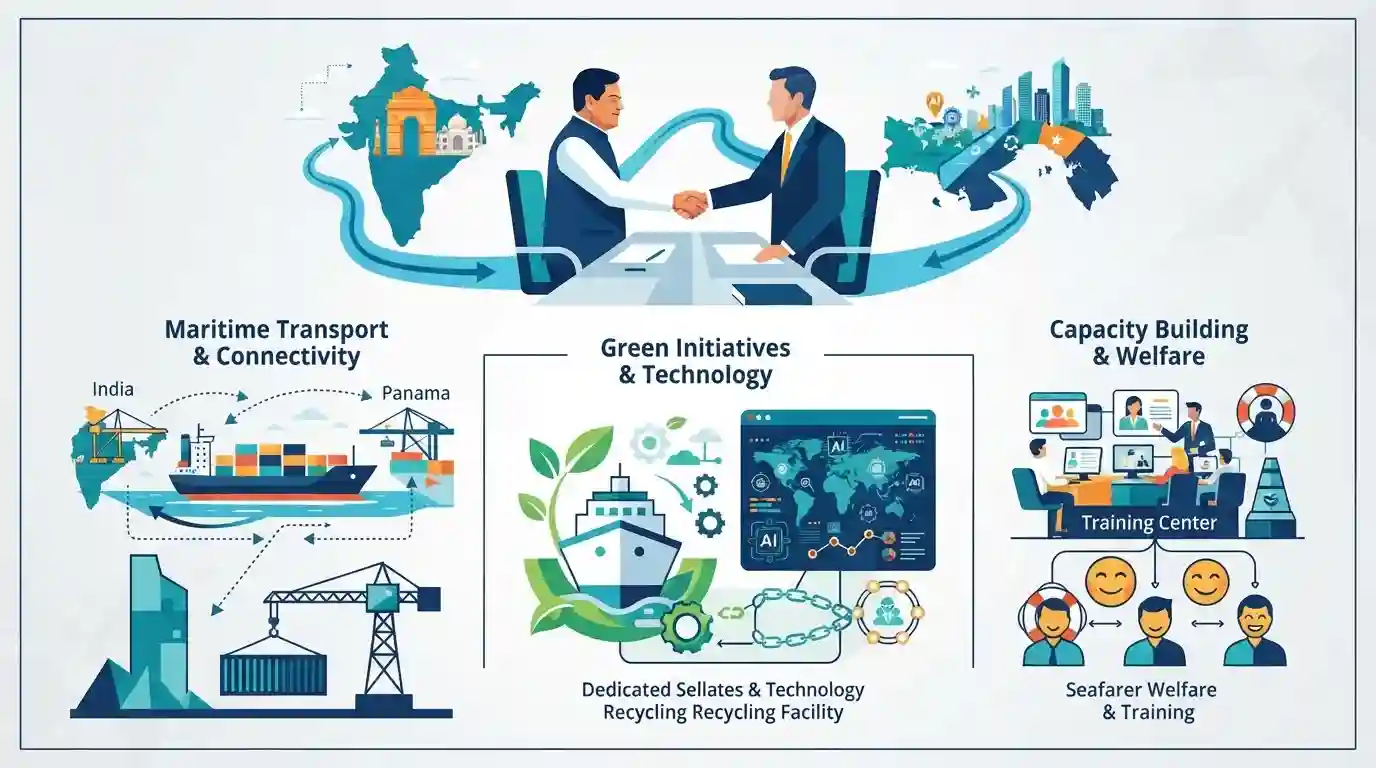
During a high-level meeting in New Delhi, India and Panama charted a new path to deepen bilateral ties by leveraging their maritime capabilities. The partnership, discussed between Indian Minister Sarbananda Sonowal and Panamanian Foreign Minister Javier Martínez-Acha Vásquez, focuses on logistics, digital innovation, and global connectivity. India highlighted Panama's role as a strategic gateway to the wider Latin American and Caribbean region. The discussed measures include expediting a bilateral maritime transport agreement, collaborating on green ship recycling, implementing digital technologies (such as AI-driven smart logistics), and ensuring capacity building and seafarer welfare.
ముఖ్య అంశాలు
- Dual-focus Partnership: India and Panama have identified key pillars—Maritime Security, Logistics, Skilling, and Digital Transformation—to expand their strategic maritime partnership.
- Strategic Gateway: India envisions Panama as a critical geographical gateway to expand its economic and logistic footprints across Central America, Latin America, and the Caribbean.
- Bilateral Maritime Cooperation: Indian Minister Sarbananda Sonowal proposed expediting a bilateral agreement on maritime transportation and port development.
- Digital and Sustainable Maritime Initiatives: Collaborative focus areas include AI-driven smart logistics, single-window systems, and green ship recycling, aligning with India's green transition goals.
- Capacity Building & Training: The nations agreed on active collaboration between India's Directorate General of Shipping and the Panama Maritime Authority, particularly around seafarer training, certification, and welfare.
ముఖ్యమైన పదాలు
Ministry of Ports, Shipping and Waterways

The Union Ministry of India responsible for formulating and administering policies, regulations, and programs governing ports, shipping, inland waterways, and maritime transport.
UPSC context
GS Paper III: Infrastructure and Ports. Tests knowledge of India's maritime policies and port-led developmental programs.
Directorate General of Shipping
India's apex maritime authority, functioning under the Ministry of Ports, Shipping and Waterways, responsible for enforcing shipping legislation, seafarer safety, and marine environment protection.
UPSC context
GS Paper II & III: Regulatory Bodies. Tests oversight of maritime administration and international shipping compliance.
Panama Maritime Authority
The public authority of Panama responsible for regulating its maritime sector and administering the world's largest ship registry to ensure global operational safety and compliance.
UPSC context
GS Paper II: International Relations. Tests understanding of foreign administrative partners critical to India's global logistics connectivity.
India Maritime Week 2026
A major international summit hosted by India to drive global maritime partnerships, showcase shipping innovations, and foster bilateral collaborations in trade and port logistics.
UPSC context
GS Paper II: Bilateral Forums. Tests knowledge of international summits driving India's maritime diplomacy and regional integration.
ప్రిలిమ్స్ ఉచ్చు
The Panama Canal is a sea-level passage connecting the Atlantic and Pacific oceans, operating entirely without locks using seawater.
The Panama Canal is not a sea-level canal like the Suez Canal; it relies on a lock system operated by fresh water from Gatun Lake, making it uniquely vulnerable to regional droughts.
అనుసంధానమైన స్థిర భావనలు
What are the key geographical and structural features of the Panama Canal?
- Lock Mechanism: Operates via a gravity-fed lock system that lifts ships 26 meters up to Gatun Lake and lowers them at the other end.
- Freshwater Reliance: Relies completely on fresh water supplied by the artificial Gatun Lake and Chagres River, making operations highly vulnerable to rainfall deficits.
- Geographic Isthmus: Cuts through the Isthmus of Panama, a narrow land bridge connecting North and South America, separating the Caribbean Sea from the Pacific Ocean.
What is the Hong Kong Convention for ship recycling?
- IMO Mandate: A treaty adopted under the International Maritime Organization (IMO) to ensure that ship recycling does not pose unnecessary risks to human health or the environment.
- Global Enforcement: It officially entered into force globally on June 26, 2025, establishing strict standards for managing hazardous materials on commercial vessels.
- India's Role: India is the world's leading ship-recycling country, primarily centered around Alang in Gujarat, which heavily relies on aligning with this convention.
అంతర-అంశ నమూనాలు
Climate change, freshwater constraints, and global trade
Panama's reliance on freshwater Gatun Lake for canal locks links climate-induced droughts directly to global shipping delays, driving India's interest in alternative logistics and digital smart ports.
LAC region as India's new trade frontier
Shifting focus toward Central America, India is utilizing maritime logistics hubs like Panama as strategic entry points to penetrate the broader Latin American and Caribbean markets.

Questions in 2026 may link the Hong Kong Convention's 2025 enforcement with Panama Canal hydrology and India's Alang recycling hub.
అనుసంధాన PYQలు · 3
అనుసంధాన PYQలు · 3
- 2026PrelimsGS1
In what way(s) does the Vizhinjam International Seaport represent a structural shift in India's maritime trade and logistics policy? 1. By functioning exclusively as a domestic cargo hub to reduce reliance on coastal shipping and eliminate the need for foreign collaborations. 2. By focusing primarily on passenger cruise tourism and heritage shipping to increase Kerala's profile as a maritime heritage destination. 3. By leveraging its natural deep draft and strategic location to reduce dependence on foreign trans-shipment ports, enhance revenue retention, and reposition India in regional maritime trade. Select the answer using the code given below :
- 2025MainsGS3
Why is maritime security vital to protect India's sea trade? Discuss maritime and coastal security challenges and the way forward.
- 2024MainsGS2
Discuss the geopolitical and geostrategic importance of Maldives for India with a focus on global trade and energy flows. Further also discuss how this relationship affects India's maritime security and regional stability amidst international competition ?
