Centre State Partnership for School Education and NEP 2020
Source:PIB ↗
આ શા માટે મહત્વનું છે
The article highlights the cooperative federalism approach required to implement crucial educational reforms like NEP 2020. It sheds light on how Centrally Sponsored Schemes (Samagra Shiksha, PM POSHAN) are the primary vehicles for delivering foundational literacy, infrastructure, and equity in India's school education sector, directly impacting human capital development.
સારાંશ
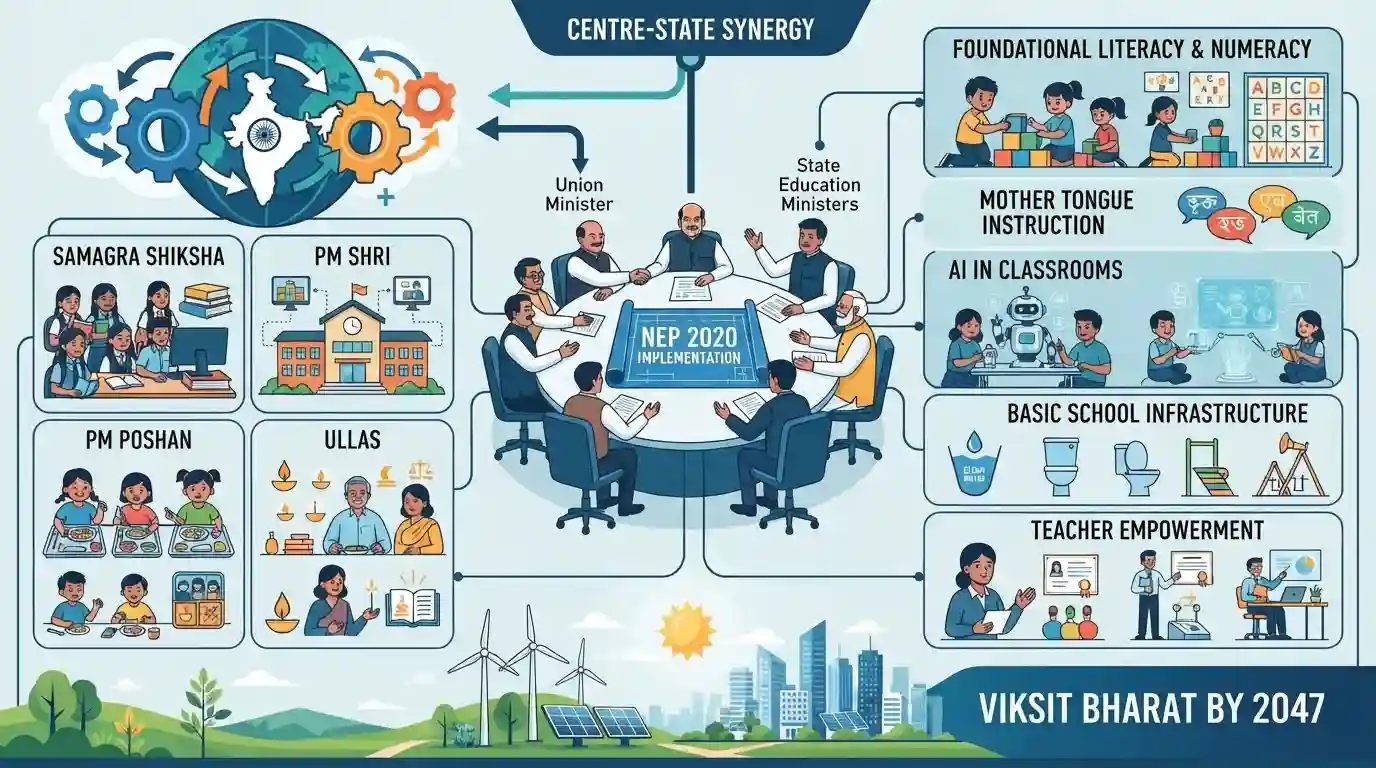
A recent two-day Conclave of State and UT Education Ministers, chaired by Union Education Minister Dharmendra Pradhan, underscored the need for Centre-State synergy in implementing the National Education Policy (NEP) 2020. The event served as a review platform for major Centrally Sponsored Schemes, including Samagra Shiksha, PM SHRI, PM POSHAN, and ULLAS. The Minister highlighted the necessity of foundational literacy, teaching in mother tongues, and incorporating AI in classrooms. Additionally, a strong push was made for saturating basic school infrastructure and prioritizing teacher empowerment, viewing the Centre and States as 'equal partners' to realize the vision of Viksit Bharat by 2047.
મુખ્ય મુદ્દા
- The Ministry of Education organized a two-day Conclave of State and UT Education Ministers to review the progress of major Centrally Sponsored Schemes of the Department of School Education and Literacy (DoSEL).
- Union Minister Dharmendra Pradhan emphasized treating Centre and States as equal partners (Team India) to build a future-ready education system aligned with NEP 2020 for Viksit Bharat 2047.
- States were urged to focus on Foundational Literacy and Numeracy (FLN), integrate mother tongue and regional languages in learning, and leverage emerging technologies like Artificial Intelligence in schools.
- The conclave discussed saturating basic school infrastructure (toilets, drinking water, electricity) and heavily focused on empowering and training teachers in new pedagogies.
- The review of schemes like PM SHRI, PM POSHAN, Samagra Shiksha, and ULLAS will also be subject to an upcoming PRAGATI review chaired by the Prime Minister.
મહત્વપૂર્ણ શબ્દો
National Education Policy (NEP) 2020

A comprehensive framework launched in 2020 to transform India's education system, introducing a 5+3+3+4 structure, multidisciplinary learning, and a focus on foundational literacy and skill-based learning.
UPSC context
GS Paper II: Government policies and interventions for development in the social sector (Education).
Samagra Shiksha
An overarching Centrally Sponsored Scheme for school education extending from pre-school to Class XII, which subsumes Sarva Shiksha Abhiyan, Rashtriya Madhyamik Shiksha Abhiyan, and Teacher Education.
UPSC context
GS Paper II: Social Sector/Services relating to Education and government welfare schemes.
PM SHRI (PM Schools for Rising India)
A Centrally Sponsored Scheme aimed at upgrading more than 14,500 government schools into eco-friendly, modern exemplar institutions that demonstrate the hands-on, NEP 2020 curriculum.
UPSC context
GS Paper II: Crucial for discussing modern education infrastructure and school governance reforms.
PM POSHAN
A Centrally Sponsored Scheme, formerly the Mid-Day Meal Scheme, providing one hot cooked meal daily to children in classes Pre-Primary to VIII in government-aided schools.
UPSC context
GS Paper II: Social sector interventions tackling malnutrition, classroom hunger, and education accessibility.
ULLAS (Understanding Lifelong Learning for All in Society)
A Centrally Sponsored Scheme aligned with NEP 2020 that provides adult education, functional literacy, and digital/financial skills to non-literates aged 15 and above.
UPSC context
GS Paper II: Policies regarding development, life-long learning, and human resource empowerment.
NIPUN Bharat
A national mission launched under Samagra Shiksha aiming to ensure every child achieves universal foundational literacy and numeracy (FLN) by the end of Grade 3.
UPSC context
GS Paper II: Focuses on resolving the early education learning crisis and foundational literacy goals.
પ્રિલિમ્સ ટ્રેપ
"ULLAS is a Central Sector Scheme aimed at bringing out-of-school children back to primary education."
ULLAS targets non-literate citizens aged 15 years and above (adult lifelong learning), not out-of-school children. It is also a Centrally Sponsored, not Central Sector, scheme.
સંલગ્ન સ્થિર ખ્યાલો
How has the Constitutional status of Education evolved in India?
- Original Status: Education was originally an exclusive State List subject under the 7th Schedule of the Constitution.
- 42nd Amendment: The 42nd Amendment Act (1976) transferred Education to the Concurrent List, enabling joint Centre-State legislative jurisdiction.
- Article 21A: Added by the 86th Amendment (2002), it made free and compulsory education a fundamental right for children aged 6 to 14 years.
What is the structural framework of the PRAGATI platform?
- Three-Tier System: It connects the Prime Minister's Office (PMO), Union Government Secretaries, and State Chief Secretaries into a single review node.
- Tech Integration: It combines Digital Data Management, Video Conferencing, and Geo-spatial technology for real-time tracking of delayed projects.
- Core Objectives: Primarily designed for Grievance Redressal, Programme Implementation, and multi-state Project Monitoring.
આંતર-વિષય પેટર્ન
Cooperative Federalism + Education
Education in the Concurrent List means national policies like NEP 2020 face implementation bottlenecks unless backed by state-level fiscal alignment and cooperative federalism.
Foundational Literacy + Emerging Tech
Integrating AI and mother-tongue instruction (e.g., Bhashini) links core pedagogical reforms in social infrastructure directly to India's emerging technology policies.

A multi-statement Prelims question will likely mix PM SHRI's CSS nature, ULLAS's adult demographic (15+), and PRAGATI's monitoring design.
સંલગ્ન PYQ · 3
સંલગ્ન PYQ · 3
- 2020MainsGS2
National Education Policy 2020 is in conformity with the Sustainable Development Goal-4 (2030). It intends to restructure and reorient education system in India. Critically examine the statement.
- 2024MainsGS2
What changes has the Union Government recently introduced in the domain of Centre-State relations ? Suggest measures to be adopted to build the trust between the Centre and the States and for strengthening federalism.
- 2016MainsGS2
Professor Amartya Sen has advocated important reforms in the realms of primary education and primary health care. What are your suggestions to improve their status and performance?
