Viksit Bharat Goals and Governance Reforms in Rural Development
Source:PIB ↗
ఇది ఎందుకు ముఖ్యం
It demonstrates the government's current administrative priorities (breaking silos, whole-of-government approach) which are highly relevant for GS2 Governance, while also touching upon distinct GS3 topics like solar agriculture (PM KUSUM) and internal security challenges (drug abuse).
సారాంశం
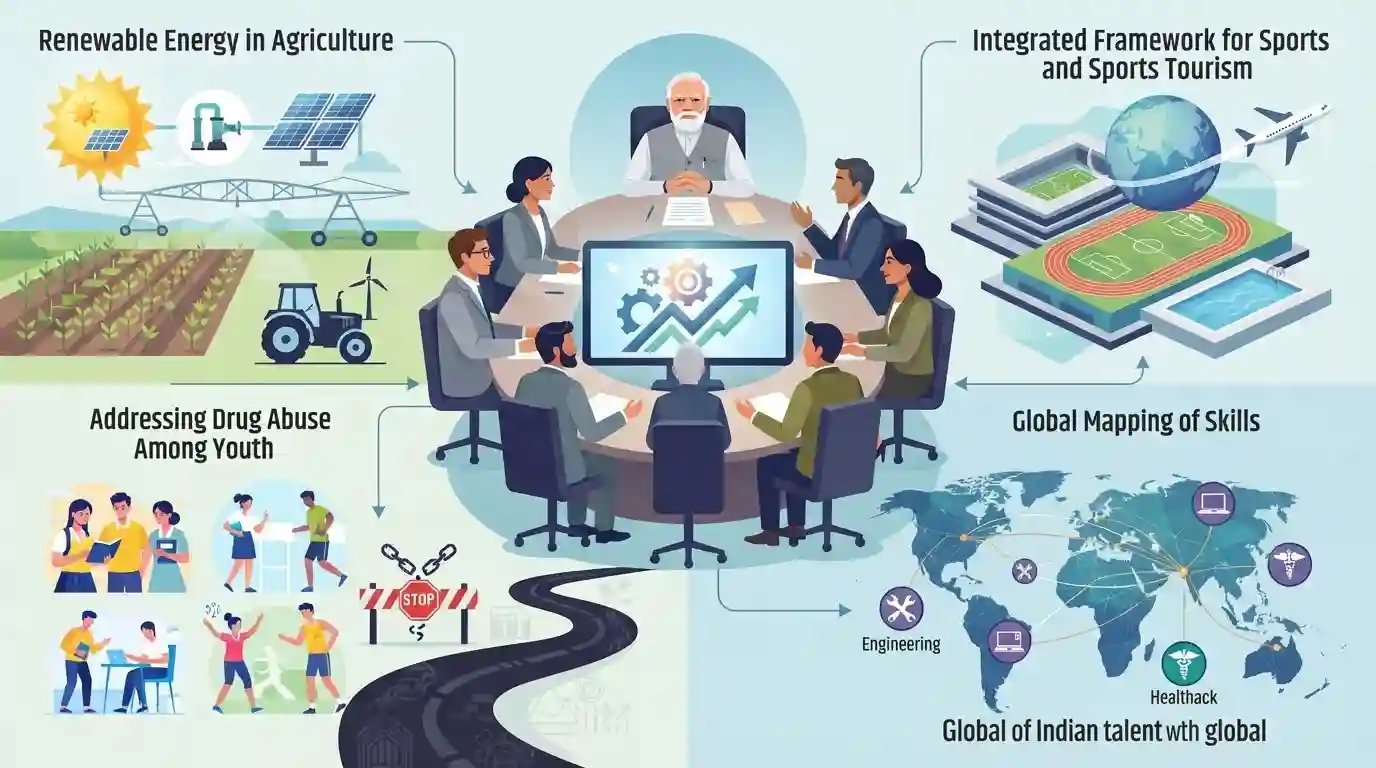
Prime Minister Narendra Modi chaired a high-level review meeting with government secretaries focusing on rural development, agriculture, social welfare, and allied sectors. The overarching theme was implementing a whole-of-government approach to dismantle departmental silos and ensure welfare-centric reforms. Key directives included scaling the PM KUSUM Scheme for agricultural modernization, creating an integrated framework for sports and sports tourism to make India a global hub, addressing drug abuse among the youth through coordinated efforts, and conducting a global mapping of skills to match Indian talent with international opportunities.
ముఖ్య అంశాలు
- The PM emphasized a whole-of-government approach to break departmental silos, placing citizens at the core of all governance reforms.
- Directed widespread adoption of the PM KUSUM Scheme to drive transformative changes in the agricultural sector through solar energy.
- Advocated for an integrated strategy encompassing sports and sports tourism to establish India as a global sports hub.
- Stressed the need for inter-departmental coordination to tackle drug abuse among the youth.
- Highlighted the importance of globally mapping skill requirements to align India's demographic dividend with international employment opportunities.
ముఖ్యమైన పదాలు
PM-KUSUM Scheme

A flagship central government initiative launched to promote solar energy in the agricultural sector by providing subsidies for standalone solar pumps and grid-connected solar power plants.
UPSC context
GS Paper 3 (Agriculture/Energy). Tests knowledge of renewable energy transitions, de-dieselisation of the farm sector, and doubling farmers' income.
Viksit Bharat
The Government of India's comprehensive vision to transform the country into a fully developed, self-reliant, and prosperous economic powerhouse by 2047, marking a century of independence.
UPSC context
GS Papers 2 & 3. Highly relevant for essays and policy analysis concerning long-term governance, infrastructure, and economic growth targets.
Whole-of-Government Approach
A collaborative governance model where multiple ministries, departments, and public agencies break out of institutional silos to pool resources and jointly implement policies for shared national objectives.
UPSC context
GS Paper 2 (Governance). Crucial for questions on administrative reforms, institutional efficiency, and citizen-centric policy implementation.
Global Mapping of Skills
A strategic assessment initiative to identify and document the competencies of the domestic workforce, aiming to align Indian talent with the demands of international labor markets.
UPSC context
GS Papers 2 & 3 (Skill Development/Demographics). Evaluates understanding of employment strategies, demographic dividend utilization, and global labor mobility.
ప్రిలిమ్స్ ఉచ్చు
"Nasha Mukt Bharat Abhiyaan is a flagship initiative implemented primarily by the Narcotics Control Bureau under the Ministry of Home Affairs."
Nasha Mukt Bharat Abhiyaan's nodal ministry is Social Justice & Empowerment (focusing on demand reduction), not MHA, though NCB aids in supply curbing.
అనుసంధానమైన స్థిర భావనలు
What are the three core components of the PM-KUSUM Scheme?
- Component A: Setting up decentralized ground-mounted grid-connected renewable power plants (up to 2 MW capacity) on barren or fallow land.
- Component B: Installation of standalone off-grid solar water pumps for agriculture in off-grid areas.
- Component C: Solarization of existing grid-connected agriculture pumps and feeder-level solarization to provide reliable daytime power to farmers.
What is the PRAGATI platform in Indian Governance?
- Platform Nature: Pro-Active Governance and Timely Implementation, a 3-tier interactive system connecting the PMO, Union Secretaries, and State Chief Secretaries.
- Core Objective: Real-time project monitoring, grievance redressal, and fostering cooperative federalism by breaking departmental silos.
- Technology Stack: It integrates three latest technologies: Digital data management, video-conferencing, and geo-spatial technology.
అంతర-అంశ నమూనాలు
G20 Declarations shaping domestic Skill Policy
The 'Global Skill Mapping' framework accepted at the G20 New Delhi Summit is now driving domestic institutional architectures like Skill India International Centres to harness India's closing demographic dividend window.
Agri-Decarbonization and Discom Viability
PM-KUSUM extends beyond farm income; feeder-level solarization (Component C) reduces the heavy agricultural cross-subsidy burden on debt-ridden Discoms, deeply linking farm policies with broader power sector reforms.

Expect a multi-statement 2026 Prelims question mapping NMBA's nodal ministries (MSJE vs MHA) or PM-KUSUM's specific grid components.
అనుసంధాన PYQలు · 4
అనుసంధాన PYQలు · 4
- 2025MainsGS2
"In contemporary development models, decision-making and problem-solving responsibilities are not located close to the source of information and execution defeating the objectives of development." Critically evaluate.
- 2020MainsGS3
Describe the benefits of deriving electric energy from sunlight in contrast to the conventional energy generation. What are the initiatives offered by our Government for this purpose?
- 2024MainsGS3
Explain how narco-terrorism has emerged as a serious threat across the country. Suggest suitable measures to counter narco-terrorism.
- 2014MainsGS3
While we flaunt India's demographic dividend, we ignore the dropping rates of employability. What are we missing while doing so? Where will the jobs that India desperately needs come from? Explain.
