Inspire Programme Impact on Basic Sciences Research and STEM Talent
Source:PIB ↗
આ શા માટે મહત્વનું છે
The article highlights a key government intervention (INSPIRE) aimed at bridging the gap in fundamental science research and R&D personnel. Understanding such schemes is critical for answering questions related to human resource development, the realization of the demographic dividend, and policies promoting scientific temper and innovation.
સારાંશ
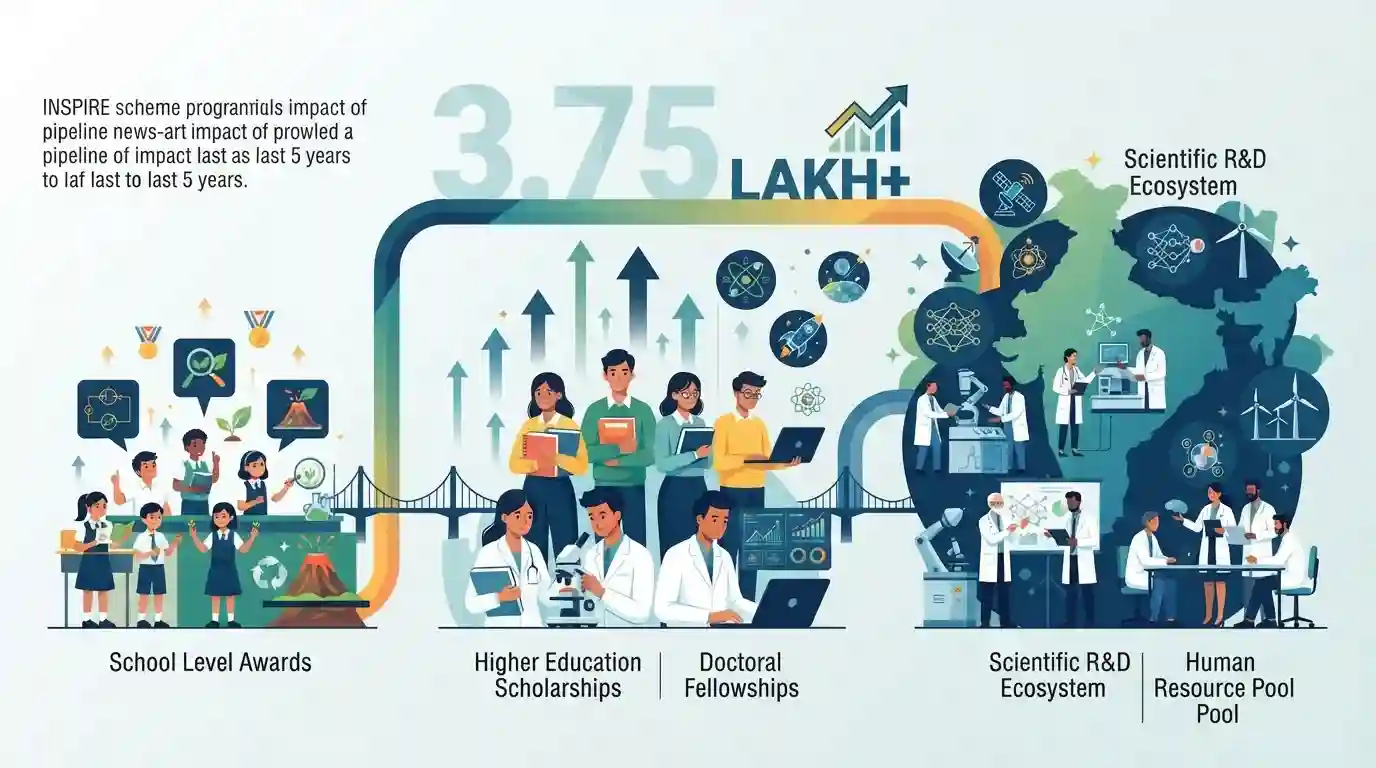
Union Minister Dr. Jitendra Singh informed Parliament that the INSPIRE (Innovation in Science Pursuit for Inspired Research) scheme has benefited more than 3.75 lakh students and researchers over the past five years. Managed by the Department of Science and Technology (DST), the program provides comprehensive support—ranging from school-level awards to post-doctoral fellowships—designed to attract early-stage talent to science. The overarching goal is to build a critical human resource pool for India's scientific and R&D ecosystem, ensuring long-term technological and innovation capabilities.
મુખ્ય મુદ્દા
- Over 3.75 lakh students and researchers have benefited from the INSPIRE programme over the last five years.
- The scheme, administered by the Department of Science and Technology (DST), aims to attract young talent to the study of basic sciences and research.
- INSPIRE supports individuals across multiple stages—from middle school (through awards and internships) to higher education and post-doctoral research (via fellowships).
- The initiative serves as a crucial intervention for expanding India's R&D base and cultivating a robust human resource pool in Science, Technology, Engineering, and Mathematics (STEM).
મહત્વપૂર્ણ શબ્દો
INSPIRE Programme

A flagship scheme managed by the Department of Science and Technology (DST) that aims to attract young talent to science and build a critical human resource pool for India's R&D base.
UPSC context
GS Paper 2 & 3: Evaluates knowledge of government policies targeting STEM education, brain drain, and scientific capacity building.
Department of Science and Technology (DST)
Established in 1971, it is the nodal agency under the Ministry of Science and Technology responsible for formulating policies, funding research, and coordinating scientific and technological activities in India.
UPSC context
GS Paper 3: Tests awareness of the institutional framework, funding mechanisms, and nodal bodies driving India's S&T ecosystem.
R&D Human Resource Pool
The collective technical talent, including STEM graduates and Full-Time Equivalent (FTE) researchers, essential for driving a country's scientific innovation, retaining domestic talent, and achieving technological self-reliance.
UPSC context
GS Paper 3: Important for topics on scientific innovation, utilizing the demographic dividend, and countering the brain drain of researchers.
પ્રિલિમ્સ ટ્રેપ
The 'Assured Opportunity' component under INSPIRE guarantees permanent faculty tenure in Central Universities upon completion of research.
The 'Assured Opportunity' (AORC) provides contract funding for independent research, but does not guarantee absorption, tenure, or permanent employment in any academic institution.
સંલગ્ન સ્થિર ખ્યાલો
What is the structure and funding landscape of India's Gross Expenditure on R&D (GERD)?
- GDP Spend Share: India spends roughly 0.6% to 0.7% of its GDP on R&D, which is lower than other BRICS nations like China (2.4%) and Brazil (1.2%).
- Public vs Private Ratio: Unlike advanced economies where the private sector contributes over 70% of R&D, in India, the public sector (Central/State Governments) funds nearly 60% of GERD.
- Sectoral Imbalance: Major chunks of government R&D funding go to strategic sectors (Defence, Space, Atomic Energy), leaving a smaller share for basic sciences and university research.
What are the primary divisions of India's scientific ministries?
- DST (Dept of Science & Technology): Nodal agency for formulating S&T policies, promoting basic sciences, and executing talent schemes like INSPIRE and the Cognitive Science Research Initiative.
- DBT (Dept of Biotechnology): Focuses on agricultural, medical, and industrial biotechnology applications, coordinating international bilateral scientific research.
- DSIR (Scientific & Industrial Research): Promotes industrial research and technology transfer; oversees the Council of Scientific and Industrial Research (CSIR) labs.
આંતર-વિષય પેટર્ન
STEM gender equity and R&D pipelines
The relaxation of age limits up to 37 years for women in INSPIRE Faculty Fellowships directly addresses the 'leaky pipeline' of women leaving academia after PhDs, linking GS-2 social justice with GS-3 R&D.
ANRF integration with school-level innovation
Connecting school-level scientific innovations (MANAK awards) to the newly established Anusandhan National Research Foundation (ANRF) highlights India's push to link early talent with formal commercialization.

Prelims 2026 may test INSPIRE components, specifically contrasting basic science eligibility (SHE) with applied engineering funding.
સંલગ્ન PYQ · 4
સંલગ્ન PYQ · 4
- 2023MainsGS2
The crucial aspect of development process has been the inadequate attention paid to Human Resource Development in India. Suggest measures that can address this inadequacy.
- 2023MainsGS2
Skill development programmes have succeeded in increasing human resources supply to various sectors. In the context of the statement analyse the linkages between education, skill and employment.
- 2015MainsGS3
What are the areas of prohibitive labour that can be sustainably managed by robots ? Discuss the initiatives that can propel research in premier research institutes for substantive and gainful innovation.
- 2014MainsGS3
While we flaunt India's demographic dividend, we ignore the dropping rates of employability. What are we missing while doing so? Where will the jobs that India desperately needs come from? Explain.
