India 6G Spectrum Roadmap and Bharat Alliance for Tech Autonomy
Source:PIB ↗
ఇది ఎందుకు ముఖ్యం
Transitioning to 6G with strong indigenous intellectual property is critical for India to reduce reliance on foreign telecom gear, ensure cybersecurity, build robust digital infrastructure, and capture a significant share of the global digital economy.
సారాంశం
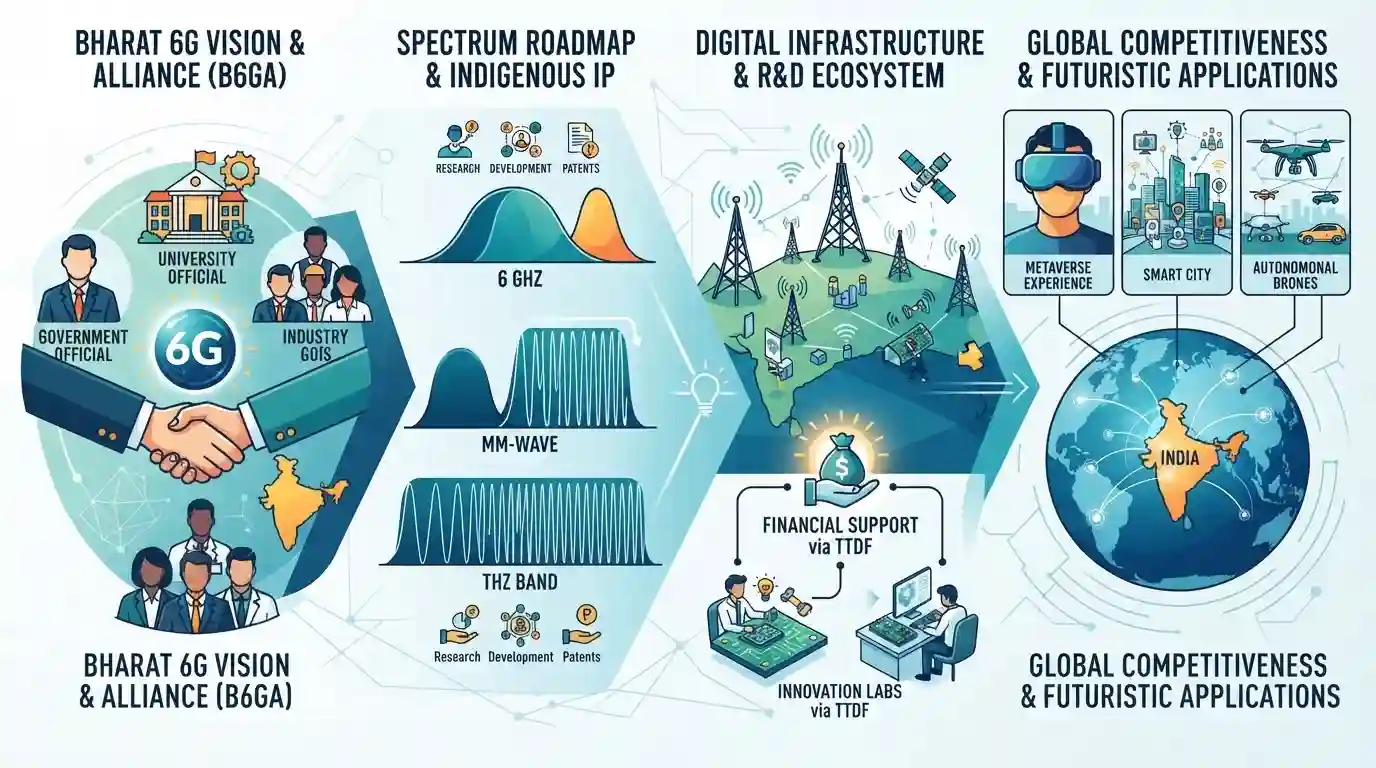
The Department of Telecommunications (DoT), Ministry of Communications, has emphasized the strategic role of the Bharat 6G Alliance (B6GA) and outlined the Spectrum Roadmap for 6G to position India as a global frontrunner in next-generation telecommunications by 2030. Driven by the 'Bharat 6G Vision', B6GA is a collaborative platform combining industry, academia, and the government to foster indigenous intellectual property (IP), R&D, and international standard-setting. The spectrum roadmap highlights crucial frequencies—including mid-band (6 GHz), millimeter-wave, and terahertz (THz) bands—essential for ultra-high-speed, low-latency applications. Financial support via the Telecom Technology Development Fund (TTDF) and global partnerships aim to ensure digital self-reliance (Atmanirbhar Bharat) and global competitiveness, enabling futuristic applications like the Metaverse, advanced IoT, and autonomous networks.
ముఖ్య అంశాలు
- Bharat 6G Alliance (B6GA) is a multi-stakeholder platform designed to drive 6G innovation, secure essential patents, and represent India in global standard-setting bodies like ITU and 3GPP.
- The Spectrum Roadmap focuses on the identification and allocation of crucial frequency bands for 6G, including the 6 GHz mid-band, millimeter-wave, and experimental terahertz (THz) spectrum, required for ultra-low latency.
- The 'Bharat 6G Vision' aims to make India a leading supplier of advanced, affordable, and sustainable 6G solutions by 2030, enhancing strategic autonomy in telecom equipment.
- Funding mechanisms like the Telecom Technology Development Fund (TTDF) are utilized to support domestic startups, MSMEs, and academia in developing indigenous network technologies.
- The 6G rollout is expected to revolutionize digital infrastructure, enabling seamless integration of AI, drone swarms, smart cities, advanced IoT, and the Metaverse.
ముఖ్యమైన పదాలు
Bharat 6G Vision

A strategic roadmap launched by India in 2023 to design, develop, and deploy affordable, secure, and sustainable indigenous 6G technologies, positioning the nation as a global leader in next-generation telecommunications by 2030.
UPSC context
GS Paper III (Science & Technology); tests knowledge of national telecom policies, digital inclusion, and indigenization of high-tech infrastructure.
Bharat 6G Alliance (B6GA)
An industry-and-academia-led collaborative platform, facilitated by the government, that drives R&D, patent creation, testbed development, and international standard-setting for 6G technology in line with India's 6G Vision.
UPSC context
GS Paper III (S&T / Industrial Growth); tests understanding of collaborative bodies driving indigenization, intellectual property creation, and industry-academic partnerships.
Telecom Technology Development Fund (TTDF)
A flagship scheme under the Department of Telecommunications that funds domestic R&D, pilot projects, and prototyping of next-generation telecom technologies (like 5G/6G and satellite communication) primarily for rural application.
UPSC context
GS Paper III (S&T / Economy); tests knowledge of funding mechanisms for indigenous technological innovation, bridging the digital divide, and promoting startups.
Universal Service Obligation Fund (USOF)
Established in 2002 to fund rural telecom connectivity, it was formally reformed and renamed as the Digital Bharat Nidhi (DBN) under the Telecommunications Act, 2023, expanding its scope to R&D and pilot projects.
UPSC context
GS Paper III (Infrastructure / Indian Economy); tests understanding of public funding mechanisms to bridge the digital divide, national telecom laws, and policy evolution.
International Telecommunication Union (ITU)
The United Nations specialized agency for information and communication technologies, responsible for global radio spectrum allocation, standardizing telecommunications, and establishing frameworks like IMT-2030 to guide worldwide 6G development.
UPSC context
GS Paper II & III (International Organizations / Science & Tech); tests knowledge of multilateral standard-setting bodies and global frameworks governing next-generation telecom.
ప్రిలిమ్స్ ఉచ్చు
"The entire 6 GHz spectrum band has been de-licensed for free public Wi-Fi use in India."
Only the lower half of the 6 GHz band is de-licensed for indoor Wi-Fi. The upper portion is reserved for licensed mobile services (5G/6G) to avoid spectrum congestion.
అనుసంధానమైన స్థిర భావనలు
How does spectrum frequency affect signal range and penetration?
- High Frequencies (THz/mmWave): Provide massive data rates and low latency but suffer severe atmospheric attenuation (signal drop) and struggle to penetrate solid obstacles like walls.
- Low Frequencies (Sub-1 GHz): Offer excellent geographic coverage and building penetration, making them ideal for rural connectivity, but support significantly lower bandwidths.
- Small Cells: High-frequency networks require dense deployments of small cell antennas to compensate for their inherently short signal ranges.
What is the Digital Bharat Nidhi (DBN)?
- Statutory Evolution: Replaced the Universal Service Obligation Fund (USOF) under the Telecommunications Act, 2023 to support telecom services in underserved areas.
- Funding Mechanism: Financed through a 5% Universal Service Levy charged on the Adjusted Gross Revenue (AGR) of telecom operators.
- Expanded Mandate: Now explicitly mandates funding for research and development (like the Telecom Technology Development Fund) alongside traditional rural connectivity rollout.
అంతర-అంశ నమూనాలు
6G Patents & Strategic Autonomy
India's push for 10% of global 6G patents mirrors its semiconductor PLI strategy—shifting from a consumer of imported telecom hardware to a standard-setter in emerging, dual-use technological architectures.
Satellite Internet vs 6G Integration
As 6G demands ubiquitous global coverage, its future integration with Low Earth Orbit (LEO) satellite constellations blurs the regulatory and infrastructural lines between terrestrial mobile networks and space-based communication.

Expect a comparative Prelims question on 5G vs 6G spectrums (mmWave vs Terahertz) and the funding transition from USOF to Digital Bharat Nidhi.
అనుసంధాన PYQలు · 4
అనుసంధాన PYQలు · 4
- 2026PrelimsGS1
Which of the following statements with regard to drone swarms is/are correct ? 1. They use Terahertz band of frequency to communicate with the command centre. 2. Individual drones in the swarm can communicate with other drones in the swarm. 3. GPS Spoofing is a commonly used technique to counter drone swarm attack. Select the answer using the code given below :
- 2018PrelimsGS1
When the alarm of your smartphone rings in the morning, you wake up and tap it to stop the alarm which causes your geyser to be switched on automatically. The smart mirror in your bathroom shows the day's weather and also indicates the level of water in your overhead tank. After you take some groceries from your refrigerator for making breakfast, it recognises the shortage of stock in it and places an order for the supply of fresh grocery items. When you step out of your house and lock the door, all lights, fans, geysers and AC machines get switched off automatically. On your way to office, your car warns you about traffic congestion ahead and suggests an alternative route, and if you are late for a meeting, it sends a message to your office accordingly. In the context of emerging communication technologies, which one of the following terms best applies to the above scenario ?
- 2023MainsGS3
What is the status of digitalization in the Indian economy? Examine the problems faced in this regard and suggest improvements.
- 2024PrelimsGS1
Which one of the following words/phrases is most appropriately used to denote 'an interoperable network of 3D virtual worlds that can be accessed simultaneously by millions of users, who can exert property rights over virtual items'?
