India Trade Policy Review at World Trade Organization in Geneva
Source:PIB ↗
কেন এটি গুরুত্বপূর্ণ
The WTO's Trade Policy Review is a critical mechanism for global trade transparency. India's official diplomatic and economic stance at the WTO is vital for answering Mains questions regarding WTO reforms, the crisis in the multilateral trading system, the impact of global protectionism on the Indian economy, and India's leadership role in negotiating equitable trade rules.
সারসংক্ষেপ
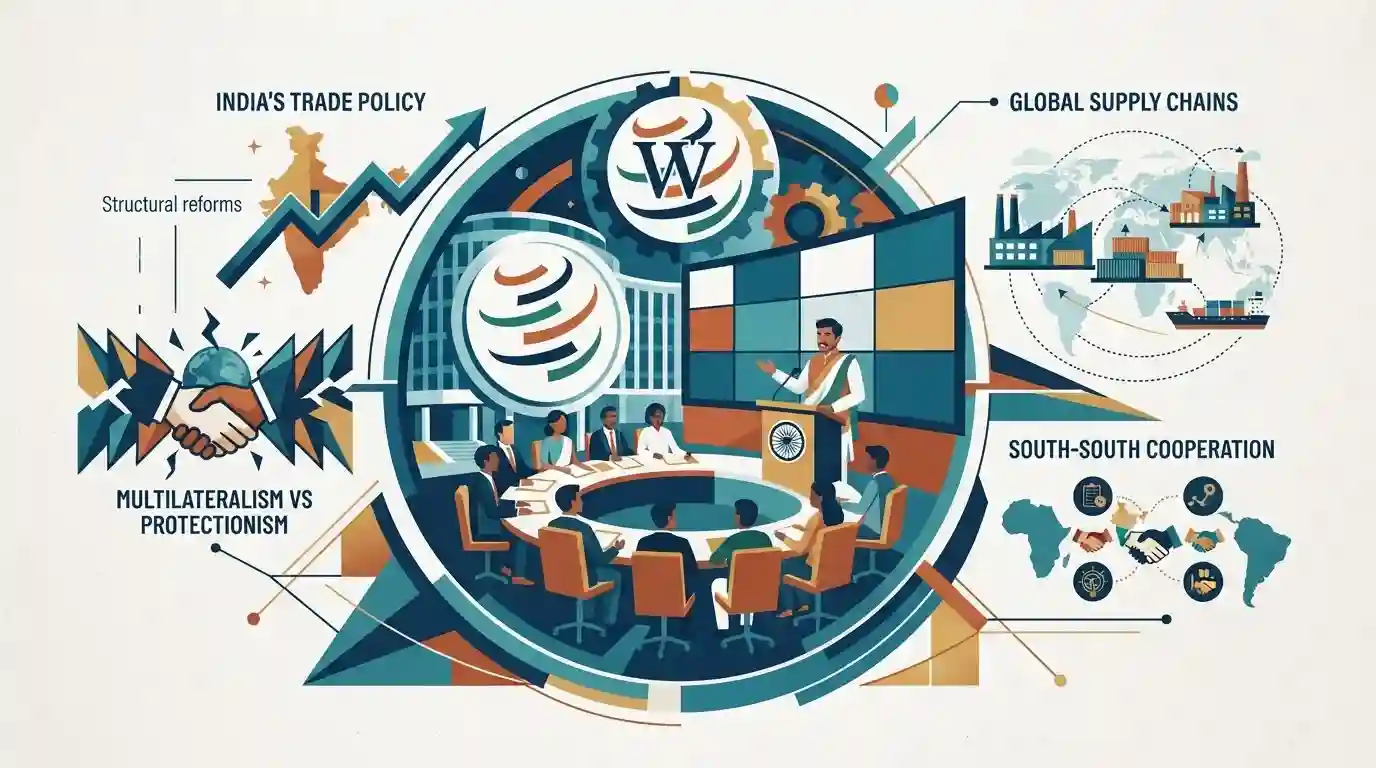
At its Trade Policy Review at the World Trade Organization in Geneva, India robustly defended its trade policies and reaffirmed its commitment to a rules-based multilateral trading system. The review provided a platform for India to showcase its economic resilience, structural reforms, and efforts to integrate into global value chains, pushing back against narratives of rising global protectionism. India emphasized that its domestic initiatives for self-reliance are complementary to global trade, while simultaneously continuing to advocate for equitable trade rules and the core interests of developing nations.
মূল বিষয়
- India participated in its Trade Policy Review (TPR) at the WTO in Geneva, reaffirming its dedication to a rules-based, transparent, and non-discriminatory multilateral trading system.
- The TPR mechanism is a mandated, periodic review designed to ensure transparency, accountability, and peer evaluation of member nations' trade and economic policies.
- India highlighted its robust economic growth, recent structural reforms, and initiatives designed to integrate deeper into global value chains while maintaining domestic economic resilience.
- Amidst rising global protectionism and bilateralism, India positioned itself as a stabilizing force and a champion for equitable trade rules, advocating for the interests of developing countries and the Global South.
প্রিলিমস ফাঁদ
The Trade Policy Review Mechanism serves as a binding dispute settlement tool to penalize non-compliance with WTO commitments.
The TPRM is strictly a peer-review and transparency mechanism. It is explicitly mandated not to serve as a basis for dispute settlement or to enforce specific trade obligations.
সংযুক্ত স্থির ধারণা
How does the WTO Trade Policy Review Mechanism (TPRM) function?
- Primary Objective: Increases global transparency, accountability, and peer evaluation of member trade policies to ensure adherence to WTO rules.
- Review Cycles: Members are reviewed based on global trade share: the top four every 3 years, next 16 every 5 years, and others every 7 years.
What is the principle of Special and Differential Treatment (SDT)?
- Core Purpose: Grants developing countries special rights, longer transition periods, and flexibility in implementing WTO agreements.
- Key Benefits: Includes preferential market access, tariff flexibilities, and protection against immediate reciprocal trade commitments.
আন্তঃবিষয় প্যাটার্ন
Import substitution vs WTO compliance
India’s PLI schemes and import monitoring systems walk a fine line between domestic industrial policy and WTO rules against trade-distorting subsidies.
Agriculture negotiations and Global South
India leverages G33 coalitions at the WTO to defend public stockholding for food security, resisting pressure from developed nations to curb domestic agricultural support.

UPSC may contrast WTO's consensus-based multilateralism with India's rise in plurilateral trade agreements in a GS-3 mains question.
সংযুক্ত PYQ · 5
সংযুক্ত PYQ · 5
- 2018MainsGS2
What are the key areas of reform if the WTO has to survive in the present context of "Trade War', especially keeping in mind the interest of India?
- 2014MainsGS2
WTO is an important international institution where decisions taken affect countries in a profound manner. What is the mandate of WTO and how binding are their decisions ? Critically analyse India's stand on the latest round of talks on Food security.
- 2016MainsGS2
The broader aims and objectives of WTO are to manage and promote international trade in the era of globalization. But the Doha round of negotiations seem doomed due to differences between the developed and the developing countries." Discuss in the Indian perspective.
- 2025MainsGS3
What are the challenges before the Indian economy when the world is moving away from free trade and multilateralism to protectionism and bilateralism? How can these challenges be met?
- 2018MainsGS3
How would the recent phenomena of protectionism and currency manipulations in world trade affect macroeconomic stability of India?
