BRICS Prosecution Services Meeting on Transnational Crime Cooperation
Source:PIB ↗
આ શા માટે મહત્વનું છે
Understanding institutional cooperation within groupings like BRICS is crucial for GS-II (International Relations). Specifically, prosecutorial and legal coordination relates directly to combating transnational organized crime and terrorism (GS-III), highlighting India's multilateral diplomatic strategies to address cross-border security challenges.
સારાંશ
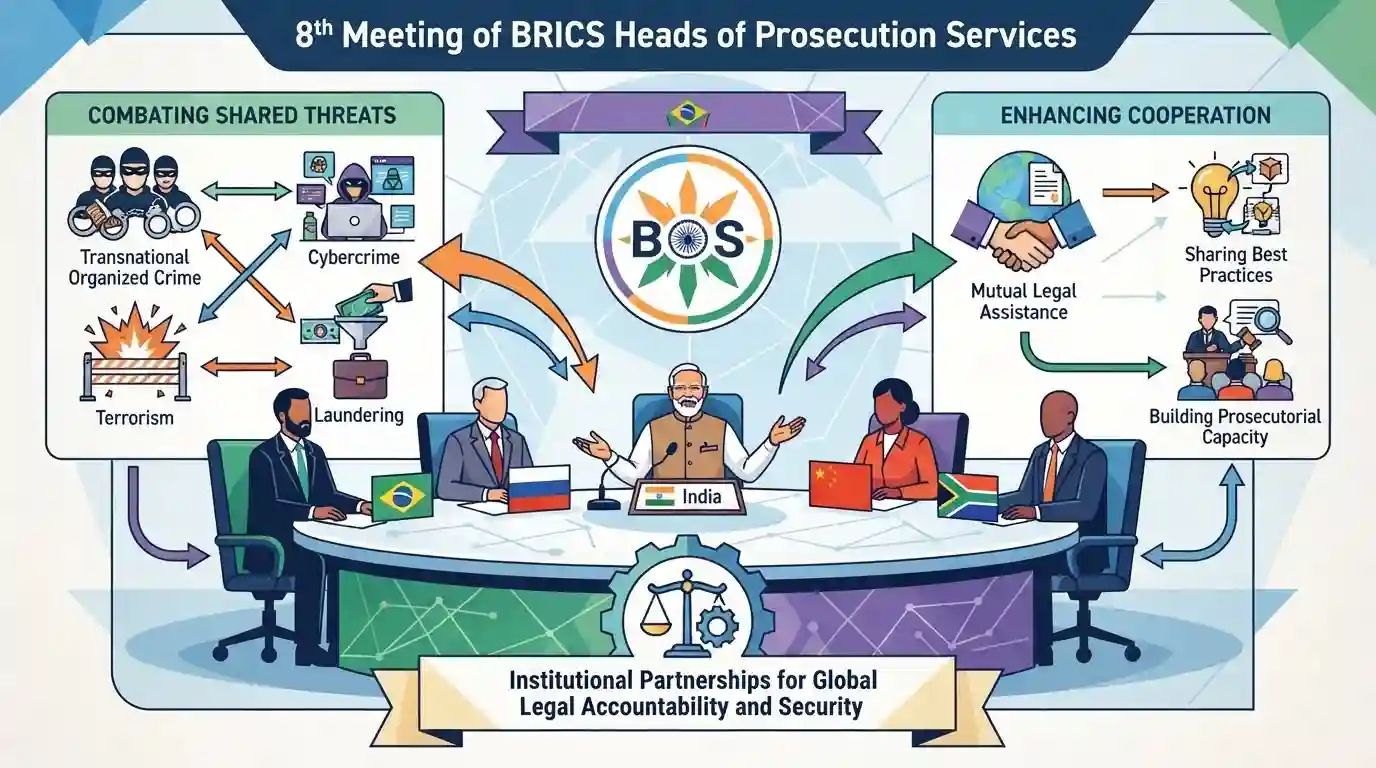
The Department of Legal Affairs, Ministry of Law and Justice hosted the 8th Meeting of BRICS Heads of Prosecution Services. The multilateral dialogue focused on enhancing cooperation among member nations to combat shared challenges like transnational organized crime, cybercrime, terrorism, and money laundering. By prioritizing Mutual Legal Assistance, sharing best practices, and building prosecutorial capacity, the meeting underscored the role of BRICS in shaping robust institutional partnerships for global legal accountability and security.
મુખ્ય મુદ્દા
- The Department of Legal Affairs, Ministry of Law and Justice hosted the 8th Meeting of BRICS Heads of Prosecution Services.
- The primary objective was to strengthen multilateral legal cooperation among BRICS nations to combat transnational organized crime, terrorism, corruption, and money laundering.
- Discussions emphasized expanding Mutual Legal Assistance, sharing best prosecutorial practices, and enhancing capacity building.
- The initiative reinforces India's commitment to building institutional frameworks within BRICS for global security and legal accountability.
મહત્વપૂર્ણ શબ્દો
Mutual Legal Assistance Treaties (MLATs)

Bilateral or multilateral agreements between nations to formally exchange evidence and information in criminal matters. They ensure criminals cannot evade justice by fleeing across borders or hiding assets abroad.
UPSC context
GS-3 (Internal Security) & GS-2 (IR). Crucial for international cooperation against transnational organized crime, cybercrime, and terrorism financing.
BRICS
An intergovernmental organization comprising major emerging economies. Originally formed by Brazil, Russia, India, China, and South Africa, it focuses on economic cooperation, shared security, and promoting a multipolar global governance system.
UPSC context
GS-2 (Regional Groupings). Highly relevant for tracking geopolitical shifts, the influence of emerging economies, and multilateral partnerships.
BRICS Heads of Prosecution Services
A multilateral forum uniting top prosecutorial leaders from BRICS nations. It facilitates institutional cooperation, capacity building, and the sharing of best practices to combat transnational crimes and implement technology-enabled adjudication.
UPSC context
GS-2 (International Institutions). Tests awareness of specific multilateral dialogues and India's leadership initiatives during its 2026 BRICS Chairship.
Department of Legal Affairs
A department under the Ministry of Law and Justice that advises Central Government ministries on legal matters, interprets the Constitution, and manages litigation and counsel engagement for the Union government.
UPSC context
GS-2 (Governance). Important for understanding the administrative structure of the government's legal operations and litigation management.
પ્રિલિમ્સ ટ્રેપ
The Ministry of Home Affairs hosted this BRICS meeting because of its role as the nodal agency for criminal mutual legal assistance.
While MHA is indeed India's nodal authority for executing criminal MLATs, this specific BRICS heads of prosecution meeting was hosted by the Department of Legal Affairs, Ministry of Law and Justice.
સંલગ્ન સ્થિર ખ્યાલો
What is India's legal framework and nodal authority for Mutual Legal Assistance Treaties (MLATs)?
- Nodal Authority: The Ministry of Home Affairs (MHA) serves as the central national authority for transmitting and receiving criminal MLAT requests.
- Statutory Basis: Secured under Section 105 of the CrPC (now Section 115 of the BNSS, 2023) and provisions of the PMLA, 2002.
How has the BRICS grouping expanded in recent years?
- BRICS+ Expansion: In January 2024, BRICS officially welcomed four new members: Egypt, Ethiopia, Iran, and the United Arab Emirates.
- Decision Making: Unlike formal treaty organizations, BRICS operates on consensus, making cooperative legal declarations non-binding but politically significant.
આંતર-વિષય પેટર્ન
MLATs + Internal Security
Cross-border legal cooperation is critical for GS3 internal security, enabling speedier prosecution of fugitive economic offenders and transnational cybercriminals.
Judicial diplomacy + Foreign Policy
India uses global legal forums to position itself as a rules-based leader, balancing Western-led judicial networks with non-Western formations like BRICS.

Expect questions linking BRICS expansion to practical challenges in harmonizing criminal prosecution and extradition frameworks in 2026.
સંલગ્ન PYQ · 3
સંલગ્ન PYQ · 3
- 2012MainsGS2
Compare the significance of IBSA and BRICS in the context of India's multilateral diplomacy.
- 2022MainsGS3
Discuss the types of organised crimes. Describe the linkages between terrorists and organised crime that exist at the national and transnational levels.
- 2021MainsGS3
Discuss how emerging technologies and globalisation contribute to money laundering. Elaborate measures to tackle the problem of money laundering both at national and international levels.
