Sanitation Worker Deaths and Implementation of Manual Scavenging Ban
Source:PIB ↗
ఇది ఎందుకు ముఖ్యం
The persistent issue of sanitation worker deaths remains a critical topic under GS Paper 2 (Social Justice and Governance). It highlights the gap between legislative frameworks (like the Manual Scavenging Prohibition Act) and their grassroots enforcement. It frequently appears in UPSC questions exploring the marginalization of vulnerable sections, the efficacy of rehabilitation schemes, and the mechanization of urban sanitation.
సారాంశం
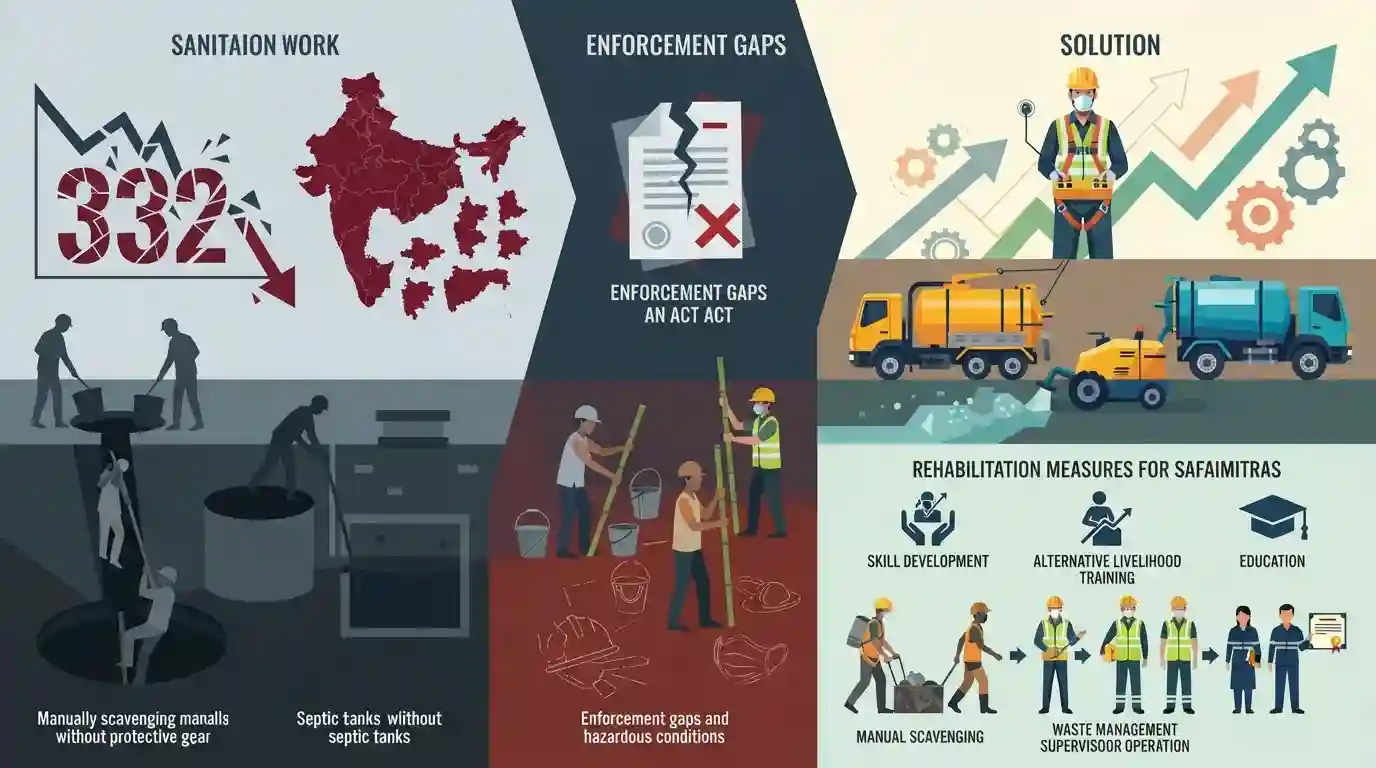
Data released reveals that 332 sanitation workers died between January 2021 and June 2026 while undertaking hazardous cleaning of sewers and septic tanks across 18 states and UTs in India. These figures highlight persistent systemic gaps in enforcing the Prohibition of Employment as Manual Scavengers Act and providing safe working conditions. The continued loss of lives underscores the urgent necessity for complete mechanization of sanitation work through initiatives like the NAMASTE scheme and stronger rehabilitation measures for marginalized Safaimitras.
ముఖ్య అంశాలు
- 332 sanitation worker deaths were reported across 18 States and UTs between January 2021 and June 2026 due to hazardous cleaning of sewers and septic tanks.
- The fatalities highlight severe implementation gaps in the Prohibition of Employment as Manual Scavengers and their Rehabilitation Act.
- There is an urgent need to expedite the 100% mechanization of sewer cleaning operations through initiatives like the NAMASTE scheme.
- The continuing deaths of Safaimitras underscore ongoing challenges in securing labor rights and ensuring social justice for marginalized communities.
ముఖ్యమైన పదాలు
Prohibition of Employment as Manual Scavengers and their Rehabilitation Act, 2013

A 2013 Indian legislation that bans manual scavenging, outlaws hazardous cleaning of sewers and septic tanks without protective gear, and mandates rehabilitation measures (cash assistance, scholarships, and alternative livelihoods) for affected sanitation workers.
UPSC context
GS Paper II (Social Justice / Mechanisms & Laws); tests legal frameworks protecting vulnerable sections and human dignity.
NAMASTE Scheme
A central sector scheme (National Action for Mechanised Sanitation Ecosystem) aiming to eliminate manual scavenging, achieve zero sanitation fatalities, and provide safety equipment, health insurance, and alternative livelihood training to sanitation workers.
UPSC context
GS Paper II (Welfare Schemes); tests policy initiatives for vulnerable sections and the transition to mechanized urban sanitation.
National Commission for Safai Karamcharis (NCSK)
A non-statutory body under the Ministry of Social Justice and Empowerment that monitors the eradication of manual scavenging, investigates grievances of sanitation workers, and recommends welfare programs.
UPSC context
GS Paper II (Governance / Institutional Bodies); tests structural mechanisms for safeguarding marginalised sanitation workforces.
Rashtriya Garima Abhiyaan
A national community-led civil society movement started in 2001 that focuses on the complete eradication of manual scavenging and the dignified rehabilitation of affected workers into mainstream society.
UPSC context
GS Paper II (Social Justice / Civil Society); tests civil society pressure and non-governmental movements for human rights.
Swachh Bharat Abhiyan
India's nationwide cleanliness campaign launched in 2014 to eliminate open defecation, expand toilet coverage, and promote scientific waste management, transitioning to SBM 2.0 with a focus on garbage-free cities.
UPSC context
GS Paper II & III (Governance / Urban Infrastructure); tests massive sanitation programs and behavioral change strategies.
Ministry of Social Justice and Empowerment
The nodal ministry of the Government of India responsible for welfare, social justice, and empowerment of marginalised sections, including scheduled castes, backward classes, and sanitation workers.
UPSC context
GS Paper II (Governance / Welfare Ministries); tests institutional executive structures implementing policies for vulnerable sections.
ప్రిలిమ్స్ ఉచ్చు
The NAMASTE Scheme for mechanizing sanitation is a Centrally Sponsored Scheme implemented solely by the Ministry of Housing and Urban Affairs.
NAMASTE is a Central Sector Scheme (100% Central funding) and is jointly implemented by both MoSJE and MoHUA, not just one ministry.
అనుసంధానమైన స్థిర భావనలు
What constitutes 'hazardous cleaning' and its legal classification under the PEMSR Act, 2013?
- Statutory Definition: Refers to the manual cleaning of sewers or septic tanks without employing protective gear and other safety equipment prescribed under the rules.
- Legal Classification: Section 9 of the Act classifies any employment or engagement for hazardous cleaning of sewers as a cognizable and non-bailable offense.
- Penalties Mandated: First-time contravention attracts imprisonment up to two years or a fine up to two lakh rupees, or both, escalating for subsequent offenses.
How has the Judiciary shaped rehabilitation and compensation norms for manual scavengers?
- 2014 SKA Judgment: Identified manual scavengers retroactively since 1993 and mandated a baseline compensation of ₹10 lakh for sewer-cleaning deaths.
- 2023 Balram Singh Ruling: Increased the mandatory compensation to ₹30 lakh for sewer-cleaning fatalities and ₹20 lakh for permanent disabilities.
- Constitutional Anchors: Underlined that hazardous sewer entry violates the Right to Dignified Life (Article 21) and reinforces untouchability practices (Article 17).
అంతర-అంశ నమూనాలు
Robotic Sanitation & Article 17
Deploying robotic scavengers like Bandicoot under Swachh Bharat 2.0 serves as a technological intervention to uphold the constitutional mandate against caste-based labor under Article 17.
Fiscal Federalism & Urban Safety
Central devolutions to Urban Local Bodies are increasingly conditioned on performance indicators like setting up functional Emergency Response Sanitation Units (ERSUs) to eliminate manual entry.

Prelims may test the design of NAMASTE (Central Sector, dual-ministry) coupled with the revised SC compensation limits for sewer deaths.
అనుసంధాన PYQలు · 2
అనుసంధాన PYQలు · 2
- 2016PrelimsGS1
'Rashtriya Garima Abhiyaan' is a national campaign to
- 2011MainsGS1
Discuss the Community-Led Total Sanitation (CLTS) approach to sanitation.
