Shshallow Aquifer Management Launched for Urban Water Security
Source:PIB ↗
কেন এটি গুরুত্বপূর্ণ
Urban water security and groundwater depletion are major challenges in India. The SAM initiative provides a scalable governance model for rainwater harvesting and aquifer recharge in urban environments, directly relevant to UPSC questions on urban water harvesting, flooding, and sustainable development.
সারসংক্ষেপ
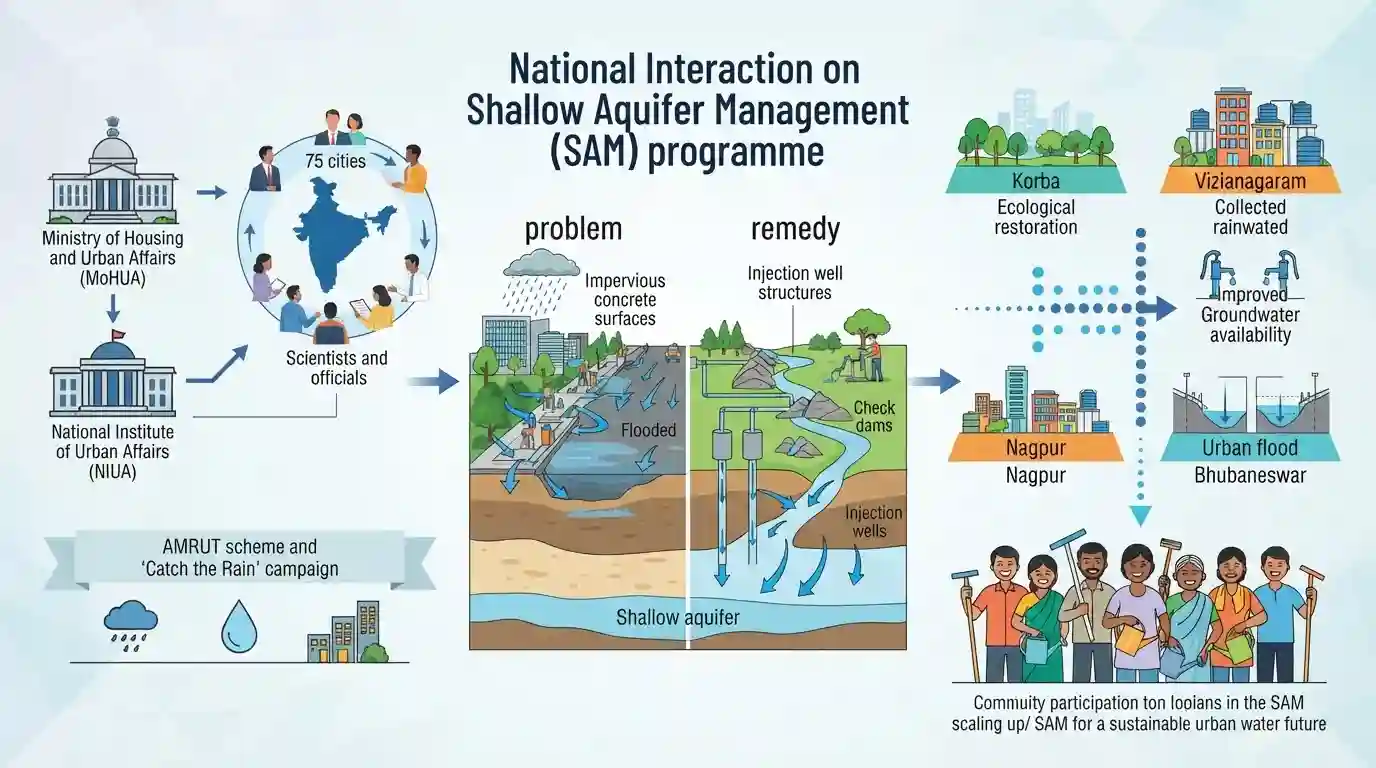
The Ministry of Housing and Urban Affairs (MoHUA), alongside the National Institute of Urban Affairs (NIUA), hosted a national interaction with 75 cities engaged in the Shallow Aquifer Management (SAM) programme under the AMRUT scheme, as part of the 'Catch the Rain' campaign. SAM aims to enhance urban water security and climate resilience by scientifically managing unconfined shallow aquifers and implementing artificial groundwater recharge structures like injection wells and check dams. The initiative highlighted successful case studies from cities like Korba, Vizianagaram, Nagpur, and Bhubaneswar, which demonstrate improved groundwater availability, ecological restoration, and urban flood mitigation. The interaction underscored the necessity of community participation and the upscaling of SAM to safeguard India’s urban water future.
মূল বিষয়
- MoHUA and NIUA organized a national interaction with 75 cities implementing the Shallow Aquifer Management (SAM) programme under AMRUT.
- The SAM programme aligns with the 'Catch the Rain' campaign to promote sustainable rainwater harvesting and combat groundwater depletion in urban centers.
- Shallow aquifers, being closer to the surface and unconfined, are vital for localized urban groundwater availability; SAM focuses on reviving them through artificial recharge structures like shafts and check dams.
- Case studies from Korba, Vizianagaram, Nagpur, and Bhubaneswar showcased the efficacy of SAM in reviving borewells, enhancing localized groundwater, and mitigating urban flooding.
- The initiative emphasizes scientific planning, continuous monitoring, and community stewardship to build climate-resilient urban water infrastructure across India.
প্রিলিমস ফাঁদ
Unconfined shallow aquifers are less vulnerable to surface contamination than deep confined aquifers due to rapid natural sand-filtration.
Shallow unconfined aquifers lack a protective impermeable overlying layer (confining bed), making them highly susceptible to immediate surface-level chemical and biological runoff contamination.
সংযুক্ত স্থির ধারণা
What is the geological distinction between Confined and Unconfined Aquifers?
- Unconfined Aquifers: Bounded by the water table at the top; they recharge directly and rapidly from surface infiltration and precipitation.
- Confined Aquifers: Trapped between two impermeable rock layers (aquitards); water is under pressure, often creating artesian wells.
- Recharge & Vulnerability: Unconfined aquifers recharge rapidly but are highly vulnerable to pollution; confined aquifers recharge extremely slowly, often taking centuries.
What is the 'Sponge Cities' concept in urban water management?
- Core Philosophy: Designing urban spaces to absorb, capture, store, filter, and purify rainwater naturally rather than draining it away.
- Key Infrastructure: Utilizes permeable pavements, rain gardens, bioswales, constructed wetlands, and green roofs to manage runoff.
- Dual Benefits: Simultaneously mitigates severe urban flash floods and recharges depleted shallow localized aquifers.
আন্তঃবিষয় প্যাটার্ন
Urban Drainage + Disaster Management
Integrating SAM with urban flood management converts hazardous concrete-induced surface runoff into a localized resource, bridging AMRUT goals with NDMA's urban flood mitigation guidelines.
Water Governance + Fiscal Federalism
Water is a State subject, but central programs like AMRUT 2.0 use NIUA's scientific mapping to incentivize municipal-level groundwater budgeting and decentralized water governance.

UPSC 2026 may link Shallow Aquifer Management (SAM) with urban flood mitigation and the geological properties of unconfined aquifers.
সংযুক্ত PYQ · 4
সংযুক্ত PYQ · 4
- 2018MainsGS1
The ideal solution of depleting ground water resources in India is water harvesting system." How can it be made effective in urban areas?
- 2021MainsGS1
What are the environmental implications of the reclamation of water bodies into urban land use ? Explain with examples.
- 2024MainsGS3
Flooding in urban areas is an emerging climate-induced disaster. Discuss the causes of this disaster. Mention the features of two such major floods in the last two decades in India. Describe the policies and frameworks in India that aim at tackling such floods.
- 2024MainsGS3
The world is facing an acute shortage of clean and safe freshwater. What are the alternative technologies which can solve this crisis? Briefly discuss any three such technologies citing their key merits and demerits.
