Operation Vajra Seizes Massive International Drug Syndicate
Source:PIB ↗
কেন এটি গুরুত্বপূর্ণ
Highlights the operational dynamics of transnational drug syndicates, narco-terrorism, and the importance of inter-agency cooperation (CBN, DRI) and international bodies (INCB) in tackling the illicit drug trade. Relevant for Mains GS3 (Organized Crime and Terrorism) and GS2 (International Organizations).
সারসংক্ষেপ
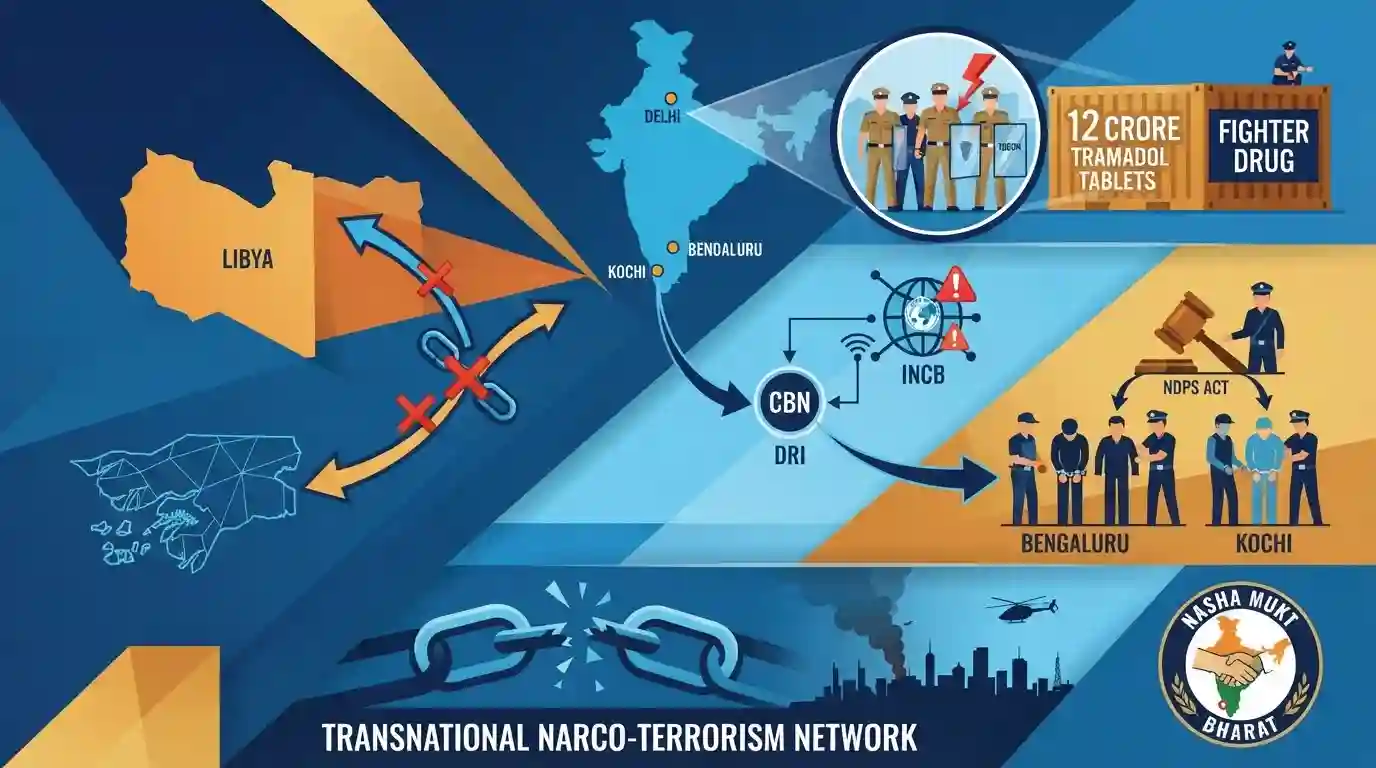
The Central Bureau of Narcotics (CBN) launched 'Operation Vajra', thwarting an international drug trafficking syndicate by seizing 12 crore Tramadol Hydrochloride tablets. The tablets, known as the "fighter drug", were intercepted in Delhi. Traffickers intended to illegally divert the consignment to Libya after initially shipping it to Guinea-Bissau. Working alongside the Directorate of Revenue Intelligence (DRI) and tracking alerts via the International Narcotics Control Board (INCB), the authorities arrested masterminds across Bengaluru and Kochi under the NDPS Act, 1985. The seizure advances India's "Nasha Mukt Bharat" vision and strikes a major blow to transnational narco-terrorism networks supplying conflict zones.
মূল বিষয়
- The Central Bureau of Narcotics (CBN) successfully intercepted 12 crore Tramadol Hydrochloride tablets under 'Operation Vajra'.
- Tramadol, widely referred to as the 'fighter drug', is frequently illicitly trafficked into conflict zones globally.
- The drugs were ostensibly meant for Guinea-Bissau but were intended for illegal diversion to Libya.
- Multiple arrests were made under the NDPS Act, 1985, following a coordinated effort by CBN and the Directorate of Revenue Intelligence (DRI).
- The operation underscored robust international cooperation utilizing intelligence alerts from the International Narcotics Control Board (INCB).
প্রিলিমস ফাঁদ
"The Central Bureau of Narcotics (CBN) operates under the Ministry of Home Affairs."
Aspirants easily confuse the Central Bureau of Narcotics (CBN), which is under the Ministry of Finance, with the Narcotics Control Bureau (NCB), under MHA.
সংযুক্ত স্থির ধারণা
How does the Central Bureau of Narcotics (CBN) differ from the NCB?
- Nodal Ministry: CBN operates under the Department of Revenue (Ministry of Finance); whereas the NCB operates under the Ministry of Home Affairs.
- Licit Control: CBN oversees the legal cultivation of opium poppy and issues EXIM authorizations for controlled substances and precursor chemicals.
- Enforcement Role: NCB acts as the apex national coordinating agency for drug law enforcement, intelligence gathering, and operations.
What is the International Narcotics Control Board (INCB)?
- Nature: An independent, quasi-judicial expert body established in 1968 to implement the UN's international drug control conventions.
- Mandate: Monitors government compliance with UN drug conventions, oversees the licit trade of narcotics, and prevents the diversion of precursor chemicals into illicit channels.
আন্তঃবিষয় প্যাটার্ন
Narco-terrorism in MENA and the Sahel
The diversion of Tramadol ('fighter drug') to Libya highlights how synthetic opioids fund insurgencies, linking India's pharmaceutical regulations directly to global anti-terror financing and FATF frameworks.
Synthetic drug transit networks
Unlike traditional plant-based heroin flows from the Golden Crescent/Triangle, India's emerging internal security challenge involves the diversion of licit synthetic pharmaceuticals utilizing legitimate maritime EXIM channels.

Expect a Prelims statement distinguishing CBN (Ministry of Finance) from NCB (MHA) alongside the mandate of the INCB in drug control.
সংযুক্ত PYQ · 3
সংযুক্ত PYQ · 3
- 2024MainsGS3
Explain how narco-terrorism has emerged as a serious threat across the country. Suggest suitable measures to counter narco-terrorism.
- 2022MainsGS3
Discuss the types of organised crimes. Describe the linkages between terrorists and organised crime that exist at the national and transnational levels.
- 2019PrelimsGS1
Consider the following statements: 1. The United Nations Convention against Corruption (UNCAC) has a 'Protocol against the Smuggling of Migrants by Land, Sea and Air'. 2. The UNCAC is the ever-first legally binding global anti-corruption instrument. 3. A highlight of the United Nations Convention against Transnational Organized Crime (UNTOC) is the inclusion of a specific chapter aimed at returning assets to their rightful owners from whom they had been taken illicitly. 4. The United Nations Office on Drugs and Crime (UNODC) is mandated by its member States to assist in the implementation of both UNCAC and UNTOC. Which of the statements given above are correct?
