Urban Flooding Mitigation Strategies Deployed across Cities
Source:PIB ↗
આ શા માટે મહત્વનું છે
Urban flooding has emerged as a major climate-induced disaster affecting almost all major Indian metropolises due to rapid, unplanned urbanization and loss of natural drainage. Correspondingly, landslides frequently threaten hilly urban settlements. Understanding the Union Government's mitigation strategies—specifically through urban planning guidelines, AMRUT drainage projects, and Smart City tech interventions—is directly relevant for answering Mains questions on disaster resilience and urban governance.
સારાંશ
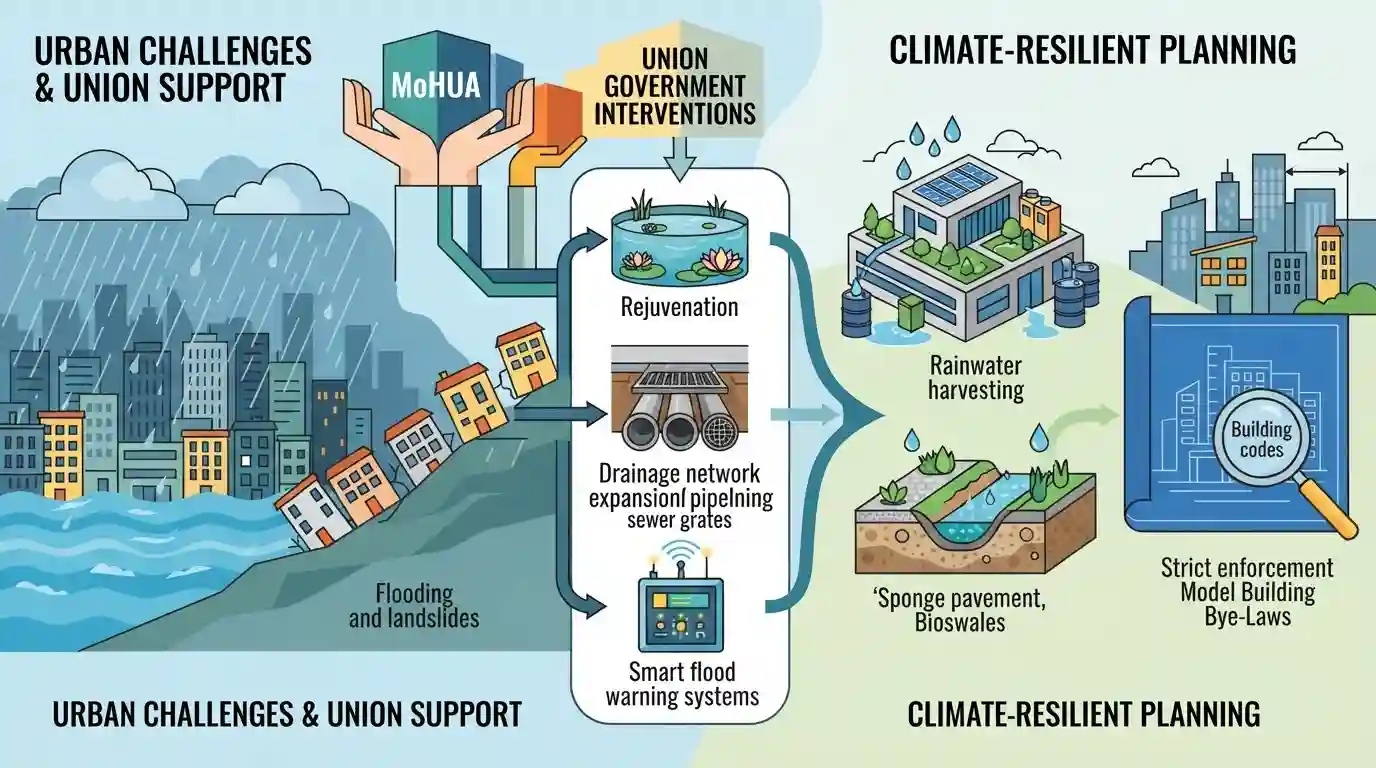
The Ministry of Housing and Urban Affairs (MoHUA) has detailed the Union Government's interventions to address the recurrent challenges of urban flooding and landslides in Indian cities. Acknowledging that local infrastructure is a State subject, MoHUA supports Urban Local Bodies (ULBs) through flagship programs like the Atal Mission for Rejuvenation and Urban Transformation (AMRUT), AMRUT 2.0, and the Smart Cities Mission. These initiatives fund the expansion of storm water drainage networks, rejuvenation of urban water bodies, and the implementation of smart flood warning systems. Furthermore, MoHUA promotes climate-resilient urban planning through its Manual on Storm Water Drainage Systems, emphasizing 'sponge city' principles, rainwater harvesting, and the strict enforcement of Model Building Bye-Laws to mitigate disaster risks.
મુખ્ય મુદ્દા
- Urban flooding and landslides are primarily managed by States and Urban Local Bodies (ULBs), with MoHUA providing supplementary technical and financial assistance.
- Under AMRUT and AMRUT 2.0, the development and rejuvenation of storm water drainage networks are prioritized to mitigate urban waterlogging.
- The Smart Cities Mission supports technology-driven disaster responses, including the deployment of flood early warning systems and integrated smart drainage sensors.
- MoHUA has issued technical guidelines, including the 'Manual on Storm Water Drainage Systems', which advocates for 'sponge city' concepts and sustainable urban drainage systems (SUDS).
- The integration of rainwater harvesting, preservation of wetlands, and strict adherence to structural safety in Model Building Bye-Laws are emphasized to reduce landslide and flood risks in urbanized topographies.
મહત્વપૂર્ણ શબ્દો
Atal Mission for Rejuvenation and Urban Transformation (AMRUT)

A Centrally Sponsored Scheme launched in 2015 to improve basic infrastructure in 500 cities, prioritizing universal water supply, sewerage management, storm water drainage, and development of green spaces and parks.
UPSC context
GS Paper II (Government Policies) and GS Paper III (Infrastructure); tests urban infrastructure planning, citizen services, and municipal reforms.
AMRUT 2.0
Launched in 2021, this scheme builds on AMRUT to make all statutory towns "water secure" through universal tap connections, 100% sewerage coverage in 500 cities, circular water economy, and rejuvenation of water bodies.
UPSC context
GS Paper II (Government Policies) and GS Paper III (Infrastructure); tests sustainable urban water management, cooperative federalism, and climate resilience.
Smart Cities Mission (SCM)
A Centrally Sponsored Scheme launched in 2015 to develop 100 sustainable, citizen-friendly cities by enhancing core infrastructure, using digital technology, and implementing area-based development (retrofitting, redevelopment, and greenfield projects).
UPSC context
GS Paper II (Government Schemes) and GS Paper III (Urbanization); tests technology integration, sustainable local development, and municipal governance models.
Model Building Bye-Laws
A set of advisory guidelines published by MoHUA in 2016 to direct states and local bodies in regulating construction, ensuring structural safety, disaster resilience, rainwater harvesting, and environmental sustainability.
UPSC context
GS Paper I (Urbanization) and GS Paper III (Disaster Management); tests risk-informed urban planning, regulatory frameworks, and disaster mitigation practices.
Urban Local Bodies (ULBs)
The third tier of government in India, constitutionalized by the 74th Amendment Act (1992), responsible for urban administration, planning, land-use regulation, and local public service delivery in cities and towns.
UPSC context
GS Paper II (Polity and Local Governance); tests decentralization, devolution of financial and functional powers, and municipal administrative capacity.
National Disaster Management Authority (NDMA)
The apex statutory body for disaster management in India, established under the Disaster Management Act, 2005, and chaired by the Prime Minister, responsible for framing policies, plans, and guidelines.
UPSC context
GS Paper III (Disaster Management); tests institutional frameworks, national preparedness strategies, and multi-hazard mitigation planning.
પ્રિલિમ્સ ટ્રેપ
Model Building Bye-Laws issued by MoHUA are legally binding on all states and municipal corporations to ensure disaster resilience.
Urban planning, land, and construction regulations are State subjects. The Model Building Bye-Laws are advisory templates, not legally binding Central mandates.
સંલગ્ન સ્થિર ખ્યાલો
What is the constitutional allocation of urban planning and water management in India?
- State List (Schedule VII): Entry 5 (Local government), Entry 17 (Water), and Entry 18 (Land) place urban development primarily under State legislative competence.
- Twelfth Schedule: Inserted by the 74th Amendment Act, it explicitly lists urban planning, regulation of land-use, and water supply under municipal functional areas.
What are the core engineering components of Sustainable Urban Drainage Systems (SUDS)?
- Source Control: Managing rainfall runoff at the source using permeable pavements, rain gardens, and green roofs to decrease peak volume.
- Conveyance & Storage: Directing and slowing water flow using bioswales and detention basins to allow safe infiltration into the ground.
આંતર-વિષય પેટર્ન
Urban Hydrology + Article 21
Frequent urban flooding is increasingly adjudicated under Article 21, linking municipal town-planning failures directly to constitutional remedies and environmental justice.
Sponge Cities + Ramsar Convention
Restoring urban wetlands to mitigate flooding simultaneously addresses Urban Heat Islands, directly linking disaster mitigation with international Ramsar Convention objectives.

UPSC is likely to test 'Sponge Cities' and 'SUDS' through a multi-statement Prelims question on Nature-based Solutions (NbS).
સંલગ્ન PYQ · 4
સંલગ્ન PYQ · 4
- 2024MainsGS3
Flooding in urban areas is an emerging climate-induced disaster. Discuss the causes of this disaster. Mention the features of two such major floods in the last two decades in India. Describe the policies and frameworks in India that aim at tackling such floods.
- 2019MainsGS3
Disaster preparedness is the first step in any disaster management process. Explain how hazard zonation mapping will help disaster mitigation in the case of landslides.
- 2021MainsGS3
Describe the various causes and the effects of landslides. Mention the important components of the National Landslide Risk Management Strategy.
- 2024MainsGS3
What is disaster resilience? How is it determined? Describe various elements of a resilience framework. Also mention the global targets of Sendai Framework for Disaster Risk Reduction (2015–2030).
