PMAY Urban Scheme Progresses with New Housing Targets
Source:PIB ↗
ఇది ఎందుకు ముఖ్యం
Understanding the evolution from PMAY-U to PMAY-U 2.0 is crucial for answering questions on urban planning, housing security, and social welfare schemes. The focus on new verticals like Affordable Rental Housing (ARH) and Interest Subsidy Scheme (ISS) reflects contemporary governmental shifts towards accommodating urban migrants and the neo-middle class, which are central topics in Mains GS1 (Urbanization) and GS2 (Social Justice/Governance).
సారాంశం
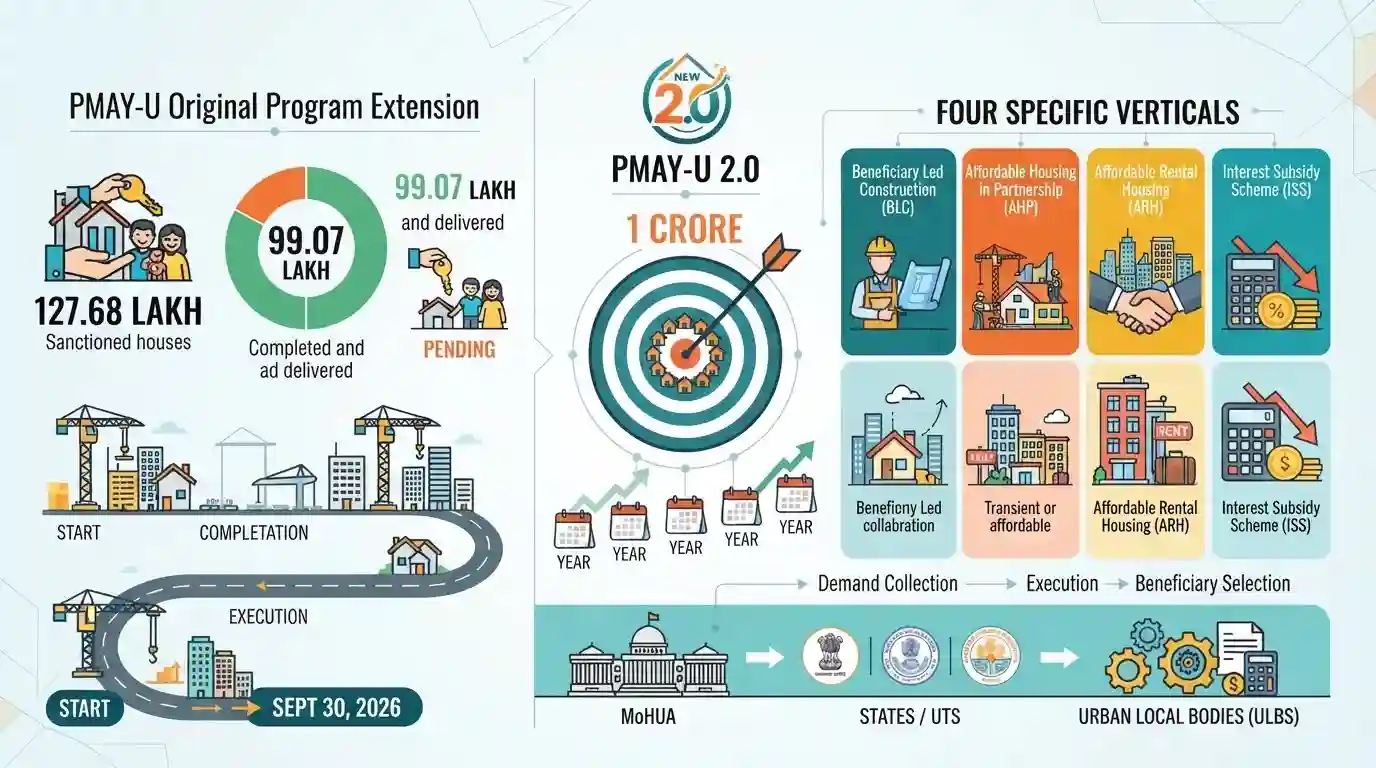
The Ministry of Housing and Urban Affairs (MoHUA) released the implementation status of the Pradhan Mantri Awas Yojana-Urban (PMAY-U) scheme, highlighting that the original program has been extended to September 30, 2026, to complete pending houses. Simultaneously, the newly launched PMAY-U 2.0 (active from September 1, 2024) aims to target 1 crore additional urban households over five years through four specific verticals: Beneficiary Led Construction (BLC), Affordable Housing in Partnership (AHP), Affordable Rental Housing (ARH), and the Interest Subsidy Scheme (ISS). Out of 127.68 lakh houses sanctioned under PMAY-U so far, 99.07 lakh have been completed and delivered as of July 13, 2026. The program operates as a demand-driven initiative where states, UTs, and Urban Local Bodies (ULBs) manage beneficiary selection and execution.
ముఖ్య అంశాలు
- Pradhan Mantri Awas Yojana-Urban (PMAY-U) is an ongoing Centrally Sponsored Scheme (CSS) launched on June 25, 2015, aimed at providing all-weather pucca houses to eligible urban households.
- The operational timeline of PMAY-U has been extended up to September 30, 2026, to enable the completion of already sanctioned houses (without change in the original funding pattern).
- The Government has launched PMAY-U 2.0, effective from September 1, 2024, to address the housing needs of 1 crore additional families (urban poor and middle-class) over a five-year period.
- PMAY-U 2.0 operates through four distinct verticals: Beneficiary Led Construction (BLC), Affordable Housing in Partnership (AHP), Affordable Rental Housing (ARH), and the Interest Subsidy Scheme (ISS).
- As of July 13, 2026, a total of 127.68 lakh houses have been sanctioned under PMAY-U, out of which 121.02 lakh have been grounded for construction, and 99.07 lakh have been completed and delivered to beneficiaries.
- The scheme is demand-driven; the primary responsibilities of identifying beneficiaries, assessing housing demand, and formulating and executing project proposals lie with the respective State Governments, UT Administrations, and Urban Local Bodies (ULBs).
- Basic civic infrastructure (such as water supply, sanitation, drainage, electricity, and approach roads) is incorporated into the projects, often achieved through convergence with other national and state-level schemes.
ముఖ్యమైన పదాలు
Pradhan Mantri Awas Yojana-Urban (PMAY-U)

A centrally sponsored flagship scheme launched in 2015 to provide all-weather pucca houses to eligible urban households. It aims for "Housing for All" and has been extended to 2026 to complete pending sanctions.
UPSC context
GS-2 (Welfare Schemes). Tested on its effectiveness in addressing urban poverty, housing deficits, and sustainable urbanization.
PMAY-U 2.0
The revamped second phase (2024–2029) targeting 1 crore additional urban families. It introduces expanded middle-income eligibility, mandatory female co-ownership, and new models for affordable rental housing with a ₹10 lakh crore investment.
UPSC context
GS-2 (Current Affairs/Schemes). Tests awareness of recent policy shifts, financial outlays, and updated target demographics for housing.
Beneficiary-Led Construction (BLC)
A core scheme vertical where the government provides direct financial assistance to eligible families for constructing or enhancing houses on their own vacant land using Direct Benefit Transfers.
UPSC context
GS-2 (Governance). Highlights demand-side subsidy mechanisms and the efficacy of Direct Benefit Transfers in public welfare delivery.
Affordable Housing in Partnership (AHP)
A public-private partnership model under PMAY-U where the Centre provides financial assistance for housing projects, provided at least 35% of the units are reserved for the Economically Weaker Section (EWS).
UPSC context
GS-3 (Infrastructure/Investment Models). Important for understanding how the state leverages private sector resources to meet public housing goals.
Affordable Rental Housing (ARH)
A PMAY-U 2.0 vertical addressing the housing needs of urban migrants, working women, and students. It operates by converting existing vacant government units or building new complexes via public-private partnerships.
UPSC context
GS-1 (Urbanization) & GS-2 (Vulnerable Sections). Crucial for evaluating policy responses to migration and informal sector vulnerabilities.
Interest Subsidy Scheme (ISS)
A central sector component offering a 4% interest subsidy on home loans up to ₹8 lakh for eligible urban households. It reduces the principal outstanding amount, lowering monthly EMIs significantly.
UPSC context
GS-3 (Inclusive Growth). Demonstrates the role of credit-linked subsidies and formal institutional financing in expanding affordable housing access.
ప్రిలిమ్స్ ఉచ్చు
PMAY-U is a 100% Central Sector scheme and the launch of PMAY-U 2.0 completely closed the 2015 program.
PMAY-U is Centrally Sponsored (shared funding). The original 2015 scheme was extended to September 2026 to complete pending structures, co-existing with PMAY-U 2.0.
అనుసంధానమైన స్థిర భావనలు
How do Centrally Sponsored Schemes differ from Central Sector Schemes?
- Funding Pattern: Centrally Sponsored Schemes (CSS) feature cost-sharing between Center and States (e.g., 60:40 or 90:10), whereas Central Sector schemes are 100% funded by the Union.
- Implementation Agency: CSS are executed by State/UT administrations, while Central Sector schemes are directly implemented by Central Ministries.
What is the economic rationale behind Affordable Rental Housing (ARH) in urban planning?
- Labor Mobility: ARH prevents spatial marginalization by giving seasonal/migrant workers flexible, affordable housing near industrial hubs without long-term debt.
- Slum Prevention: By legalizing and institutionalizing low-cost rentals, cities can mitigate the proliferation of informal settlements and hazardous slums.
అంతర-అంశ నమూనాలు
Urban rental housing + Migrant labor welfare
Aligning rental housing (ARH) under PMAY-U 2.0 with migrant labor trends reflects a critical shift from absolute homeownership to transient housing security for informal urban workers.
Cooperative federalism + ULB financial capacity
PMAY-U's demand-driven execution highlights the bottlenecks of the 74th Amendment, where financially constrained Urban Local Bodies struggle with administrative convergence for civic infrastructure.

PMAY-U 2.0's structural shift to rental housing (ARH) and municipal convergence is likely to feature in 2026 GS1 Urbanization questions.
అనుసంధాన PYQలు · 2
అనుసంధాన PYQలు · 2
- 2023MainsGS1
Does urbanization lead to more segregation and/or marginalization of the poor in Indian metropolises?
- 2019MainsGS2
Performance of welfare schemes that are implemented for vulnerable sections is not so effective due to absence of their awareness and active involvement at all stages of policy process. Discuss.
