India Undergoes Trade Policy Review at World Trade Organization
Source:PIB ↗
Why It Matters
The Trade Policy Review Mechanism provides an international assessment of India's economic reforms, trade policies, and overall integration into the global economy. For civil servants, understanding this mechanism is crucial for evaluating India's strategic positioning at the WTO, its defense of domestic initiatives (like PLI and PM Gati Shakti) against international scrutiny, and its transition towards targeted Free Trade Agreements.
Summary
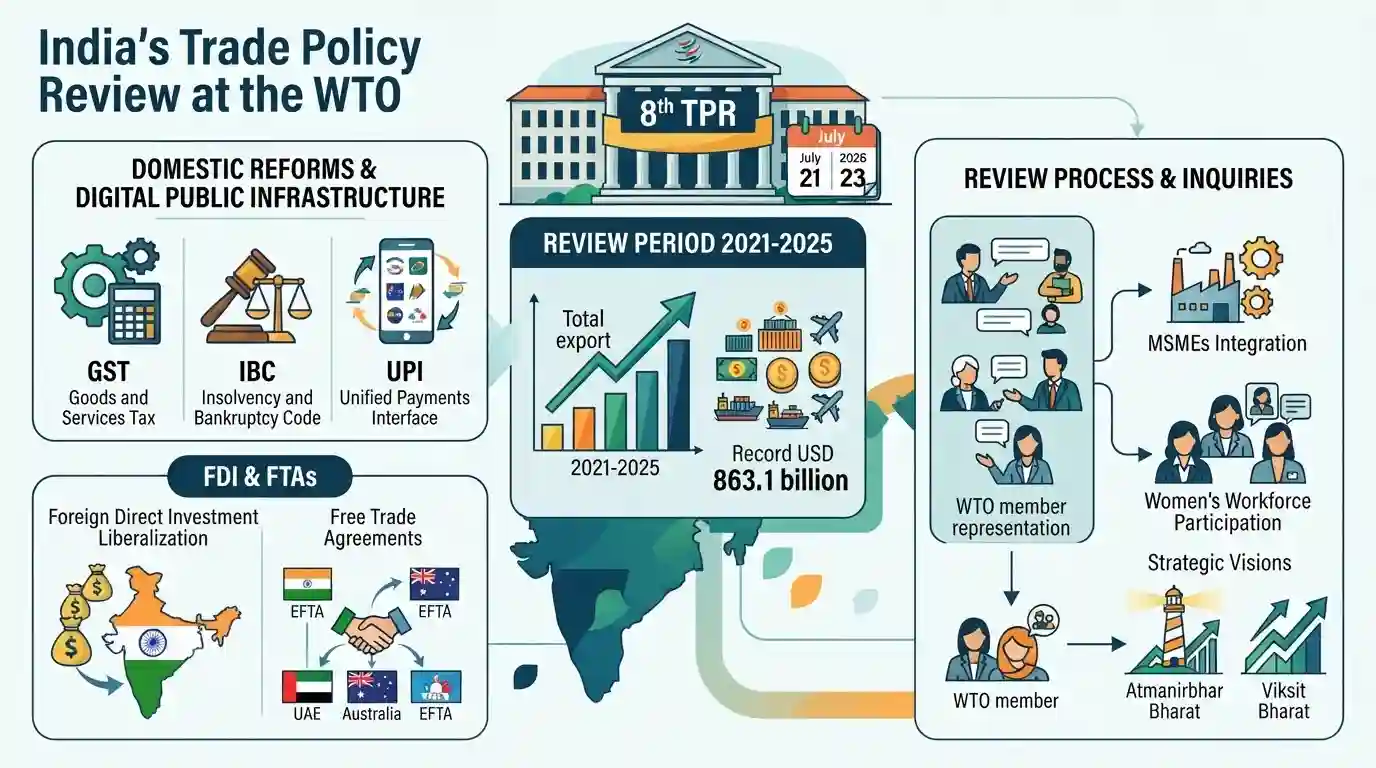
India is set to undergo its 8th Trade Policy Review (TPR) at the World Trade Organization (WTO) in Geneva on July 21 and 23, 2026. The TPR is a critical transparency mechanism that evaluates the trade policies of member states; India is now reviewed every five years. The review encompasses the 2021-2025 period, during which India's total exports hit a record USD 863.1 billion. The Government of India’s report emphasizes significant domestic economic reforms and digital public infrastructure, such as GST, the Insolvency and Bankruptcy Code (IBC), and the Unified Payments Interface (UPI). It also highlights foreign direct investment (FDI) liberalization and the successful negotiation of Free Trade Agreements (FTAs) with the UAE, Australia, and the EFTA. The WTO review process involves addressing questions from other member nations regarding India's integration of MSMEs, women's workforce participation, and overarching economic strategies like Atmanirbhar Bharat and Viksit Bharat.
Key Points
- India's 8th Trade Policy Review (TPR) at the WTO is scheduled for 21 and 23 July 2026 in Geneva, covering the review period of 2021-2025.
- Under the revised cycle, India undergoes a Trade Policy Review every five years, serving as the WTO's primary transparency mechanism.
- The review will assess India's trade and economic policies, backed by record total exports of USD 863.1 billion in the fiscal year 2025-26.
- India's report highlights structural reforms, including GST, IBC, UPI, FDI liberalization, and the signing of new FTAs with the UAE, Australia, and the EFTA.
- WTO members have raised questions regarding India's digitization efforts, PLI schemes, PM Gati Shakti, and policies supporting MSMEs and women's participation.
Important Terms
Trade Policy Review Mechanism (TPRM)

A key transparency mechanism under the WTO's Marrakesh Agreement that regularly audits and evaluates member states' trade policies to enhance adherence to rules and global transparency.
UPSC context
GS Paper II (International Institutions) and GS Paper III (Economy); tests knowledge of multilateral trade governance and global trade bodies.
Unified Payments Interface (UPI)
An instant, real-time, 24/7 interbank payment system developed by the National Payments Corporation of India (NPCI) that facilitates secure mobile-based Peer-to-Peer and Peer-to-Merchant fund transfers using virtual identifiers.
UPSC context
GS Paper III (Indian Economy & Digital Infrastructure); tests understanding of financial inclusion, digital public infrastructure, and fintech innovations.
Insolvency and Bankruptcy Code (IBC)
A landmark 2016 Indian legislation that consolidates the legal framework for time-bound insolvency resolution of corporate entities, partnerships, and individuals to maximize asset value and tackle non-performing assets.
UPSC context
GS Paper III (Indian Economy & Banking Reforms); tests comprehension of corporate governance, debt resolution mechanisms, and financial sector stability.
Atmanirbhar Bharat
A comprehensive economic initiative launched by the Indian government to promote national self-reliance, boost domestic manufacturing, reduce import dependence, and integrate India effectively into global supply chains.
UPSC context
GS Paper III (Indian Economy & Growth); tests understanding of industrial policies, self-reliance strategies, and macroeconomic resilience.
Viksit Bharat
The Government of India’s long-term strategic vision to transform the country into a fully developed nation by 2047, focusing on high per capita income, inclusive growth, sustainable infrastructure, and agile governance.
UPSC context
GS Paper III (Growth, Development, & Governance); tests evaluation of long-term development targets, social equity, and economic planning.
Comprehensive Economic Partnership Agreement (CEPA)
A deep, broad-based bilateral trade agreement that goes beyond traditional free trade agreements by integrating trade in goods and services, investment, intellectual property rights, and regulatory cooperation.
UPSC context
GS Paper II (Bilateral Groupings & Agreements) and GS Paper III (Economy); tests knowledge of trade agreements and economic integration.
Prelims Trap
The Trade Policy Review Body is a distinct, independent judicial organ of the WTO separate from the General Council.
The TPRB is actually the WTO General Council itself, convening under a different mandate. It has no judicial or dispute enforcement powers.
Static Concepts Connected
What is the WTO Trade Policy Review Mechanism (TPRM)?
- Origin and Purpose: Established under Annex 3 of the Marrakesh Agreement to facilitate transparency and peer accountability of members' trade regimes.
- Review Frequency: Determined by global trade share. Top 4 traders are reviewed every 3 years; next 16 (including India) every 5 years.
- Non-enforcement Nature: Reviews do not serve as a basis for dispute settlement or enforcing specific WTO compliance obligations.
How does the Trade Policy Review Body (TPRB) operate?
- Institutional Identity: It is the WTO General Council operating under special terms of reference, meaning all WTO members participate.
- Dual Reports: Every review is based on two reports: a policy statement by the member country and a detailed report by the WTO Secretariat.
Cross-Topic Patterns
DPI as trade facilitation diplomacy
India positions domestic digital platforms like UPI and GST at the WTO to redefine trade facilitation benchmarks beyond physical customs infrastructure.
Bilateral FTAs vs WTO gridlock
India's shift to targeted deals (UAE, EFTA) bypasses stalled WTO negotiations while aligning with GATT Article XXIV criteria for regional trade exceptions.

Expect questions testing the WTO TPRM cycle changes (3/5/7 years) paired with India's unique EFTA investment commitments in 2026.
Linked PYQs · 3
Linked PYQs · 3
- 2014MainsGS2
WTO is an important international institution where decisions taken affect countries in a profound manner. What is the mandate of WTO and how binding are their decisions ? Critically analyse India's stand on the latest round of talks on Food security.
- 2016MainsGS2
The broader aims and objectives of WTO are to manage and promote international trade in the era of globalization. But the Doha round of negotiations seem doomed due to differences between the developed and the developing countries." Discuss in the Indian perspective.
- 2025MainsGS3
What are the challenges before the Indian economy when the world is moving away from free trade and multilateralism to protectionism and bilateralism? How can these challenges be met?
