EShram Portal Expands Social Security for Unorganised Workers
Source:PIB ↗
কেন এটি গুরুত্বপূর্ণ
The unorganised sector employs the vast majority of India's workforce. The e-Shram portal represents a pivotal e-governance shift from fragmented welfare delivery to a centralized database approach, crucial for Mains GS2 (welfare schemes/vulnerable sections) and GS3 (employment/formalization of the economy). Prelims frequently tests the eligibility and features of integrated schemes like PM-SYM.
সারসংক্ষেপ
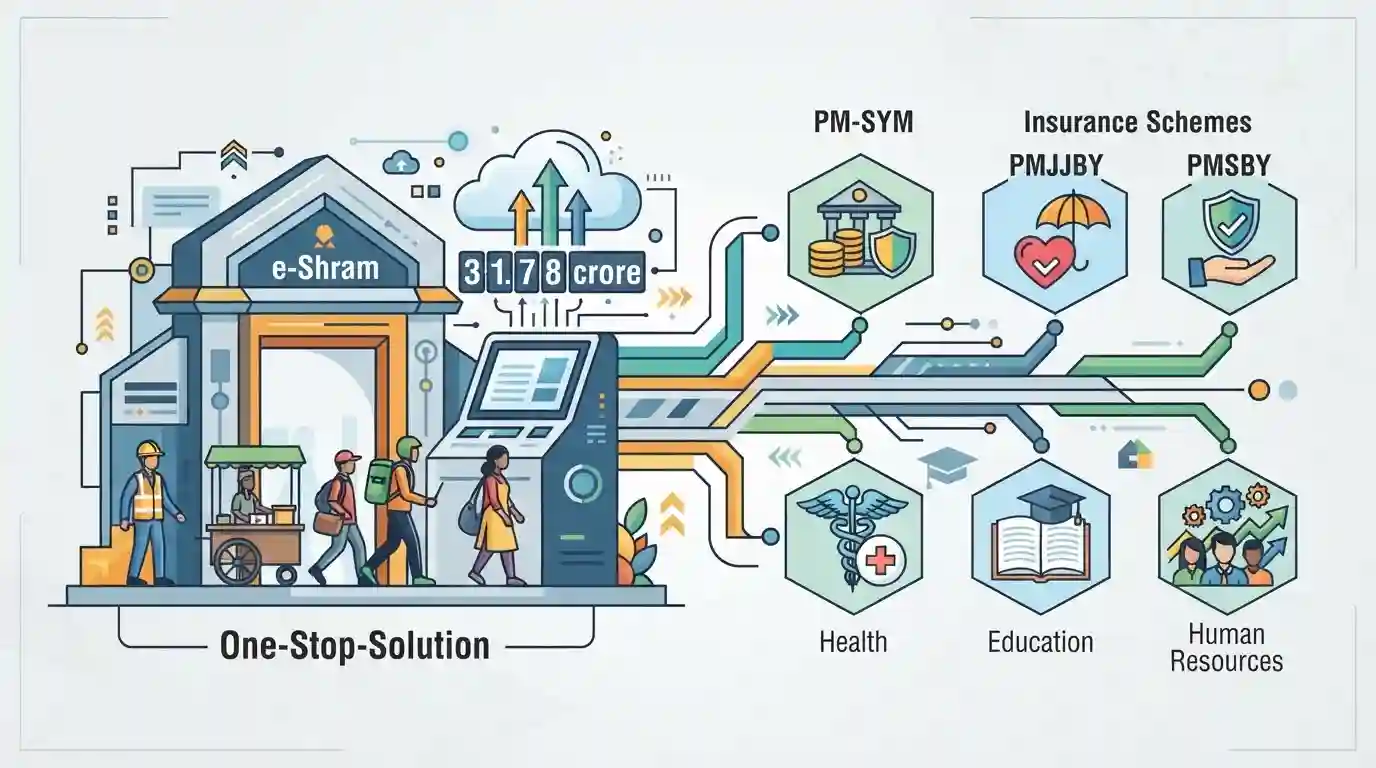
The Ministry of Labour and Employment has significantly scaled up the e-Shram portal, registering over 31.78 crore unorganised workers to date. E-Shram serves as a centralized 'One-Stop-Solution' designed to integrate diverse social security frameworks, such as PM-SYM and insurance schemes (PMJJBY, PMSBY), into a unified delivery mechanism. This comprehensive database enables targeted welfare administration for India's vast informal sector, including gig workers and migrant labourers, mitigating historical challenges related to policy awareness and last-mile service delivery among vulnerable sections.
মূল বিষয়
- The e-Shram portal has registered over 31.78 crore unorganised workers, creating a comprehensive National Database of Unorganised Workers (NDUW).
- It acts as a 'One-Stop-Solution' to integrate and streamline the delivery of various social security and welfare schemes.
- The initiative targets vulnerable groups including migrant workers, street vendors, domestic workers, and gig/platform workers, ensuring they are not excluded from the social safety net.
- By integrating with schemes like PM-SYM, PMJJBY, and PMSBY, it tackles the absence of awareness and fragmented delivery highlighted as major hurdles in social welfare policies.
গুরুত্বপূর্ণ শব্দ
e-Shram Portal

A digital portal launched by the Ministry of Labour and Employment to register unorganised workers and create a comprehensive database for delivering social security benefits.
UPSC context
GS Paper II (Welfare Schemes) & GS Paper III (Employment); tests understanding of e-governance solutions for the informal sector.
Pradhan Mantri Shram Yogi Maan-dhan (PM-SYM) Yojana
A voluntary and contributory pension scheme for unorganised workers aged 18-40 with monthly income up to ₹15,000, offering a guaranteed monthly pension of ₹3,000 after reaching 60 years.
UPSC context
GS Paper II (Welfare Schemes) & GS Paper III (Indian Economy); tests knowledge of social security and pension frameworks.
Pradhan Mantri Jeevan Jyoti Bima Yojana (PMJJBY)
A government-backed, one-year renewable life insurance scheme offering ₹2 lakh coverage for death due to any cause, available to individuals aged 18-50 with a bank account at a low annual premium.
UPSC context
GS Paper II (Government Schemes) & GS Paper III (Inclusive Growth); tests comprehension of financial inclusion and social safety nets.
Pradhan Mantri Suraksha Bima Yojana (PMSBY)
A government-backed, one-year renewable accident insurance scheme offering ₹2 lakh cover for accidental death or total permanent disability, and ₹1 lakh for partial disability, to individuals aged 18-70.
UPSC context
GS Paper II (Welfare Schemes) & GS Paper III (Indian Economy); tests knowledge of affordable social security and accident risk-mitigation.
Ministry of Labour & Employment
A Union ministry responsible for safeguarding worker interests, promoting employment, and implementing social security schemes and labour laws across the formal and unorganised sectors in India.
UPSC context
GS Paper II (Government Policies & Interventions); tests understanding of institutional mechanisms managing labor welfare and employment policy.
প্রিলিমস ফাঁদ
Registration on the e-Shram portal automatically enrolls and provides free life insurance and pension coverage to all informal workers.
Registration on e-Shram registers workers in the database but does not automatically enroll or fund contributory schemes like PM-SYM or PMJJBY, which require separate eligibility verification and premium payments.
সংযুক্ত স্থির ধারণা
How does the Code on Social Security, 2020 define informal workers?
- Unorganised Worker: Home-based, self-employed, or wage workers in the unorganised sector, excluding those covered under EPFO or ESIC.
- Gig Worker: A person performing work or participating in a work arrangement outside of traditional employer-employee relationships.
- Platform Worker: An individual utilizing online platforms to connect with other organizations or individuals to provide specific services.
Which Directive Principles of State Policy (DPSPs) guide labor welfare and social security?
- Article 41: Directs the State to secure the right to work, education, and public assistance in cases of unemployment or old age.
- Article 42: Mandates the State to make provision for securing just and humane conditions of work and for maternity relief.
- Article 43: Urges the State to secure a living wage, decent conditions of life, and social-cultural opportunities for all workers.
আন্তঃবিষয় প্যাটার্ন
Digital Federalism and Welfare Delivery
e-Shram microsites show how central database structures require localized state-level administrative execution to overcome regional language barriers and digital divides.
Formalization vs. Informalization of Labor
While digital registration maps informal workers for welfare delivery, it highlights structural economic challenges where formal job creation struggles to keep pace with informalization.

DPI-led social security integration (e-Shram) and definition of gig/platform workers under the 2020 Code highly probable for GS-3 in 2026.
সংযুক্ত PYQ · 3
সংযুক্ত PYQ · 3
- 2024PrelimsGS1
With reference to the Pradhan Mantri Shram Yogi Maan-dhan (PM-SYM) Yojana, consider the following statements : 1. The entry age group for enrolment in the scheme is 21 to 40 years. 2. Age specific contribution shall be made by the beneficiary. 3. Each subscriber under the scheme shall receive a minimum pension of ₹ 3,000 per month after attaining the age of 60 years. 4. Family pension is applicable to the spouse and unmarried daughters. Which of the statements given above is/are correct?
- 2019MainsGS2
Performance of welfare schemes that are implemented for vulnerable sections is not so effective due to absence of their awareness and active involvement at all stages of policy process. Discuss.
- 2023MainsGS2
“Development and welfare schemes for the vulnerable, by its nature, are discriminatory in approach.” Do you agree? Give reasons for your answer.
