Draft Advocates Amendment Bill Released for Public Consultation
Source:PIB ↗
આ શા માટે મહત્વનું છે
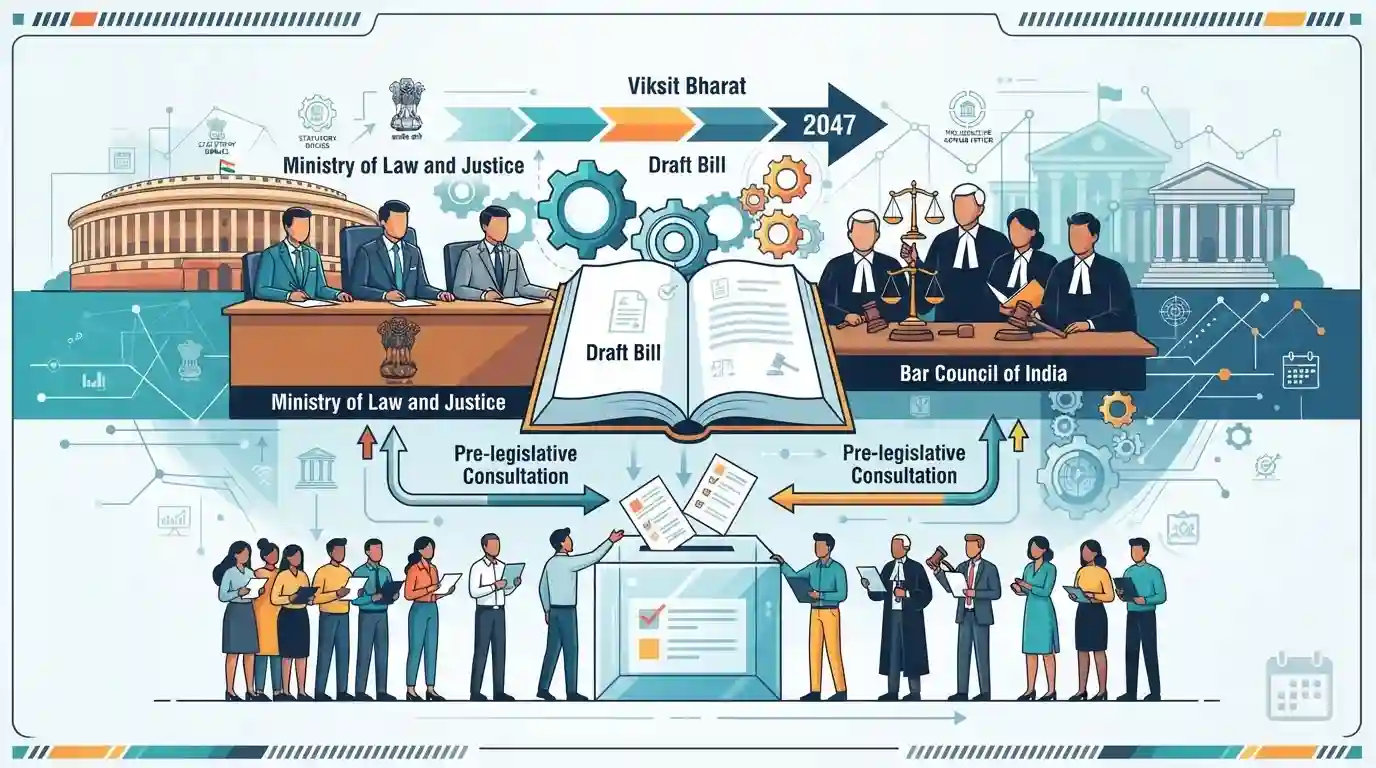
The legal framework governing advocates is crucial for the administration of justice. Updates to the Advocates Act highlight potential reforms in the legal profession, while the consultative process itself is a prime example of participative democracy and the pre-legislative consultation policy in action.
સારાંશ
The Ministry of Law and Justice, in consultation with the Bar Council of India (BCI), has released the Draft Advocates (Amendment) Bill, 2026 for stakeholder and public consultation. Feedback can be submitted until July 31, 2026. This initiative underscores the government's commitment to pre-legislative consultation, aiming to foster a transparent and participative law-making process that adapts the legal profession to evolving needs and aligns with the vision of Viksit Bharat @2047.
મુખ્ય મુદ્દા
- The Draft Advocates (Amendment) Bill, 2026 has been published to gather feedback from stakeholders and the general public.
- The draft bill was formulated by the Ministry of Law and Justice in consultation with the Bar Council of India (BCI).
- The deadline for submitting inputs, suggestions, and feedback is set for July 31, 2026.
- The release of the draft highlights the government's adherence to the pre-legislative consultation policy, emphasizing a transparent and participative law-making process.
મહત્વપૂર્ણ શબ્દો
Draft Advocates (Amendment) Bill, 2026

A proposed legislative amendment released for stakeholder consultation to reform and adapt the legal profession in India to contemporary requirements and align it with the vision of Viksit Bharat @2047.
UPSC context
GS Paper II: Government Policies and Interventions, testing understanding of legislative processes and regulatory reforms in the legal sector.
Advocates Act, 1961
A central legislation enacted to amend and consolidate the laws relating to legal practitioners, establish Bar Councils, and integrate the legal profession in India into a single class of advocates.
UPSC context
GS Paper II: Statutory Bodies, testing knowledge of historical and legal frameworks regulating professionals and governance mechanisms in India.
Bar Council of India (BCI)
A statutory body established under the Advocates Act, 1961, responsible for regulating and representing the Indian legal profession, setting standards for professional conduct, and overseeing legal education.
UPSC context
GS Paper II: Statutory and Quasi-Judicial Bodies, evaluating comprehension of self-regulatory frameworks and legal education standards in India.
Ministry of Law and Justice
The apex Union cabinet-level ministry in India responsible for legislative affairs, administration of justice, drafting central laws, and managing matters related to the legal profession and judiciary.
UPSC context
GS Paper II: Executive and Ministries, testing knowledge of administrative machinery, law-making procedures, and public policy formulation.
સંલગ્ન PYQ · 1
સંલગ્ન PYQ · 1
- 2022PrelimsGS1
With reference to India, consider the following statements: 1. Government law officers and legal firms are recognised as advocates, but corporate lawyers and patent attorneys are excluded from recognition as advocates. 2. Bar Councils have the power to lay down the rules relating to legal education and recognition of law colleges. Which of the statements given above is/are correct?
