NHRC Takes Cognizance of Schoolgirl Assault in Sawai Madhopur
Source:PIB ↗
Why It Matters
This case highlights the active supervisory and protective jurisdiction of the NHRC through its suo motu powers. In the RPSC RAS exam, statutory bodies like the NHRC and the Rajasthan State Human Rights Commission (RSHRC) are highly emphasized, with frequent questions regarding their composition, statutory background, amendments, and chairperson terms.
Summary
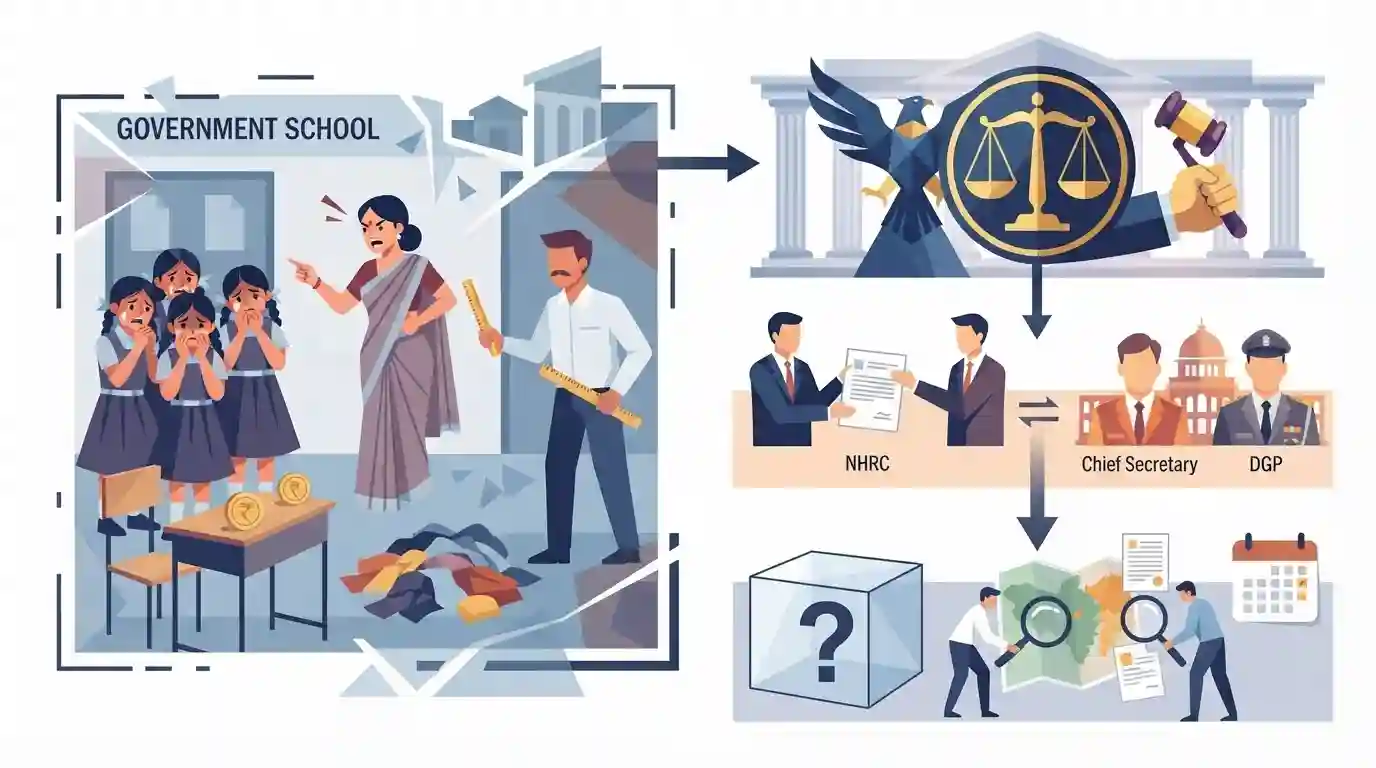
The National Human Rights Commission (NHRC) has taken suo motu cognizance of a shocking incident of physical assault, forced strip-searching, and forced removal of clothes of schoolgirls by teachers at a government school in Sawai Madhopur district, Rajasthan, following the loss of Rs. 1,000 by a teacher. Highlighting it as a gross violation of human rights and dignity, the NHRC has issued notices to the Rajasthan Chief Secretary and DGP, demanding a comprehensive investigation and action-taken report within four weeks.
Key Points
- The National Human Rights Commission (NHRC), India, has taken suo motu cognizance of a media report detailing the forced strip-searching, beating, and forced removal of clothes of girl students at a government school in Liwali village, Sawai Madhopur district, Rajasthan.
- The humiliating treatment was reportedly meted out by school teachers after one of the teachers misplaced Rs. 1,000.
- The NHRC observed that, if true, the incident represents a severe violation of human rights, bodily integrity, and the right to dignity and safe education of the girl students.
- The Commission has issued notices to the Chief Secretary and the Director General of Police (DGP) of Rajasthan, demanding a detailed report within four weeks.
- The required report must include details about the registration of a criminal case (FIR), the disciplinary and legal action taken against the responsible teachers, and steps to provide psychological counseling to the victims.
- This incident underscores the vital monitoring and oversight roles of human rights commissions (both national and state level) in addressing human rights violations and ensuring the accountability of state-run institutions.
Important Terms
National Human Rights Commission (NHRC)

A statutory watchdog established in 1993 to investigate human rights violations in India. It possesses powers of a civil court and can intervene on complaints or take suo motu cognizance of rights abuses.
UPSC context
GS Paper 2 (Statutory, Regulatory & Quasi-judicial bodies). Tests knowledge of institutional frameworks safeguarding citizen rights.
Protection of Human Rights Act, 1993
The legislative framework that mandates the establishment of the National Human Rights Commission (NHRC), State Human Rights Commissions, and Human Rights Courts for the effective promotion and protection of human rights in India.
UPSC context
GS Paper 2 (Polity/Legislation). Essential for understanding the statutory mandate, composition, and limitations of rights commissions.
Right of Children to Free and Compulsory Education (RTE) Act, 2009
An Act guaranteeing fundamental education rights for children aged 6 to 14. Section 17 specifically prohibits any physical punishment or mental harassment of students, mandating disciplinary action against offenders.
UPSC context
GS Paper 2 (Issues relating to Education). Highlights statutory protections against corporal punishment in schools and welfare schemes.
Suo motu cognizance
The authority of constitutional courts and statutory bodies (like the NHRC) to initiate legal or investigative proceedings on their own initiative, without requiring a formal complaint or petition from an affected party.
UPSC context
GS Paper 2 (Polity/Judiciary). Tests understanding of proactive institutional interventions, constitutional oversight, and judicial activism.
Prelims Trap
NHRC recommendations following a suo motu inquiry are binding on the state government.
While the NHRC possesses broad suo motu investigative powers, its final recommendations are purely advisory and cannot legally bind governments.
Static Concepts Connected
What are the key limitations on the powers of the NHRC?
- Recommendatory nature: Its recommendations are not legally binding on governments or authorities; it acts primarily as a moral authority.
- One-year limitation: It cannot investigate any human rights violation incident if more than one year has passed since its occurrence.
- Armed forces limit: It has highly restricted jurisdiction regarding allegations of human rights violations committed by armed forces personnel.
How is corporal punishment legally regulated in Indian schools?
- RTE Act 2009: Section 17 imposes an absolute statutory prohibition on physical punishment and mental harassment, prescribing departmental disciplinary action.
- Juvenile Justice Act: Section 75 establishes criminal liability and imprisonment for persons in charge of a child who assault or abuse them.
Cross-Topic Patterns
NHRC & Article 21 expansiveness
The Supreme Court integrates the Right to Dignity under Article 21, making the NHRC a vital institutional mechanism against state-inflicted bodily violations like illegal strip searches or custodial torture.
Overlap of RTE and JJ Act
School abuse cases simultaneously trigger the administrative disciplinary mechanisms of the RTE Act (Section 17) and the stringent criminal liability framework of the Juvenile Justice Act 2015.

Expect a Prelims question contrasting the suo motu investigative powers of NHRC with its non-binding, purely recommendatory outcomes.
Linked PYQs · 3
Linked PYQs · 3
- 2023RPSC_PRELIMSGS1
Consider the following statements regarding the Rajasthan State Human Rights Commission: (i) According to the provisions of the Human Rights Protection (Amendment) Act, 2006, the Commission has one Chairman and four members. (ii) Currently, Justice Gopal Krishna Vyas is the Chairman.
- 2025RPSC_PRELIMSGS1
Which of the following chairpersons of the Rajasthan State Human Rights Commission completed a five-year term?
- 2021RPSC_PRELIMSGS1
Who is authorized to appoint the Chairman of the Rajasthan State Human Rights Commission?
