NHRC Takes Cognizance of Student Harassment in Rajasthan
Source:PIB ↗
આ શા માટે મહત્વનું છે
This incident is a prime example of the NHRC's active role in protecting human rights using its suo motu powers. It highlights critical governance and social justice issues, including safety in public schools, ethical code of conduct for teachers, and the protection of vulnerable groups (minor girls).
સારાંશ
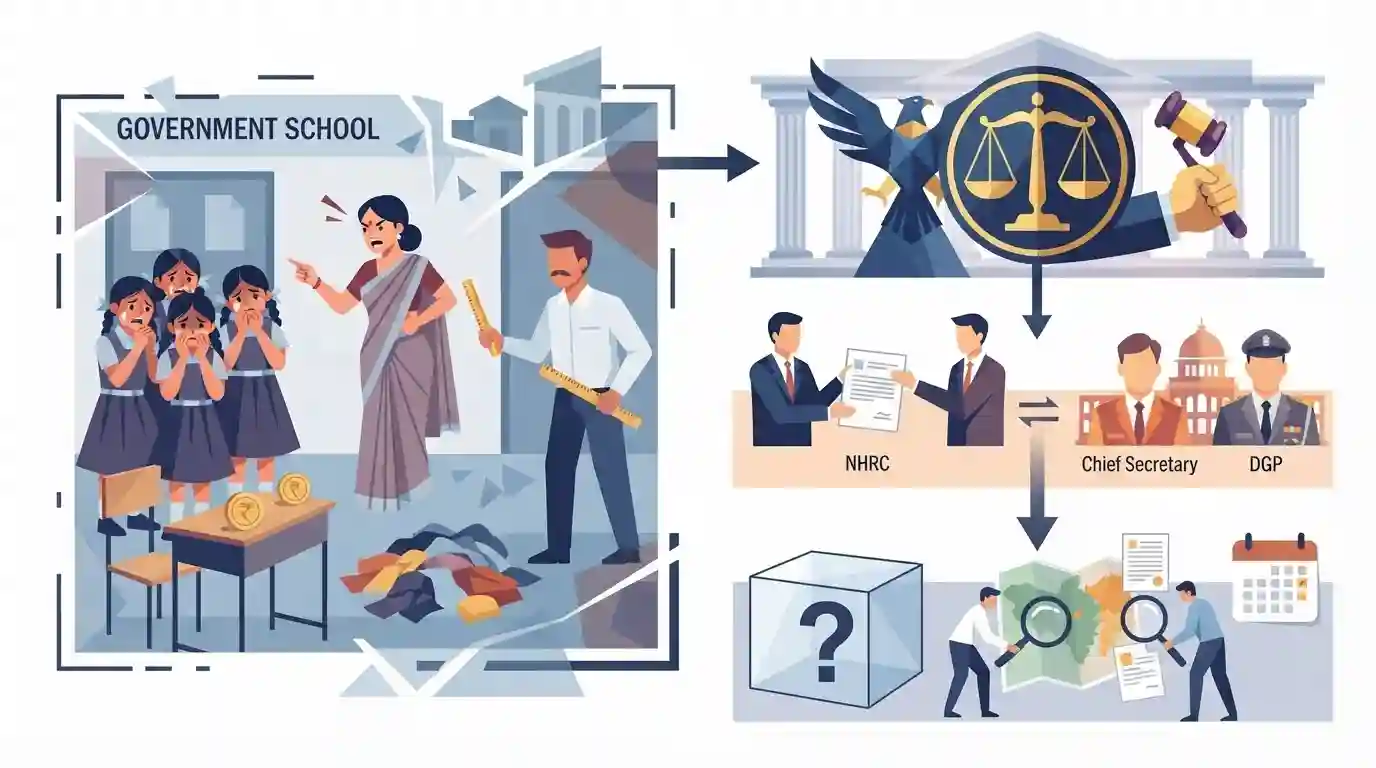
The National Human Rights Commission (NHRC) has taken suo motu cognizance of a media report alleging that female students of classes IX and XI were beat, frisked, and forced to strip by two teachers at a government school in Sawai Madhopur district, Rajasthan, following the loss of Rs. 1,000 by a teacher. Highlighting the severe violation of human rights and dignity, the NHRC has issued a notice to the Chief Secretary of Rajasthan demanding a detailed investigation report within two weeks.
મુખ્ય મુદ્દા
- The National Human Rights Commission (NHRC) has taken suo motu cognizance of an incident involving the beating, forced stripping, and frisking of Class IX and XI girl students by two teachers at a government school in Rajasthan.
- The incident allegedly took place in Liwali village, Sawai Madhopur, over a teacher's lost Rs. 1,000, which led to a massive protest by the students' parents.
- NHRC noted that the incident, if true, constitutes a grave violation of the human rights and dignity of the minor victim students.
- The Commission has issued a formal notice to the Chief Secretary of Rajasthan, demanding a detailed investigation and action-taken report within two weeks.
- The development highlights key issues surrounding child safety, the lack of teacher sensitization, and the role of statutory oversight bodies in safeguarding citizens' fundamental rights.
મહત્વપૂર્ણ શબ્દો
National Human Rights Commission (NHRC)

An independent statutory body established in 1993 under the Protection of Human Rights Act to protect, promote, and investigate violations of human rights (life, liberty, equality, and dignity) in India.
UPSC context
GS Paper II (Polity & Governance - Statutory Bodies); tests institutional mechanisms protecting fundamental rights.
Protection of Human Rights Act, 1993
The central Indian legislation providing for the constitution of the National Human Rights Commission, State Human Rights Commissions, and Human Rights Courts to safeguard human rights in India.
UPSC context
GS Paper II (Polity - Legislative Acts); tests understanding of legislative frameworks enforcing constitutional and international human rights.
Right to Education (RTE) Act, 2009
A landmark act enacted under Article 21A of the Indian Constitution, guaranteeing free and compulsory elementary education to all children aged 6 to 14 years.
UPSC context
GS Paper II (Social Justice - Education); tests understanding of welfare legislation, educational reforms, and child rights in India.
પ્રિલિમ્સ ટ્રેપ
The NHRC Chairperson must strictly be a retired Chief Justice of India, and its recommendations are legally binding.
The 2019 amendment allows retired Supreme Court judges to be Chairperson. Furthermore, NHRC recommendations are advisory and not legally binding.
સંલગ્ન સ્થિર ખ્યાલો
What is the composition and tenure of the NHRC post the 2019 Amendment?
- Chairperson eligibility: Can be a retired Chief Justice of India or any retired Judge of the Supreme Court.
- Ex-Officio Members: Expanded to include Chairpersons of NCBC, NCPCR, and the Chief Commissioner for Persons with Disabilities.
- Tenure change: Reduced from five years to three years, with removal of the five-year cap on reappointment eligibility.
What are the core jurisdictional limitations of the NHRC?
- One-year limitation: Cannot investigate any human rights violation case after one year from its date of occurrence.
- Armed Forces limitation: Can only seek reports from the Central government; cannot conduct independent investigations directly.
- Advisory character: Its recommendations, including compensations, are non-binding advisory directives to the government.
આંતર-વિષય પેટર્ન
NHRC and NCPCR Jurisdictional Overlap
When rights violations occur in schools, both NHRC and NCPCR possess concurrent power to issue notices, testing cooperative institutional alignment.
RTE Act and Article 21
Corporal punishment violates physical integrity, linking the statutory safeguards of the RTE Act directly with constitutional protection under Article 21.

2026 focus will likely test the 2019 PHRA amendment provisions on NHRC composition alongside the body's quasi-judicial limitations.
સંલગ્ન PYQ · 2
સંલગ્ન PYQ · 2
- 2014MainsGS2
National Human Rights Commission (NHRC) in India can be most effective when its tasks are adequately supported by other mechanisms that ensure the accountability of a government. In light of the above observation assess the role of NHRC as an effective complement to the judiciary and other institutions in promoting and protecting human rights standards.
- 2023PrelimsGS1
Consider the following organizations/bodies in India: 1. The National Commission for Backward Classes 2. The National Human Rights Commission 3. The National Law Commission 4. The National Consumer Disputes Redressal Commission How many of the above are constitutional bodies?
