Index of Core Industries Revised with New Base Year
Source:PIB ↗
આ શા માટે મહત્વનું છે
The Index of Core Industries is a critical macroeconomic indicator often tested in Prelims. The revision of its base year and the addition of a ninth core industry (Iron Ore) are significant factual updates. Understanding the core sector's performance and composition is also essential for answering Mains GS3 questions on industrial growth and manufacturing.
સારાંશ
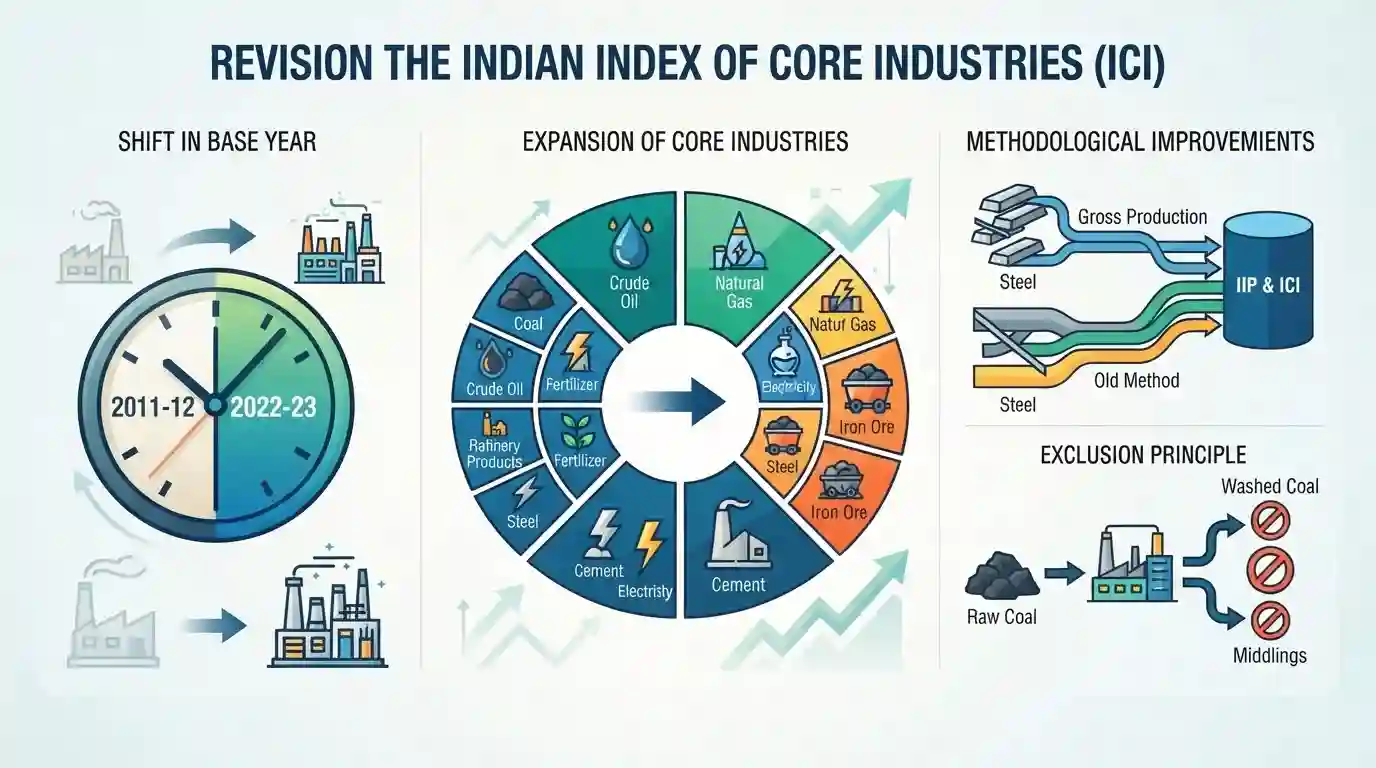
The Department for Promotion of Industry and Internal Trade (DPIIT) has introduced the revised Index of Core Industries (ICI) with a new base year of 2022-23, replacing the older 2011-12 series. A major highlight of the revision is the expansion of the core sector from eight to nine industries with the inclusion of Iron Ore. Methodological improvements have also been made, such as utilizing gross production data for steel to ensure consistency with the Index of Industrial Production (IIP) and excluding washed coal and middlings to avoid double counting.
મુખ્ય મુદ્દા
- The base year for the Index of Core Industries (ICI) has been revised from 2011-12 to 2022-23 by the DPIIT.
- The number of core industries has been expanded from eight to nine with the addition of Iron Ore.
- The nine core industries now include Coal, Natural Gas, Crude Oil, Refinery Products, Fertilizers, Steel, Cement, Electricity, and Iron Ore.
- The compilation of the Steel index has shifted to using gross production data instead of net production data to align with the Index of Industrial Production (IIP).
- To eliminate double counting, only 'Raw Coal' is retained in the coal index, excluding Coal Middling and Washed Coal.
- The linking factor for the overall Index of Core Industries to connect the new and old series has been set at 1.47.
મહત્વપૂર્ણ શબ્દો
Index of Core Industries (ICI)

A monthly index tracking the production volume of key infrastructure sectors. Recently revised to a 2022-23 base year, it now includes nine core industries (up from eight) with the addition of Iron Ore.
UPSC context
Crucial for GS-3 Economy. Prelims heavily test its core constituents, their weights, new base year, and releasing agency (OEA).
Index of Industrial Production (IIP)
A composite monthly indicator compiled by the National Statistical Office (NSO) that measures short-term changes in the volume of industrial production across mining, manufacturing, and electricity sectors.
UPSC context
Important for GS-3. UPSC frequently tests its compiling agency (NSO/MoSPI), base year, and the 40% weightage of core sectors within it.
Department for Promotion of Industry and Internal Trade (DPIIT)
A nodal department under the Ministry of Commerce and Industry. It formulates industrial policies, regulates foreign direct investment (FDI), manages intellectual property rights, and drives the Startup India initiative.
UPSC context
Essential for GS-3. Prelims and Mains target its role in FDI frameworks, IPR, Startups, and publishing crucial industrial indices.
Office of Economic Adviser (OEA)
An attached office under the DPIIT that provides industrial policy advice and compiles major macroeconomic statistics, specifically the Wholesale Price Index (WPI) and the Index of Core Industries (ICI).
UPSC context
Relevant for Prelims Economy. Questions frequently ask candidates to match critical macro indices (like WPI and ICI) with their publishing agencies.
સંલગ્ન PYQ · 3
સંલગ્ન PYQ · 3
- 2015PrelimsGS1
In the 'Index of Eight Core Industries', which one of the following is given the highest weight?
- 2012PrelimsGS1
In India, in the overall Index of Industrial Production, the Indices of Eight Core Industries have a combined weight of 37.90%. Which of the following are among those Eight Core Industries? 1. Cement 2. Fertilizers 3. Natural gas 4. Refinery products 5. Textiles Select the correct answer using the codes given below:
- 2017MainsGS3
Industrial growth rate has lagged-behind in the overall growth of Gross-Domestic-Product (GDP) in the post-reform period." Give reasons. How far the recent changes in Industrial-Policy are capable of increasing the industrial growth rate?
