मजबूत लेनदेन के साथ UPI उपयोगकर्ता आधार ने मील का पत्थर छुआ
स्रोत:पीआईबी ↗
क्यों मायने रखता है
UPI serves as the bedrock of India's Digital Public Infrastructure (DPI) and is a prime case study for financial inclusion, digital diplomacy, and cashless economics in UPSC GS3 (Economy) and GS2 (Governance/IR). Understanding its volume growth, regulatory background (Payment and Settlement Systems Act), and international integrations is highly relevant for both MCQ assessments (NPCI vs. CBDC, BHIM mechanics) and subjective Mains analysis on digitalization.
सारांश
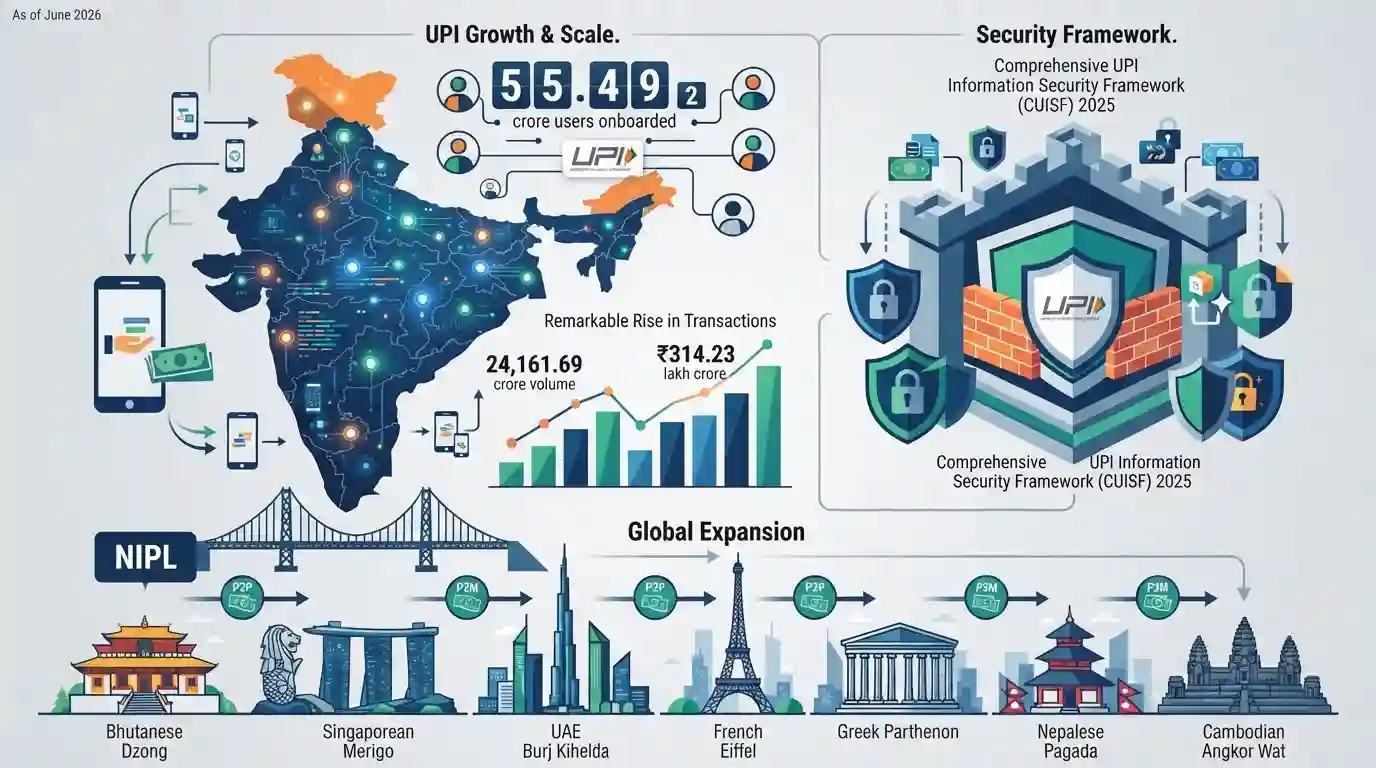
The Ministry of Finance highlighted that as of June 2026, nearly 55.49 crore users have been onboarded on the Unified Payments Interface (UPI) platform. Operated by the National Payments Corporation of India (NPCI) under the Payment and Settlement Systems Act, 2007, UPI transactions witnessed a remarkable rise, reaching 24,161.69 crore in volume and ₹314.23 lakh crore in value during FY 2025-26. To secure this growth, initiatives such as the Comprehensive UPI Information Security Framework (CUISF) 2025 have been introduced. Additionally, NPCI International Payments Ltd. (NIPL) has successfully expanded UPI and RuPay's reach globally, integrating P2P and P2M remittance systems with partner institutions in countries like Bhutan, Singapore, UAE, France, Greece, Nepal, and Cambodia.
मुख्य बिंदु
- UPI यूजर बेस: जून 2026 तक, यूनिफाइड पेमेंट्स इंटरफेस (UPI) प्लेटफॉर्म पर लगभग 55.49 करोड़ उपयोगकर्ताओं को ऑनबोर्ड किया जा चुका है।
- लेनदेन में घातीय वृद्धि: UPI लेनदेन की मात्रा वित्त वर्ष 2021-22 के 4,595.61 करोड़ लेनदेन से बढ़कर वित्त वर्ष 2025-26 में 24,161.69 करोड़ हो गई। इसी अवधि के दौरान लेनदेन का मूल्य ₹84.16 लाख करोड़ से बढ़कर ₹314.23 लाख करोड़ हो गया।
- Regulatory & Statutory Base: UPI is operated by the National Payments Corporation of India (NPCI), which is authorized under the Payment and Settlement Systems Act, 2007.
- Security Upgrades: Measures taken by the Government, RBI, and NPCI include risk-based transaction limits, safeguards against unauthorized mobile number changes/SMS misuse, and the enforcement of the Comprehensive UPI Information Security Framework (CUISF) 2025 and the Mobile Application Security Framework.
- वैश्विक पदचिह्न (NIPL): NPCI इंटरनेशनल पेमेंट्स लिमिटेड (NIPL) सक्रिय रूप से UPI और RuPay को अंतर्राष्ट्रीय बाजारों में ले जा रहा है, जिससे सीमा-पार P2P प्रेषण (remittance) और P2M लेनदेन सुगम हो रहे हैं।
- प्रमुख अंतर्राष्ट्रीय इंटरऑपरेबिलिटी मील के पत्थर: भूटान, सिंगापुर, यूएई, फ्रांस, मॉरीशस, श्रीलंका, नेपाल, कतर और कंबोडिया (नवीनतम जून 2026 में) जैसे देशों में P2M के लिए UPI लाइव है। यह सिंगापुर, ग्रीस (यूरोबैंक, मई 2026) और नेपाल (NCHL, जून 2026) में P2P के लिए लाइव है।
महत्वपूर्ण शब्द
National Payments Corporation of India (NPCI)

भारत में खुदरा भुगतान और निपटान प्रणालियों का संचालन करने वाला एक अम्ब्रेला संगठन, जिसे भुगतान और निपटान प्रणाली अधिनियम, 2007 के तहत RBI और IBA द्वारा स्थापित किया गया था। यह UPI और RuPay जैसी डिजिटल सार्वजनिक वस्तुओं का प्रबंधन करता है।
UPSC context
Highly relevant for GS Paper 3 (Economy) concerning digital public infrastructure, fintech evolution, and financial inclusion in India.
Payment and Settlement Systems Act, 2007
भारत में भुगतान प्रणालियों को विनियमित और पर्यवेक्षित करने के लिए एक कानूनी ढांचा प्रदान करने वाला अधिनियम। यह भारतीय रिजर्व बैंक (RBI) को सभी वित्तीय और भुगतान प्रणाली संचालन की निगरानी करने के लिए एकमात्र प्राधिकरण के रूप में नामित करता है।
UPSC context
बैंकिंग विनियमन, डिजिटल भुगतान निगरानी और RBI की वैधानिक प्रवर्तन शक्तियों को समझने के तहत GS पेपर 3 (अर्थव्यवस्था) के लिए अत्यंत महत्वपूर्ण।
Comprehensive UPI Information Security Framework (CUISF) 2025
An advanced security protocol issued by NPCI mandating stringent controls across the UPI ecosystem. It establishes safeguards against fraudulent transactions, unauthorized mobile number changes, and SMS authentication misuse to ensure robust digital payment resilience.
UPSC context
Important for GS Paper 3 (Cyber Security & Tech) as it details India's strategy to secure critical digital financial infrastructure against threats.
एनपीसीआई इंटरनेशनल पेमेंट्स लिमिटेड (NIPL)
वर्ष 2020 में स्थापित NPCI की एक पूर्ण स्वामित्व वाली सहायक कंपनी। यह भारत की स्वदेशी डिजिटल भुगतान प्रणालियों, मुख्य रूप से UPI और RuPay कार्ड योजना को वैश्विक बाजारों में निर्यात करती है, जिससे वास्तविक समय में निर्बाध सीमा-पार प्रेषण सक्षम होता है।
UPSC context
भारत की सॉफ्ट पावर, डिजिटल पब्लिक इंफ्रास्ट्रक्चर कूटनीति और वैश्विक वित्तीय कनेक्टिविटी के संबंध में GS पेपर 2 (IR) और GS पेपर 3 (अर्थव्यवस्था) के लिए उपयुक्त।
RuPay Card Scheme
An indigenous, highly secure domestic card payment network launched by NPCI. It reduces reliance on foreign payment gateways, fosters domestic financial inclusion, and is increasingly integrated into international payment markets.
UPSC context
Tests knowledge of GS Paper 3 (Economy) focusing on indigenous technological self-reliance, cashless economy initiatives, and India's digital banking penetration.
संबद्ध PYQ · 5
संबद्ध PYQ · 5
- 2018PrelimsGS1
With reference to digital payments, consider the following statements: 1. BHIM app allows the user to transfer money to anyone with a UPI-enabled bank account. 2. While a chip-pin debit card has four factors of authentication, BHIM app has only two factors of authentication. Which of the statements given above is/are correct?
- 2026PrelimsGS1
Which one of the following statements about Unified Payments Interface (UPI) and Central Bank Digital Currency (Digital Rupee) is not correct ?
- 2017PrelimsGS1
Consider the following statements: 1. National Payments Corporation of India (NPCI) helps in promoting the financial inclusion in the country. 2. NPCI has launched RuPay, a card payment scheme. Which of the statements given above is/are correct?
- 2023MainsGS3
What is the status of digitalization in the Indian economy? Examine the problems faced in this regard and suggest improvements.
- 2022MainsGS3
Is inclusive growth possible under market economy ? State the significance of financial inclusion in achieving economic growth in India.
