UPI User Base Reaches Milestone with Robust Transactions
Source:PIB ↗
Why It Matters
UPI serves as the bedrock of India's Digital Public Infrastructure (DPI) and is a prime case study for financial inclusion, digital diplomacy, and cashless economics in UPSC GS3 (Economy) and GS2 (Governance/IR). Understanding its volume growth, regulatory background (Payment and Settlement Systems Act), and international integrations is highly relevant for both MCQ assessments (NPCI vs. CBDC, BHIM mechanics) and subjective Mains analysis on digitalization.
Summary
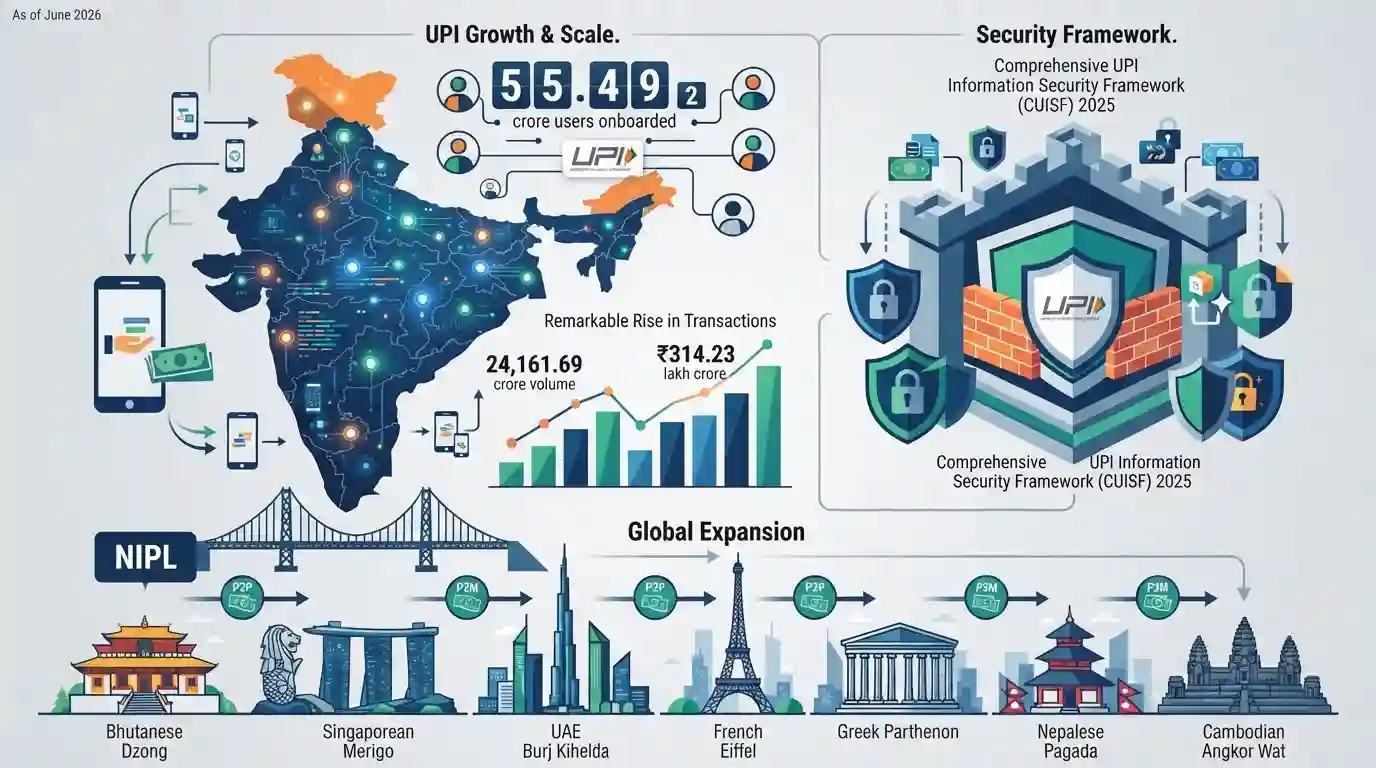
The Ministry of Finance highlighted that as of June 2026, nearly 55.49 crore users have been onboarded on the Unified Payments Interface (UPI) platform. Operated by the National Payments Corporation of India (NPCI) under the Payment and Settlement Systems Act, 2007, UPI transactions witnessed a remarkable rise, reaching 24,161.69 crore in volume and ₹314.23 lakh crore in value during FY 2025-26. To secure this growth, initiatives such as the Comprehensive UPI Information Security Framework (CUISF) 2025 have been introduced. Additionally, NPCI International Payments Ltd. (NIPL) has successfully expanded UPI and RuPay's reach globally, integrating P2P and P2M remittance systems with partner institutions in countries like Bhutan, Singapore, UAE, France, Greece, Nepal, and Cambodia.
Key Points
- UPI User Base: As of June 2026, nearly 55.49 crore users have been onboarded on the Unified Payments Interface (UPI) platform.
- Exponential Transaction Growth: UPI volume grew from 4,595.61 crore transactions in FY 2021-22 to 24,161.69 crore in FY 2025-26. Transaction value grew from ₹84.16 lakh crore to ₹314.23 lakh crore during the same period.
- Regulatory & Statutory Base: UPI is operated by the National Payments Corporation of India (NPCI), which is authorized under the Payment and Settlement Systems Act, 2007.
- Security Upgrades: Measures taken by the Government, RBI, and NPCI include risk-based transaction limits, safeguards against unauthorized mobile number changes/SMS misuse, and the enforcement of the Comprehensive UPI Information Security Framework (CUISF) 2025 and the Mobile Application Security Framework.
- Global Footprint (NIPL): NPCI International Payments Ltd. (NIPL) is actively taking UPI and RuPay to international markets, facilitating cross-border P2P remittances and P2M transactions.
- Key International Interoperability Milestones: UPI is live for P2M in countries like Bhutan, Singapore, UAE, France, Mauritius, Sri Lanka, Nepal, Qatar, and Cambodia (the latest in June 2026). It is live for P2P in Singapore, Greece (Eurobank, May 2026), and Nepal (NCHL, June 2026).
Important Terms
National Payments Corporation of India (NPCI)

The umbrella organization operating retail payments and settlement systems in India, created by RBI and IBA under the Payment and Settlement Systems Act, 2007. It manages digital public goods like UPI and RuPay.
UPSC context
Highly relevant for GS Paper 3 (Economy) concerning digital public infrastructure, fintech evolution, and financial inclusion in India.
Payment and Settlement Systems Act, 2007
An act providing the legal framework to regulate and supervise payment systems in India. It designates the Reserve Bank of India (RBI) as the sole authority to oversee all financial and payment system operations.
UPSC context
Crucial for GS Paper 3 (Economy) under banking regulations, digital payments oversight, and understanding RBI's statutory enforcement powers.
Comprehensive UPI Information Security Framework (CUISF) 2025
An advanced security protocol issued by NPCI mandating stringent controls across the UPI ecosystem. It establishes safeguards against fraudulent transactions, unauthorized mobile number changes, and SMS authentication misuse to ensure robust digital payment resilience.
UPSC context
Important for GS Paper 3 (Cyber Security & Tech) as it details India's strategy to secure critical digital financial infrastructure against threats.
NPCI International Payments Ltd. (NIPL)
A wholly-owned subsidiary of NPCI established in 2020. It exports India's indigenous digital payment systems, primarily UPI and the RuPay card scheme, to global markets, thereby enabling seamless real-time cross-border remittances.
UPSC context
Fits GS Paper 2 (IR) and GS Paper 3 (Economy) regarding India's soft power, digital public infrastructure diplomacy, and global financial connectivity.
RuPay Card Scheme
An indigenous, highly secure domestic card payment network launched by NPCI. It reduces reliance on foreign payment gateways, fosters domestic financial inclusion, and is increasingly integrated into international payment markets.
UPSC context
Tests knowledge of GS Paper 3 (Economy) focusing on indigenous technological self-reliance, cashless economy initiatives, and India's digital banking penetration.
Linked PYQs · 5
Linked PYQs · 5
- 2018PrelimsGS1
With reference to digital payments, consider the following statements: 1. BHIM app allows the user to transfer money to anyone with a UPI-enabled bank account. 2. While a chip-pin debit card has four factors of authentication, BHIM app has only two factors of authentication. Which of the statements given above is/are correct?
- 2026PrelimsGS1
Which one of the following statements about Unified Payments Interface (UPI) and Central Bank Digital Currency (Digital Rupee) is not correct ?
- 2017PrelimsGS1
Consider the following statements: 1. National Payments Corporation of India (NPCI) helps in promoting the financial inclusion in the country. 2. NPCI has launched RuPay, a card payment scheme. Which of the statements given above is/are correct?
- 2023MainsGS3
What is the status of digitalization in the Indian economy? Examine the problems faced in this regard and suggest improvements.
- 2022MainsGS3
Is inclusive growth possible under market economy ? State the significance of financial inclusion in achieving economic growth in India.
