Fintech Ecosystem Regulation Strengthened by Government and RBI
Source:PIB ↗
কেন এটি গুরুত্বপূর্ণ
The rapid rise of Fintech, digital lending, and digital transactions (UPI) has democratized finance but escalated risks like cyber scams, illegal loan apps, and data privacy breaches. UPSC repeatedly tests digital payments infrastructure (UPI vs. CBDC), cybercrime regulatory responses, and data protection mechanisms. This article provides a comprehensive ready-to-use checklist of government/RBI interventions for mains answers on financial regulation and cybersecurity.
সারসংক্ষেপ
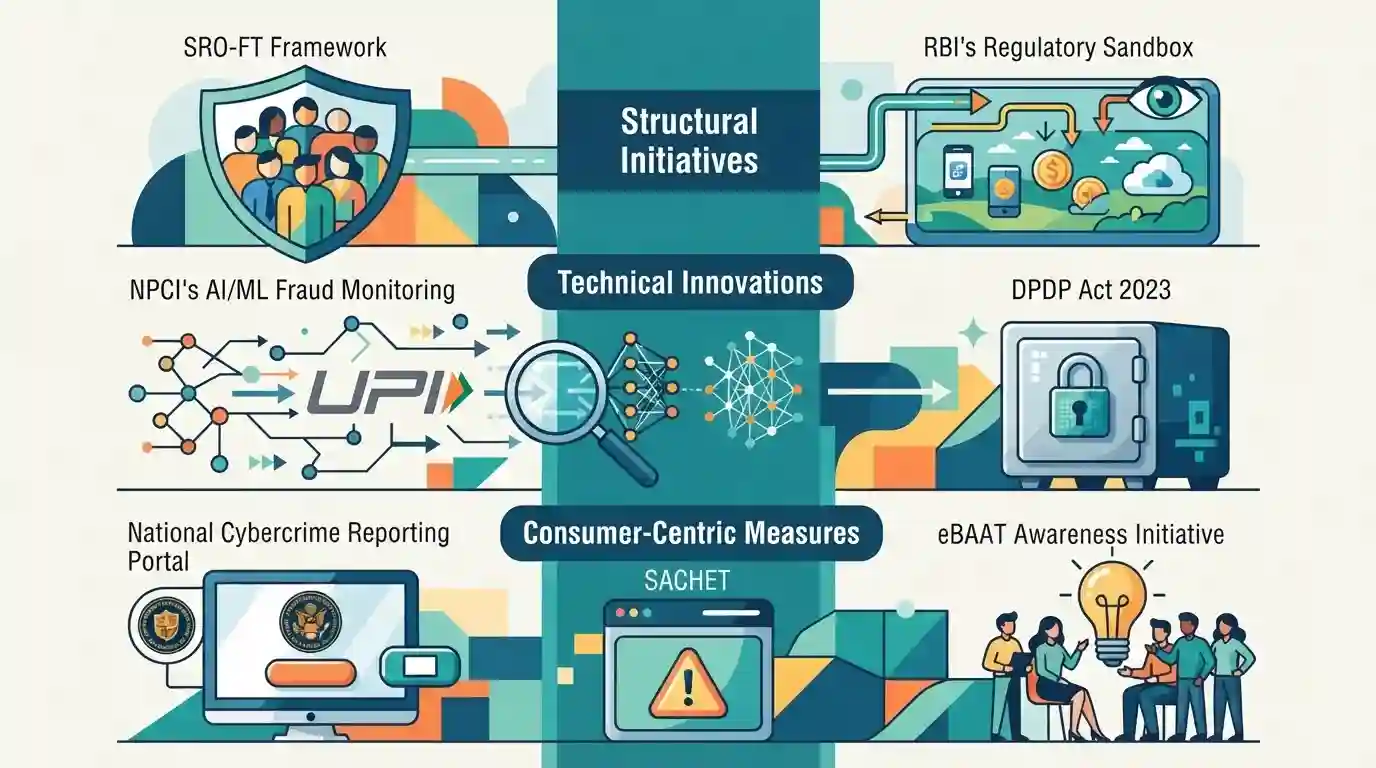
The written reply in Lok Sabha by the Ministry of Finance outlines key structural, technical, and consumer-centric initiatives taken by the Government and RBI to regulate the Fintech sector and control financial crimes. These measures include the SRO-FT framework for self-regulation, NPCI's AI/ML fraud monitoring for UPI, the DPDP Act 2023 for data protection, RBI's Regulatory Sandbox, and consumer platforms such as the National Cybercrime Reporting Portal, SACHET, and the eBAAT awareness initiative.
মূল বিষয়
- The Government and RBI have deployed several multi-pronged regulatory and safety measures to strengthen India's booming Fintech ecosystem, specifically focusing on digital lending, payment aggregators, and consumer safety.
- RBI issued the Framework for Self-Regulatory Organisation(s) in the FinTech Sector (SRO-FT framework) in May 2024 to foster ethical conduct, standard-setting, transparency, and dispute resolution within the fintech industry.
- For cybersecurity, RBI's Master Directions on Digital Payment Security Controls (2021) mandate banks to implement standard security controls. Simultaneously, NPCI provides AI/ML-based fraud monitoring to banks for flagging or declining suspicious UPI transactions.
- MeitY has notified the Digital Personal Data Protection (DPDP) Act, 2023 and the DPDP Rules 2025 to safeguard individuals' financial and personal data in the digital realm.
- To encourage risk-controlled innovation, the RBI introduced an enabling framework for its Regulatory Sandbox in 2019, permitting the live-testing of financial products under relaxed or controlled regulatory parameters.
- For grievance redressal and fraud prevention, MHA hosts the National Cybercrime Reporting Portal and Helpline (1930) for illegal loan apps, whereas the 'SACHET' portal and State Level Coordination Committees (SLCC) allow citizens to lodge complaints against illegal deposit collection. Additionally, RBI conducts the electronic-banking awareness and training (eBAAT) program.
প্রিলিমস ফাঁদ
The RBI's Regulatory Sandbox operates exclusively within a simulated environment using synthetic data to prevent any risk to live retail markets.
It actually involves live testing of innovative financial products on real consumers under controlled regulatory relaxations, not just simulated environments.
সংযুক্ত স্থির ধারণা
What is a Regulatory Sandbox and how does it operate under RBI?
- Live Testing: Allows testing of innovative financial products or services on real consumers on a limited scale.
- Regulatory Relaxations: Grants relaxed regulatory requirements temporarily for sandbox entities to foster innovation.
- Thematic Cohorts: Operates under specific target themes such as retail payments, cross-border payments, or digital lending.
What is the role of a Self-Regulatory Organisation (SRO) in Fintech?
- Mediator Role: Acts as a vital bridge between the industry stakeholders and the primary regulator (RBI).
- Standard Setting: Establishes ethical standards, codes of conduct, and minimum benchmark practices for member fintechs.
- Non-Statutory Enforcement: Relies on industry-consensus enforcement rather than direct statutory police powers, promoting voluntary compliance.
আন্তঃবিষয় প্যাটার্ন
Fintech credit & DPDP Act friction
The DPDP Act's strict consent mandates disrupt alternative credit-scoring fintechs that scrape phone metadata, forcing a shift towards formal credit registries.
Cooperative federalism in financial policing
State Level Coordination Committees (SLCCs) bridge federal regulators like RBI/SEBI with state law enforcement to enforce the BUDS Act against illegal deposit schemes.

Expect questions distinguishing the regulatory mandates of RBI's SACHET portal (illegal deposits) from MHA's Cybercrime Portal in 2026.
সংযুক্ত PYQ · 4
সংযুক্ত PYQ · 4
- 2024MainsGS3
Describe the context and salient features of the Digital Personal Data Protection Act, 2023.
- 2026PrelimsGS1
Which one of the following statements about Unified Payments Interface (UPI) and Central Bank Digital Currency (Digital Rupee) is not correct ?
- 2023MainsGS3
What is the status of digitalization in the Indian economy? Examine the problems faced in this regard and suggest improvements.
- 2020MainsGS3
Discuss different types of cyber crimes and measures required to be taken to fight the menace.
