President Murmu Visits Moldova to Strengthen Bilateral Ties
Source:PIB ↗
Why It Matters
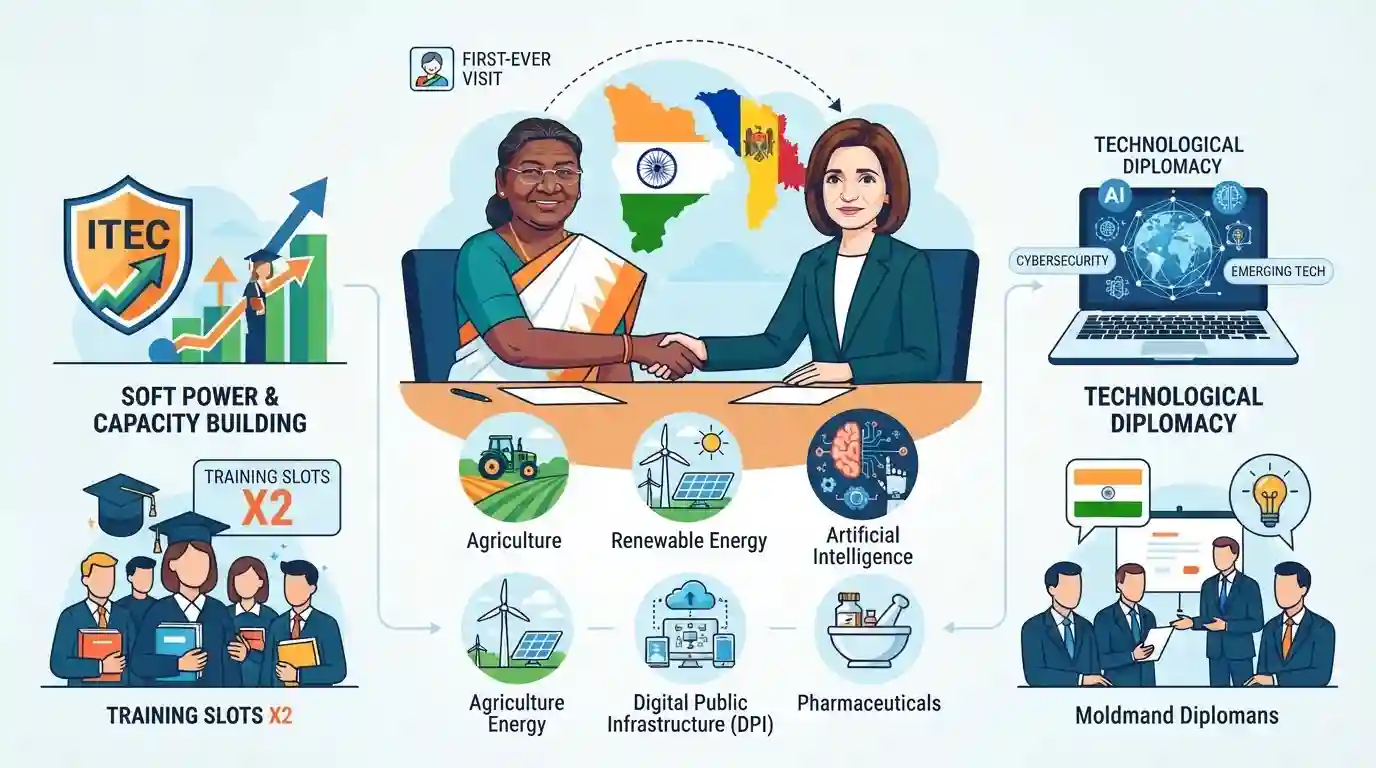
Demonstrates India's expanding diplomatic footprint in Eastern Europe and its strategic use of technological expertise (DPI, AI) and capacity-building programs (ITEC) as vital instruments of soft power and international cooperation.
Summary
President Droupadi Murmu concluded a historic first-ever state visit by an Indian President to Moldova, holding bilateral talks with President Maia Sandu. Both nations agreed to enhance cooperation in various sectors, including agriculture, renewable energy, Digital Public Infrastructure (DPI), Artificial Intelligence, and pharmaceuticals. Highlighting its technological diplomacy and soft power, India announced the doubling of ITEC training slots for Moldovan professionals and invited their diplomats to participate in specialized courses focusing on AI, emerging technologies, and cyber diplomacy.
Key Points
- President Droupadi Murmu completed the first-ever state visit by an Indian President to Moldova, meeting with Moldovan President Maia Sandu.
- The leaders agreed to deepen bilateral cooperation across sectors including agriculture, healthcare, pharmaceuticals, logistics, and renewable energy.
- India continues to leverage its digital success as a diplomatic tool by focusing on Digital Public Infrastructure (DPI), Artificial Intelligence (AI), and cyber diplomacy in its international partnerships.
- India announced the doubling of ITEC training slots for Moldovan professionals, specifically offering specialized courses in AI and emerging technologies.
Important Terms
ITEC (Indian Technical and Economic Cooperation) programme

A bilateral capacity-building program launched in 1964 by India's Ministry of External Affairs, providing training, technology transfer, and developmental assistance to over 160 partner countries in the Global South.
UPSC context
GS Paper II (Bilateral groupings, foreign policy) — tests understanding of India's development cooperation and soft power projection.
Sushma Swaraj Institute of Foreign Service (SSIFS)
Established in 1986 under the Ministry of External Affairs, SSIFS (formerly Foreign Service Institute) is India's premier institution for training diplomats and conducting specialized courses to foster global cooperation.
UPSC context
GS Paper II (Bilateral agreements, soft power) — tests knowledge of diplomatic training institutions, capacity building, and soft power.
Digital Public Infrastructure (DPI)
A set of open, interoperable, and scalable digital systems—such as digital identity, payment systems, and data exchange platforms—that enable efficient public and private service delivery at a societal scale.
UPSC context
GS Paper II & III (E-governance, technology) — tests knowledge of digital governance models, India Stack, and tech diplomacy.
Cyber Diplomacy
The conduct of foreign policy, negotiations, and international coordination regarding digital networks, cyberspace security protocols, and international norms to prevent conflict in the digital domain.
UPSC context
GS Paper II (Bilateral/regional groupings) — tests comprehension of digital statecraft, global cyber norms, and international security architecture.
Prelims Trap
Moldova is a littoral state of the Black Sea, granting India direct maritime trade access to Eastern Europe.
Moldova is entirely landlocked. It is separated from the Black Sea by Ukrainian territory, though it has minor access to the Danube River.
Static Concepts Connected
What is the Indian Technical and Economic Cooperation (ITEC) programme?
- Launch and Funding: Formulated in 1964, it is fully funded and managed by India's Ministry of External Affairs.
- Core Objective: Focuses on institutional capacity building, skill sharing, and technological training for developing and transition economies.
- Key Modalities: Delivers developmental assistance via training programs, project consultancies, study tours, and humanitarian aid.
What are the key geographical features of Moldova?
- Landlocked Position: Positioned in Eastern Europe, entirely landlocked between Ukraine to the north, east, south, and Romania to the west.
- Transnistria Issue: Contains the breakaway, Russian-backed de facto independent region of Transnistria along its eastern border with Ukraine.
Cross-Topic Patterns
DPI and digital soft power
Using Digital Public Infrastructure (DPI) as a foreign policy tool establishes India as a key technology provider, counterbalancing traditional cyber-powers in developing nations.
Eurasian geopolitics and diplomacy
India's outreach to smaller Eastern European nations diversifies bilateral ties, bypassing gridlocked multilateral systems to secure key geopolitical support in UN bodies.

Geopolitical map questions on landlocked Eastern European nations and India's DPI-led digital diplomacy are highly probable for 2026.
Linked PYQs · 3
Linked PYQs · 3
- 2025MainsGS2
India-Africa digital partnership is achieving mutual respect, co-development and long-term institutional partnerships. Elaborate.
- 2024MainsGS2
Critically analyse India's evolving diplomatic, economic and strategic relations with the Central Asian Republics (CARs) highlighting their increasing significance in regional and global geopolitics.
- 2015MainsGS2
Terrorist activities and mutual distrust have clouded India-Pakistan relations. To what extent the use of soft power like sports and cultural exchanges could help generate goodwill between the two countries? Discuss with suitable examples.
