Amul Bengal Dairy Project and Cooperative Expansion
Source:PIB ↗
આ શા માટે મહત્વનું છે
This article represents a key developmental milestone in the expansion of India's cooperative dairy model (the Amul model) to Eastern India, which is critical for rural diversification, women empowerment (Lakhpati Didis), and animal husbandry yield improvements (using biotechnology like Sex-Sorted Semen). It also highlights 'platform cooperatives' (the Sarathi taxi cooperative), showing how cooperative structures can evolve to protect workers in the modern gig/service economy.
સારાંશ
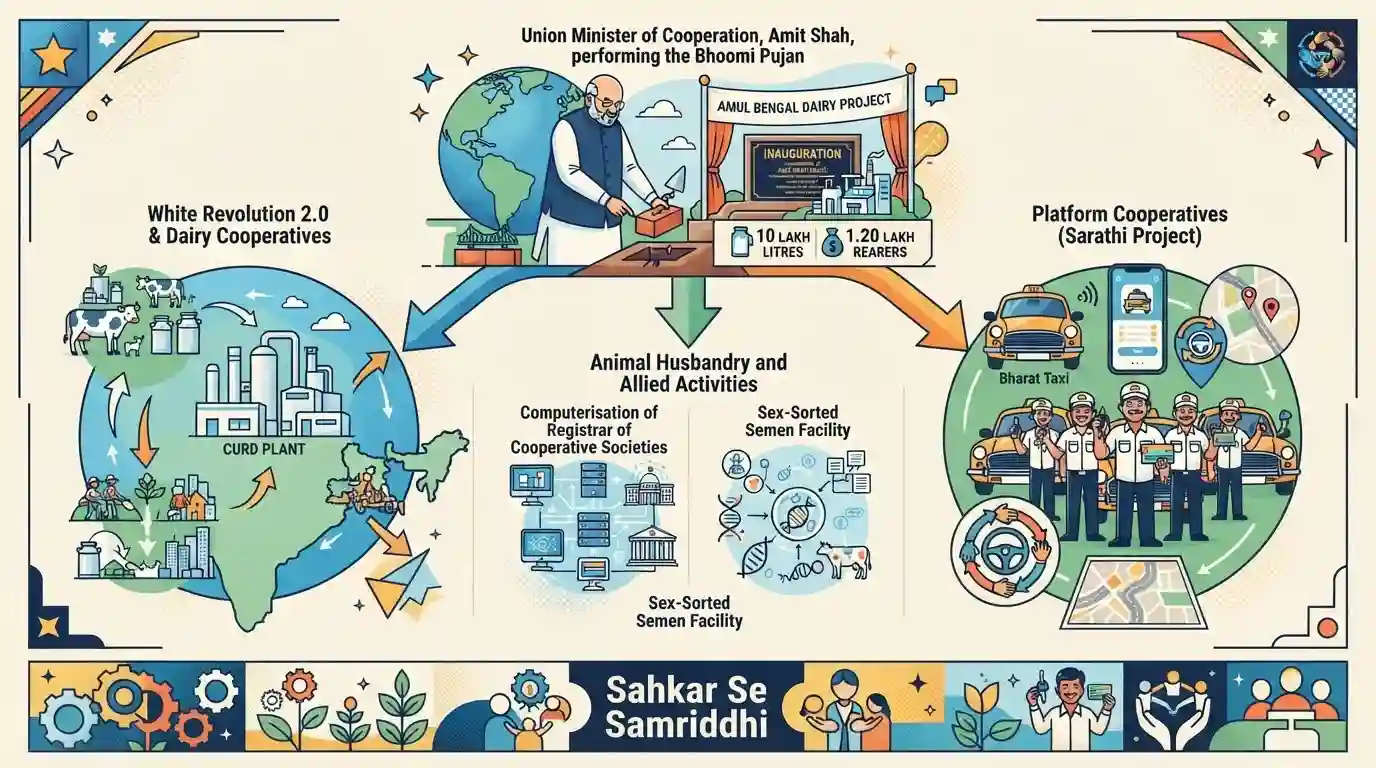
The Union Minister of Cooperation, Amit Shah, performed the Bhoomi Pujan for the world's largest curd manufacturing plant under the Amul Bengal Dairy Project in Kolkata, West Bengal. Able to process 10 lakh litres of milk daily, this project aims to support over 1.20 lakh livestock rearers and expand 'White Revolution 2.0' to Eastern India. Alongside dairy, the event highlighted key cooperative reforms including the computerisation of the Registrar of Cooperative Societies, the creation of a Sex-Sorted Semen facility for breed improvement, and the innovative 'Sarathi' (Bharat Taxi) initiative, which applies the cooperative model to the local transport/gig economy to empower taxi drivers as owners.
મુખ્ય મુદ્દા
- The Bhoomi Pujan for the world's largest curd manufacturing plant under the Amul Bengal Dairy Project was performed in Dankuni near Kolkata, West Bengal.
- The plant will process 10 lakh litres of milk per day, benefiting over 1.20 lakh dairy farmers in Bengal, built on 30 acres of land registered under West Bengal Dairy Cooperatives.
- The initiative aligns with 'White Revolution 2.0' and 'Sahkar Se Samriddhi', focusing on dairy expansion and improving rural incomes in Eastern India.
- Key central interventions include setting up an animal breed improvement center, a Sex-Sorted Semen facility in West Bengal, and computerising the state's Registrar of Cooperative Societies.
- The 'Sarathi' (Bharat Taxi) project was introduced as a platform cooperative model to integrate local taxi drivers as owners and shareholders, eliminating middleman commissions.
મહત્વપૂર્ણ શબ્દો
White Revolution 2.0

A national initiative launched in 2024 to increase dairy cooperative milk procurement by 50% over five years, focusing on expanding village-level cooperatives, modernizing infrastructure, and empowering women livestock rearers.
UPSC context
GS Paper III (Agriculture & Allied Activities); tests schemes for dairy development, rural income diversification, and women's economic empowerment.
Sahkar Se Samriddhi
The central government’s guiding vision meaning "prosperity through cooperation," aiming to revitalize India's cooperative sector by modernizing Primary Agricultural Credit Societies (PACS), improving transparency, and fostering digital inclusive growth.
UPSC context
GS Paper II & III (Governance and Economy); tests policies, administrative reforms, and credit access models in India’s cooperative movement.
Bharat Taxi (Sarathi Project)
India's first government-backed, cooperative-based ride-hailing platform launched in 2026. Under the "Sarathi" model, drivers are registered co-owners who retain full earnings without paying commissions or surge fees to private aggregators.
UPSC context
GS Paper III (Indian Economy/Gig Economy); tests labor welfare, inclusive digital public infrastructure (DPI), and innovative platform cooperative models.
Platform Cooperatives
A digital economy business model where workers collectively own, govern, and share profits of a technological platform, presenting an equitable, democratic alternative to private, investor-driven gig aggregators.
UPSC context
GS Paper III (Employment/Social Security); tests solutions for gig worker exploitation, labor rights, and digital economic empowerment models.
Ministry of Cooperation
A separate Union Ministry established in July 2021 to provide a dedicated administrative, legal, and policy framework for strengthening India's grassroots cooperative movement and boosting ease of doing business.
UPSC context
GS Paper II (Governance/Statutory Bodies); tests administrative changes, cooperative federalism, and legislative amendments.
Amul (Anand Pattern)
India’s premier three-tier dairy cooperative model consisting of village societies, district unions, and a state federation, which eliminated middlemen and transformed India into the world’s largest milk producer.
UPSC context
GS Paper III (Agriculture/Food Processing); tests successful models of collective bargaining, cooperative federalism, and rural poverty alleviation.
પ્રિલિમ્સ ટ્રેપ
Cooperative societies are exclusively governed under the Union List of the Seventh Schedule of the Indian Constitution.
Cooperative societies is a State subject (Entry 32). Only Multi-State Cooperative Societies with operations in multiple states fall under the Union List (Entry 44).
સંલગ્ન સ્થિર ખ્યાલો
What is the constitutional framework governing cooperative societies in India?
- State Subject: Cooperative societies fall under Entry 32 of the State List, meaning state governments legislate on domestic cooperatives.
- Union List Exception: Multi-State cooperative societies with operations in more than one state are regulated under Entry 44 of the Union List.
- 97th Amendment: Added Article 19(1)(c) making the right to form cooperatives a fundamental right, and inserted Article 43B as a Directive Principle.
What are Platform Cooperatives and how do they function?
- Democratic Ownership: They are cooperatively owned, democratically governed digital businesses where the platform's algorithm, code, and profits are owned by the service-providers.
- Value Retention: Unlike VC-backed corporate platforms, they eliminate high intermediary commission fees, redistributing surplus earnings back to the gig workers.
આંતર-વિષય પેટર્ન
Platform Cooperatives + Gig Economy Security
Applies cooperative ownership principles to the digital gig economy, offering a viable model to resolve regulatory deadlocks over gig worker social security under the Code on Social Security.
Livestock Breeding + Climate Mitigation
Utilizing sex-sorted semen to select for female calves optimizes feed efficiency and reduces unproductive livestock populations, directly lowering agricultural methane emissions.

White Revolution 2.0 targets and the operational structure of multi-state platform cooperatives likely to feature in GS3 Agriculture in 2026.
સંલગ્ન PYQ · 3
સંલગ્ન PYQ · 3
- 2014MainsGS3
In the villages itself no form of credit organization will be suitable except the cooperative society. -All India Rural Credit Survey. Discuss this statement in the background of agricultural finance in India. What constraints and challenges do financial institutions supplying agricultural finance face? How can technology be used to better reach and serve rural clients?
- 2015MainsGS3
Livestock rearing has a big potential for providing non-farm employment and income in rural areas. Discuss suggesting suitable measures to promote this sector in India.
- 2024PrelimsGS1
With reference to the sectors of the Indian economy, consider the following pairs: Economic activity | Sector 1. Storage of agricultural produce | Secondary 2. Dairy farm | Primary 3. Mineral exploration | Tertiary 4. Weaving cloth | Secondary How many of the pairs given above are correctly matched?
