NAMASTE Scheme and Mechanised Sanitation Workers Welfare
Source:PIB ↗
ఇది ఎందుకు ముఖ్యం
The eradication of manual scavenging is a critical human rights and social justice issue in India. The NAMASTE scheme is a definitive policy intervention to address this by formalizing the sector, providing essential safety nets (like PM-JAY and PPE), and offering economic empowerment to sanitation workers, making it a highly probable topic for GS2 and GS1 (society).
సారాంశం
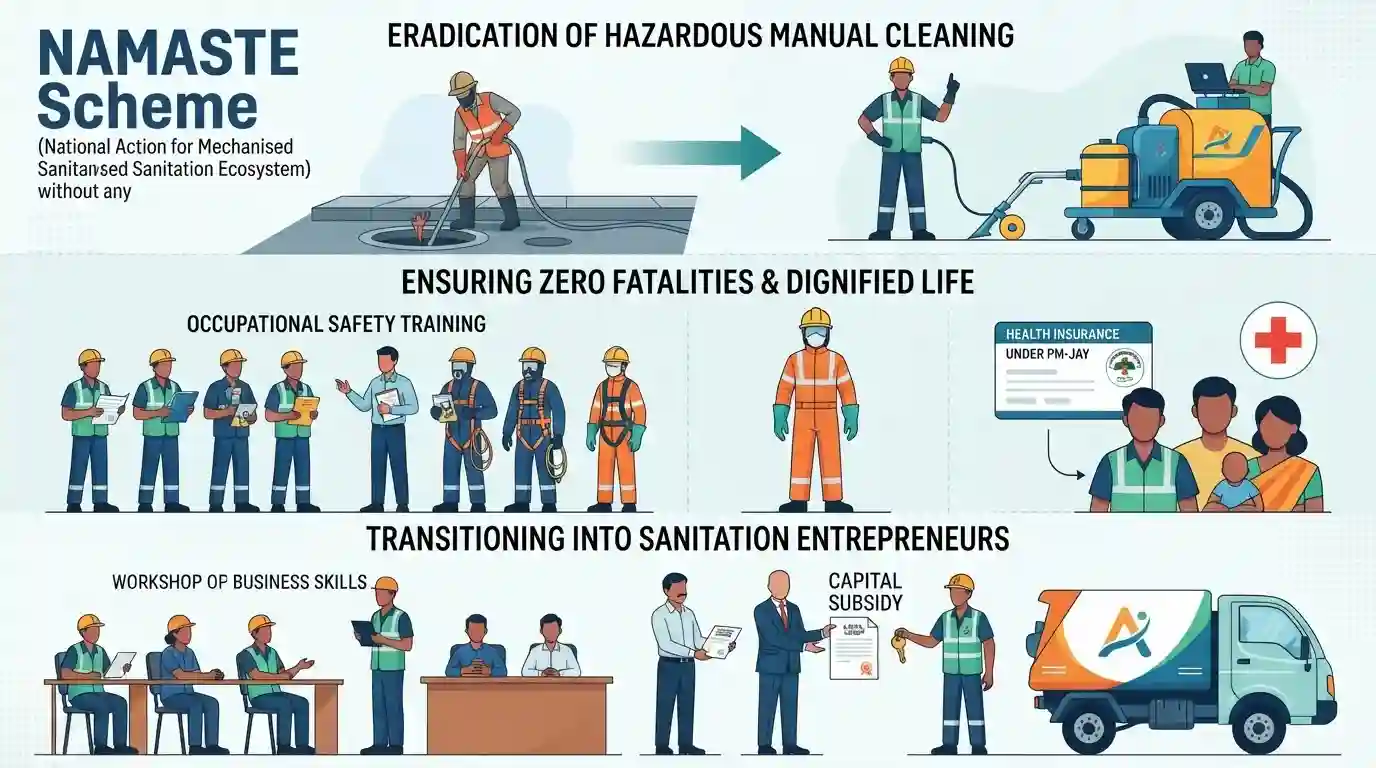
The NAMASTE Scheme (National Action for Mechanised Sanitation Ecosystem) aims to eradicate hazardous manual cleaning of sewers and septic tanks by shifting to 100% mechanised practices. Jointly implemented by the Ministry of Social Justice and Empowerment and the Ministry of Housing and Urban Affairs, the scheme focuses on ensuring zero fatalities and providing a dignified life for sanitation workers. Through occupational safety training, PPE provision, health insurance under PM-JAY, and capital subsidies for equipment ownership, the government intends to formally recognize these workers and transition them into sanitation entrepreneurs, thereby fulfilling its commitment to social justice and the vision of 'Sabka Saath, Sabka Vikas'.
ముఖ్య అంశాలు
- The NAMASTE Scheme is a joint initiative of the Ministry of Social Justice and Empowerment and the Ministry of Housing and Urban Affairs.
- It aims to eliminate hazardous manual cleaning of sewers and septic tanks and achieve zero fatalities in sanitation work.
- The scheme promotes 100% mechanised cleaning and provides capital subsidies to sanitation workers to become entrepreneurs by purchasing cleaning equipment.
- Identified workers receive Occupational Safety Training, Personal Protective Equipment (PPE) kits, Health Insurance under PM-JAY, and health cards.
- Emergency Response Sanitation Units (ERSUs) are being set up to handle sanitation emergencies safely and rapidly.
ముఖ్యమైన పదాలు
NAMASTE Scheme (National Action for Mechanised Sanitation Ecosystem)

A Central Sector Scheme jointly implemented by MoSJE and MoHUA to eradicate manual scavenging, eliminate fatalities in sewer cleaning, promote 100% mechanization, and provide social security and entrepreneurship opportunities to sanitation workers and waste pickers.
UPSC context
GS Paper II: Welfare schemes for vulnerable sections, focusing on social justice, human dignity, and manual scavenging rehabilitation.
Ayushman Bharat - Pradhan Mantri Jan Arogya Yojana (PM-JAY)
The world's largest government-funded health insurance scheme, offering up to ₹5 lakh per family annually for secondary and tertiary hospitalization to over 12 crore poor and vulnerable families, including registered sanitation workers.
UPSC context
GS Paper II: Social sector services relating to Health; tests knowledge of universal health coverage and safety nets.
Ministry of Housing and Urban Affairs (MoHUA)
The Union Ministry responsible for formulating policies, administering schemes, and coordinating urban development, sanitation (including Swachh Bharat Mission-Urban), housing, and urban livelihoods across India.
UPSC context
GS Paper II: Government policies, interventions, and urban governance; tests understanding of municipal administration and urban infrastructure.
Ministry of Social Justice and Empowerment (MoSJE)
The nodal Union Ministry responsible for welfare, social justice, and empowerment of marginalized sections, including Scheduled Castes, OBCs, persons with disabilities, manual scavengers, and elderly citizens.
UPSC context
GS Paper II: Executive and ministries; tests governance, institutional mechanisms for vulnerable sections, and affirmative action policies.
National Safai Karamcharis Finance and Development Corporation (NSKFDC)
A wholly owned Government of India non-profit undertaking under MoSJE, set up in 1997 as the apex body for the socio-economic upliftment, skill-training, and financial rehabilitation of Safai Karamcharis, manual scavengers, and waste pickers.
UPSC context
GS Paper II: Institutions constituted for the protection and betterment of vulnerable sections; tests implementation mechanisms of welfare policies.
ప్రిలిమ్స్ ఉచ్చు
NAMASTE is a Centrally Sponsored Scheme under the exclusive jurisdiction of MoSJE targeting only sewer and septic tank workers.
Aspirants often assume NAMASTE is a Centrally Sponsored Scheme run solely by MoSJE for septic tank workers. In reality, it is a Central Sector Scheme, jointly run by MoSJE and MoHUA, and has been expanded to include waste pickers.
అనుసంధానమైన స్థిర భావనలు
What are the key penal distinctions under the PEMSR Act, 2013?
- Section 8 offence: Prohibits employing manual scavengers; carries up to 1-year imprisonment or fifty thousand rupees fine for first-time offenders.
- Section 9 offence: Prohibits hazardous cleaning of sewers/septic tanks without protective gear; carries a stricter 2-year imprisonment or two lakh rupees fine.
Which constitutional provisions protect sanitation workers from hazardous labor?
- Article 17: Abolishes untouchability, targeting caste-based occupational traps such as forced manual cleaning of human excreta.
- Article 21: Guarantees the right to life with dignity, protecting workers from degrading, life-threatening hazardous labor.
- Article 46: Directs state action to protect weaker sections from social injustice and all forms of exploitation.
అంతర-అంశ నమూనాలు
Judicial Mandates + Executive Welfare Delivery
Supreme Court mandates like Balram Singh (2023) directly alter executive policy, forcing retroactive financial compensation structures and shaping active welfare schemes.
Affirmative Action + Micro-Entrepreneurship
Transitioning manual laborers into mechanized 'Sanipreneurs' reflects a shift from survival-level rehabilitation to asset-backed economic empowerment under Swachhata Udyami Yojana.

Expect questions testing the dual-ministry governance of NAMASTE, its recent expansion to waste pickers, and the PEMSR Act penal hierarchy.
అనుసంధాన PYQలు · 3
అనుసంధాన PYQలు · 3
- 2016PrelimsGS1
'Rashtriya Garima Abhiyaan' is a national campaign to
- 2019MainsGS2
Performance of welfare schemes that are implemented for vulnerable sections is not so effective due to absence of their awareness and active involvement at all stages of policy process. Discuss.
- 2017MainsGS2
To ensure effective implementation of policies addressing water, sanitation and hygiene needs the identification of the beneficiary segments is to be synchronized with the anticipated outcomes." Examine the statement in the context of the WASH scheme.
