West Bengal Law and Order and Internal Security Review
Source:PIB ↗
આ શા માટે મહત્વનું છે
This meeting represents a rare instance of high-level cooperative federal consensus on internal security between the Union and the West Bengal State government. It highlights actionable models for security reforms (such as transforming LWE security camps into civic public service centers, phasing out controversial civic volunteers, and creating state-level SIAs modeled after federal agencies like the NIA) that are directly applicable to GS Paper 3 (Internal Security and Police Reforms) and GS Paper 2 (Federal challenges in maintaining law and order).
સારાંશ
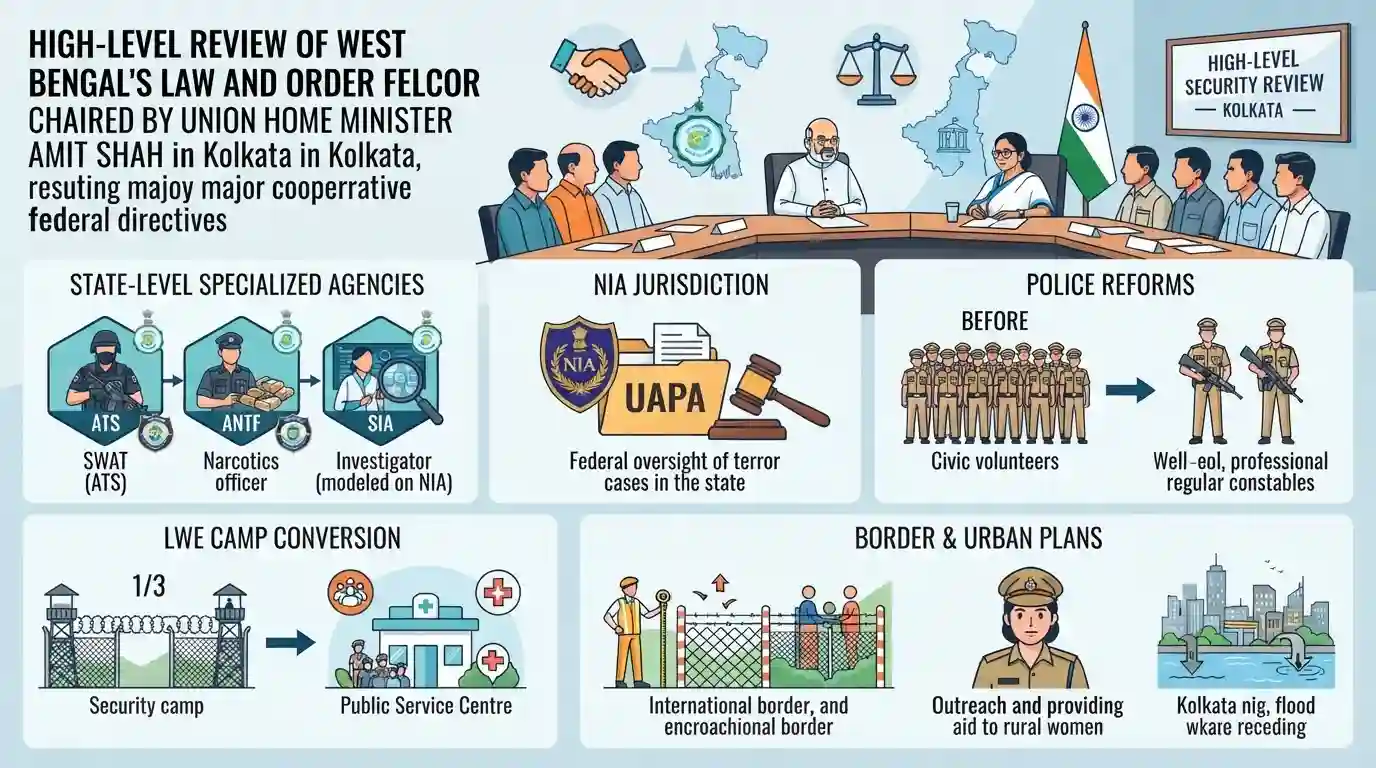
Union Home Minister Amit Shah chaired a high-level review of West Bengal’s law and order situation in Kolkata, resulting in major cooperative federal directives. These include establishing state-level ATS, ANTF, and an SIA (modeled on the NIA); giving the NIA reviewing authority over all UAPA/terror cases in the state; phasing out civic volunteers in favor of regular constables; converting 1/3 of former LWE security camps into Public Service Centres; and formulating dedicated plans for border land encroachments, rural women outreach, and urban flooding in Kolkata.
મુખ્ય મુદ્દા
- Union Home Minister Amit Shah chaired a high-level security and law-and-order review meeting for West Bengal in Kolkata, attended by the state's Chief Minister, Chief Secretary, and senior Union and state officials.
- Directives were issued to establish state-level dedicated bodies: an Anti-Narcotics Task Force (ANTF), an Anti-Terrorist Squad (ATS), and a Special Investigation Agency (SIA) modeled after the Central National Investigation Agency (NIA).
- It was decided that the Central National Investigation Agency (NIA) will conduct a comprehensive review of all active terrorism and UAPA-related cases in West Bengal.
- Major structural police reforms were announced, including phasing out reliance on 'civic volunteers' (replacing them with regular recruited constables), increasing the police-to-population ratio to the national average, rationalizing police districts, and providing federal budgetary support for state police modernization.
- In former Left-Wing Extremism (LWE) affected areas, one-third of the existing security camps will be converted into 'Public Service Centres' to facilitate access to civil government services.
- The Union Home Minister directed the removal of illegal encroachments on government land in border areas, capacity building in cybersecurity, and holding regular NCORD meetings.
- A 'Women Outreach Programme' was mandated to prioritize the safety, awareness, and empowerment of rural women. Furthermore, a comprehensive flood management plan for Kolkata was ordered to address urban flooding.
મહત્વપૂર્ણ શબ્દો
Unlawful Activities (Prevention) Act (UAPA)

India's primary anti-terrorism law aimed at preventing unlawful activities and associations. It empowers the central government to designate individuals and organizations as terrorists, and investigate terror financing.
UPSC context
Core to GS Paper 3 (Internal Security) for topics on anti-terror legislation, state overreach debates, and national security frameworks.
National Investigation Agency (NIA)
India's central counter-terrorism law enforcement agency. It has the mandate to investigate and prosecute federal crimes—including terrorism and UAPA offenses—across states without requiring special permission from state governments.
UPSC context
Important for GS Paper 2 and 3 regarding federalism, Center-State relations, and central agencies' jurisdiction over terror investigations.
Special Investigation Agency (SIA)
A specialized state-level law enforcement agency modeled after the central NIA. It serves as a nodal agency to investigate, prosecute, and coordinate terrorism and UAPA-related crimes at the state level.
UPSC context
Relevant to GS Paper 3 (Internal Security) highlighting state-level capacity building and structural police reforms for counter-terrorism.
Anti-Narcotics Task Force (ANTF)
Dedicated enforcement units established in states and UTs to combat drug syndicates. They function as the local secretariat for NCORD, ensuring targeted actions, intelligence sharing, and compliance in anti-drug operations.
UPSC context
Key for GS Paper 3 (Internal Security) concerning organized crime, narco-terrorism, and inter-agency coordination to combat drug trafficking.
Narco Coordination Centre (NCORD)
A four-tier institutional mechanism under the Ministry of Home Affairs designed to facilitate coordination among central and state agencies to dismantle drug trafficking networks and monitor enforcement actions.
UPSC context
Critical for GS Paper 3 (Internal Security) as part of India's institutional framework for countering drug abuse and border smuggling.
Left-Wing Extremism (LWE)
An armed insurgency by Maoist or Naxalite groups striving to overthrow the state system. The government employs a combined security and development strategy to stabilize and reclaim LWE-affected regions.
UPSC context
A major topic in GS Paper 3 (Internal Security), examining the roots of radicalism and multi-pronged state responses.
પ્રિલિમ્સ ટ્રેપ
The Union Home Ministry holds constitutional authority to directly establish and govern Anti-Terrorist Squads (ATS) within state police departments.
'Police' and 'Public Order' are strictly State subjects (Schedule VII, List II). The Center can advise or fund, but states independently establish and govern their own police squads.
સંલગ્ન સ્થિર ખ્યાલો
What are the NIA's jurisdictional powers regarding state-level terror investigations?
- Scheduled Offenses: Investigates offenses explicitly listed in the NIA Act Schedule, including UAPA, hijacking, and nuclear terrorism.
- Suo Motu Takeovers: The Central Government can direct the NIA to take over state-registered cases without requiring the State Government's consent.
- Special Courts: Prosecutions bypass regular district courts, going directly to designated NIA Special Courts for expedited trials.
What is the structural strategy for post-conflict transition in LWE-affected areas?
- SAMADHAN Doctrine: The comprehensive strategy emphasizing smart leadership, aggressive operations, and development to tackle the root causes of extremism.
- Base Conversion: Converting former security camps (FOBs) into Public Service Centres to deliver welfare, digital services, and governance directly to remote populations.
- Civic Action Programme: Providing direct funds to Central Armed Police Forces (CAPFs) to build trust through local infrastructure, education, and health initiatives.
આંતર-વિષય પેટર્ન
Federal friction in border policing
MHA's law-and-order review in West Bengal mirrors tensions in Punjab over BSF jurisdiction, reflecting how national security mandates frequently strain constitutional federal boundaries.
Internal Security + Urban Flooding
Grouping Kolkata's flood management within a security review highlights how the MHA and NDMA increasingly treat climate-induced urban disasters as critical public order and internal security threats.

Expect a multi-statement Prelims question contrasting NIA's suo motu jurisdiction under UAPA with the State's exclusive policing powers.
સંલગ્ન PYQ · 4
સંલગ્ન PYQ · 4
- 2025MainsGS3
The Government of India recently stated that Left Wing Extremism (LWE) will be eliminated by 2026. What do you understand by LWE and how are the people affected by it? What measures have been taken by the government to eliminate LWE?
- 2019MainsGS3
Indian Government has recently strengthened the anti-terrorism laws by amending the Unlawful Activities (Prevention) Act (UAPA), 1967 and the NIA Act. Analyze the changes in the context of prevailing security environment while discussing the scope and reasons for opposing the UAPA by human rights organizations.
- 2024MainsGS3
Explain how narco-terrorism has emerged as a serious threat across the country. Suggest suitable measures to counter narco-terrorism.
- 2024MainsGS3
Flooding in urban areas is an emerging climate-induced disaster. Discuss the causes of this disaster. Mention the features of two such major floods in the last two decades in India. Describe the policies and frameworks in India that aim at tackling such floods.
