CCPA Action Against Default Service Charges in Restaurants
Source:PIB ↗
ఇది ఎందుకు ముఖ్యం
Demonstrates the practical enforcement of the Consumer Protection Act, 2019 by a statutory body (CCPA) to curb unfair trade practices in the hospitality sector, an important aspect of governance and consumer protection for UPSC GS-II and GS-III.
సారాంశం
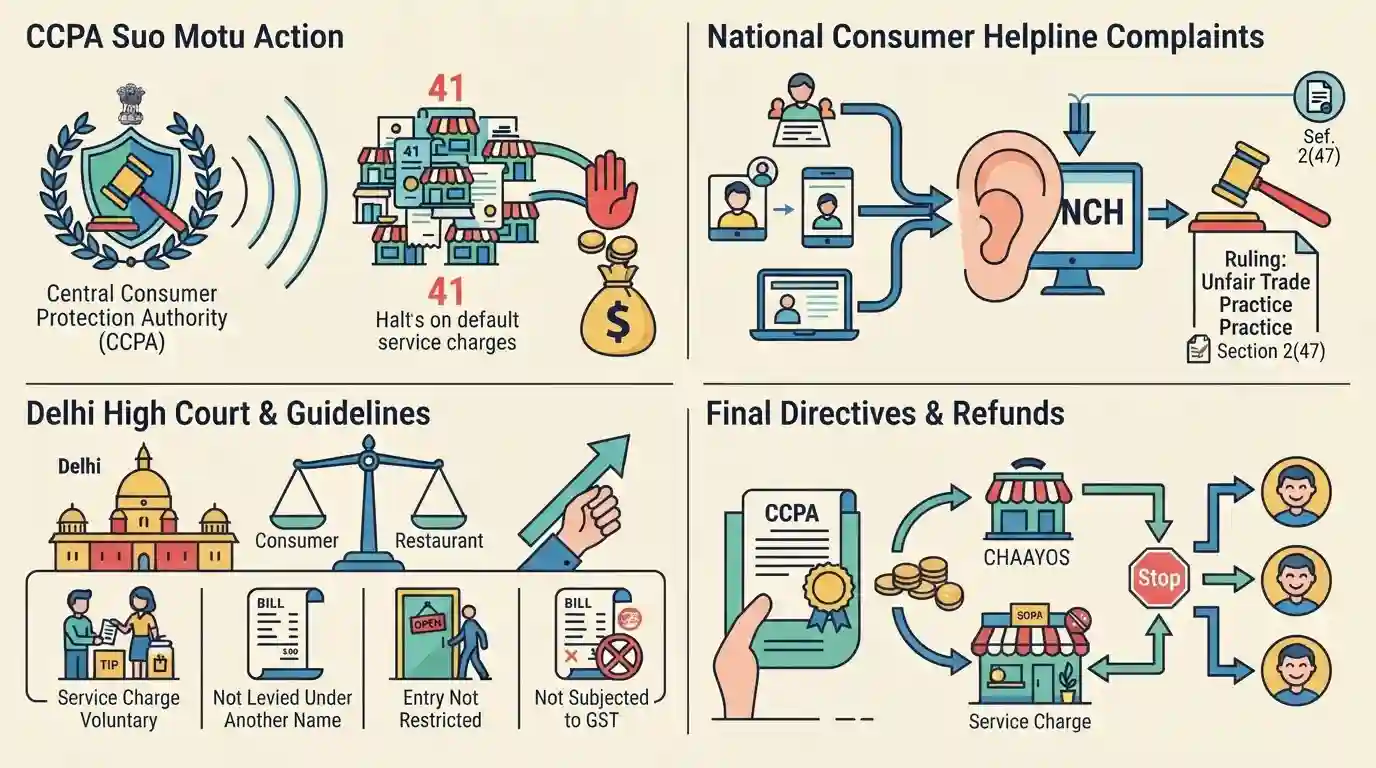
The Central Consumer Protection Authority (CCPA) took suo motu action against 41 restaurants for illegally adding service charges to consumer bills by default. Acting on complaints from the National Consumer Helpline (NCH), the CCPA ruled this an "unfair trade practice" under Section 2(47) of the Consumer Protection Act, 2019. The Delhi High Court supported the CCPA's regulatory guidelines, reinforcing that service charges are strictly voluntary, cannot be levied under another name, must not restrict consumer entry if unpaid, and cannot be subjected to GST. The CCPA has issued final directives to restaurants like Chaayos to refund affected customers and halt automatic service charges.
ముఖ్య అంశాలు
- The CCPA initiated suo motu action against 41 restaurants based on complaints on the National Consumer Helpline regarding automatic levy of service charges.
- Under Section 2(47) of the Consumer Protection Act, 2019, levying a default service charge is considered an unfair trade practice.
- The Delhi High Court upheld the validity of CCPA's Guidelines on Service Charge, affirming that such charges cannot be mandatory.
- According to the guidelines, service charges must be voluntary, cannot be added to the food bill by default, and cannot attract GST.
- CCPA issued final orders directing violators, including prominent chains like Chaayos, to refund consumers and cease the practice.
ముఖ్యమైన పదాలు
Central Consumer Protection Authority (CCPA)

A statutory body established under India's Consumer Protection Act, 2019, to protect and enforce consumer rights, investigate violations, and prevent unfair trade practices.
UPSC context
GS Paper II: Statutory, regulatory and quasi-judicial bodies. Relevant for consumer protection frameworks and regulatory governance.
Consumer Protection Act, 2019
An act of the Parliament of India designed to protect consumer interests, establish regulatory authorities, and provide an effective mechanism for settling consumer disputes.
UPSC context
GS Paper II: Government policies and interventions. It is the primary legal framework for consumer dispute resolution in India.
CCPA Guidelines on Service Charge
Regulatory directives issued in July 2022 that prohibit hotels and restaurants from automatically adding service charges to food bills, making such levies strictly voluntary.
UPSC context
GS Paper II: Regulatory guidelines. Tests awareness of policy measures to curb deceptive pricing and protect consumer choices.
National Consumer Helpline (NCH)
A flagship digital initiative under India's Department of Consumer Affairs that serves as a single portal for pre-litigation grievance redressal, counseling, and dispute resolution.
UPSC context
GS Paper II: Governance and accountability. Important for e-governance initiatives and citizen-centric public grievance redressal systems.
Unfair Trade Practice
Under Section 2(47) of the CPA 2019, any trade practice adopting deceptive or unfair methods to promote the sale, use, or supply of goods and services.
UPSC context
GS Paper II/III: Economic regulation and consumer rights. Tests understanding of legal safeguards against business malpractice.
National Restaurant Association of India (NRAI)
A national trade association representing the interests of the Indian restaurant industry, which legally contested the CCPA's ban on mandatory service charges.
UPSC context
GS Paper III: Indian Economy. Tests understanding of corporate interest groups, business environments, and industry-state interactions.
ప్రిలిమ్స్ ఉచ్చు
The CCPA is a quasi-judicial body under the Ministry of Corporate Affairs established to adjudicate individual consumer disputes.
CCPA is a statutory regulatory body under the Ministry of Consumer Affairs, Food and Public Distribution. Adjudication of individual disputes is done by Consumer Commissions, not the CCPA.
అనుసంధానమైన స్థిర భావనలు
How does the CCPA differ from Consumer Disputes Redressal Commissions (CDRCs)?
- Nature of Body: CCPA is an administrative regulatory authority, whereas CDRCs are quasi-judicial courts established to adjudicate individual complaints.
- Initiation Powers: CCPA can initiate class-action suits, order product recalls, and launch suo motu investigations; CDRCs only adjudicate cases filed before them.
- Inquiry Mechanism: CCPA features a dedicated Investigation Wing headed by a Director-General to conduct inquiries; CDRCs rely on judicial evidence presentation.
అంతర-అంశ నమూనాలు
Consumer Rights & Digital Economy
The expansion of the 2019 Act to cover e-commerce and 'dark patterns' links GS-3 digital economy regulation with GS-2 citizen-centric governance.
Taxation vs. Regulatory Levies
Disputes over applying GST on voluntary service charges highlight the legal friction between indirect fiscal policies and consumer protection guidelines.

The distinction between CCPA's regulatory/suo motu powers and CDRCs' adjudicatory functions is highly likely to be tested in Prelims.
