Parliamentary Consensus Building and Monsoon Session Prep
Source:PIB ↗
ఇది ఎందుకు ముఖ్యం
Understanding the mechanisms that facilitate the smooth functioning of Parliament, such as all-party meetings and the Rules of Procedure, is crucial for assessing legislative productivity, reducing parliamentary disruptions, and ensuring robust executive accountability. This forms a core part of the GS-2 Polity syllabus.
సారాంశం
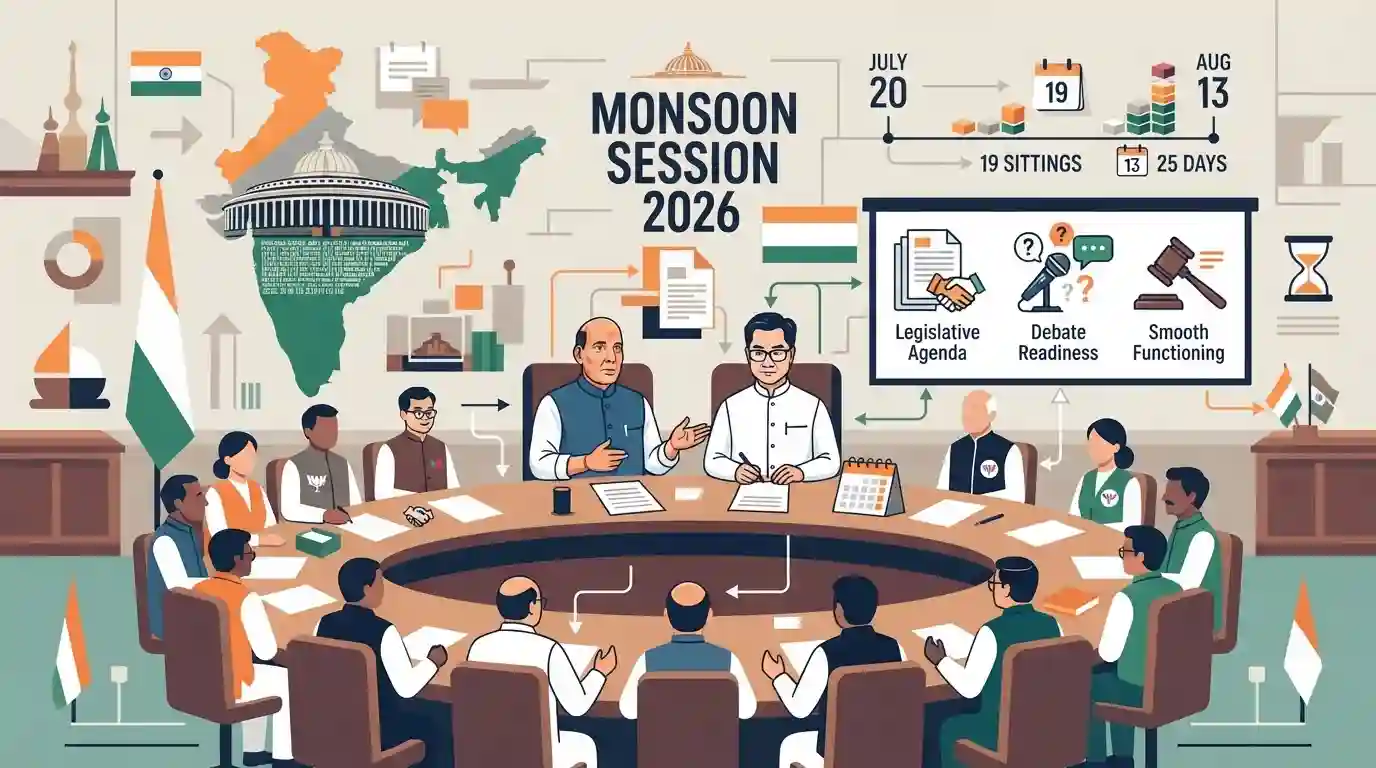
Ahead of the Monsoon Session of Parliament, 2026, the Government of India convened an all-party meeting to seek the constructive cooperation of all political parties for the smooth and productive functioning of both Houses. Chaired by Defence Minister Rajnath Singh and convened by Parliamentary Affairs Minister Kiren Rijiju, the meeting focused on the session's timeline (July 20 to August 13, 2026, spanning 19 sittings over 25 days) and the government's readiness to debate public issues within the framework of parliamentary rules.
ముఖ్య అంశాలు
- The all-party meeting was convened ahead of the Monsoon Session of Parliament, 2026, which is scheduled to run from July 20 to August 13, 2026.
- The upcoming session will consist of 19 sittings spread over a 25-day period.
- The meeting was chaired by Union Defence Minister Rajnath Singh and attended by senior leaders of various political parties represented in Parliament.
- Union Minister of Parliamentary Affairs Kiren Rijiju requested the active and constructive cooperation of all parties to ensure the smooth conduct of legislative and other business.
- The government expressed its commitment to discussing any public issue on the floor of the House as permitted by the Presiding Officers under the Rules of Procedure and Conduct of Business.
- The tentative legislative business has been published in the respective Bulletin Part-II of both the Lok Sabha and Rajya Sabha.
ముఖ్యమైన పదాలు
Rules of Procedure and Conduct of Business in Lok Sabha

The formal set of rules governing the procedure, conduct, and scheduling of legislative and deliberative work within India's Lower House, as authorized under Article 118 of the Constitution.
UPSC context
GS Paper II: Parliament functioning; tests procedural motions, legislative scheduling, and Speaker powers.
Rules of Procedure and Conduct of Business in Rajya Sabha
The regulatory guidelines created under Article 118 of the Constitution to govern parliamentary proceedings, debates, and conduct of members in India's Upper House.
UPSC context
GS Paper II: Functioning of Parliament; tests comparative analysis of parliamentary rules and member conduct.
Ministry of Parliamentary Affairs
The central government ministry managing executive-legislative coordination, scheduling sessions, prioritizing government business, and constituting consultative committees of members of Parliament.
UPSC context
GS Paper II: Executive-legislative relations; tests the executive's role in facilitating legislative business.
Lok Sabha
The Lower House of India’s bicameral Parliament, representing the public through directly elected members and holding key powers over money bills and government confidence.
UPSC context
GS Paper II: Parliament structure; tests composition, special powers, and legislative processes.
Rajya Sabha
The Upper House of India's Parliament, representing states and union territories, functioning as a permanent chamber with crucial role in federal matters.
UPSC context
GS Paper II: Federal structure; tests state representation and bicameral legislative balance.
Parliament of India
The supreme legislative organ of India, consisting of the President, Lok Sabha, and Rajya Sabha, responsible for lawmaking and executive oversight.
UPSC context
GS Paper II: Structure, functioning, and conduct of business of the legislature.
ప్రిలిమ్స్ ఉచ్చు
The Cabinet Committee on Parliamentary Affairs (CCPA) is chaired by the Prime Minister of India.
While the Prime Minister chairs most major Cabinet Committees, the CCPA is traditionally chaired by a senior Cabinet Minister, currently the Minister of Defence.
అనుసంధానమైన స్థిర భావనలు
How is a Parliamentary session summoned under the Constitution?
- Constitutional Mandate: Article 85(1) empowers the President to summon Parliament, ensuring six months do not intervene between sessions. Specific sessions (Monsoon, Winter) are conventional, not constitutional.
- Executive Role: The Cabinet Committee on Parliamentary Affairs (CCPA) decides the session dates, which are then formally approved and issued by the President.
What is the Cabinet Committee on Parliamentary Affairs (CCPA)?
- Constitutional Status: It is an extra-constitutional body established under the Government of India (Transaction of Business) Rules, 1961.
- Unique Chairmanship: Unlike most key cabinet committees chaired by the Prime Minister, the CCPA is headed by a senior Cabinet Minister, traditionally the Defence Minister.
అంతర-అంశ నమూనాలు
Executive discretion in legislative scheduling
The executive's power to determine session dates via the CCPA highlights Westminster executive-dominance, occasionally sparking constitutional debates on legislative independence.
Informal consensus vs formal floor procedure
All-party meetings act as extra-constitutional consensus tools to manage floor disruptions, filling the gap when formal parliamentary mechanisms face persistent gridlock.

Expect a 2026 question contrasting the CCPA's chairmanship and functions with PM-led Cabinet Committees like Security or Economic Affairs.
అనుసంధాన PYQలు · 3
అనుసంధాన PYQలు · 3
- 2020PrelimsGS1
Consider the following statements: 1. The President of India can summon a session of the Parliament at such place as he/she thinks fit. 2. The Constitution of India provides for three sessions of the Parliament in a year, but it is not mandatory to conduct all three sessions. 3. There is no minimum number of days that the Parliament is required to meet in a year. Which of the statements given above is/are correct?
- 2022PrelimsGS1
With reference to Deputy Speaker of Lok Sabha, consider the following statements: 1. As per the Rules of Procedure and Conduct of Business in Lok Sabha, the election of Deputy Speaker shall be held on such date as the Speaker may fix. 2. There is a mandatory provision that the election of a candidate as Deputy Speaker of Lok Sabha shall be from either the principal opposition party or the ruling party. 3. The Deputy Speaker has the same power as of the Speaker when presiding over the sitting of the House and no appeal lies against his rulings. 4. The well established parliamentary practice regarding the appointment of Deputy Speaker is that the motion is moved by the Speaker and duly seconded by the Prime Minister. Which of the statements given above are correct?
- 2023MainsGS2
Discuss the role of Presiding Officers of state legislatures in maintaining order and impartiality in conducting legislative work and in facilitating best democratic practices.
