Preventive Healthcare and Non-Communicable Diseases in India
Source:PIB ↗
Why It Matters
The burden of Non-Communicable Diseases (NCDs) in India is rising and affecting the young workforce, threatening the demographic dividend. Addressing this requires a structural policy shift from curative to preventive public healthcare, which involves expanding indigenous genomic research (Genome India Project), curbing medical misinformation, and fostering public-private partnerships in healthcare. This makes the article highly relevant for issues surrounding health governance (GS2) and applied biotechnology (GS3).
Summary
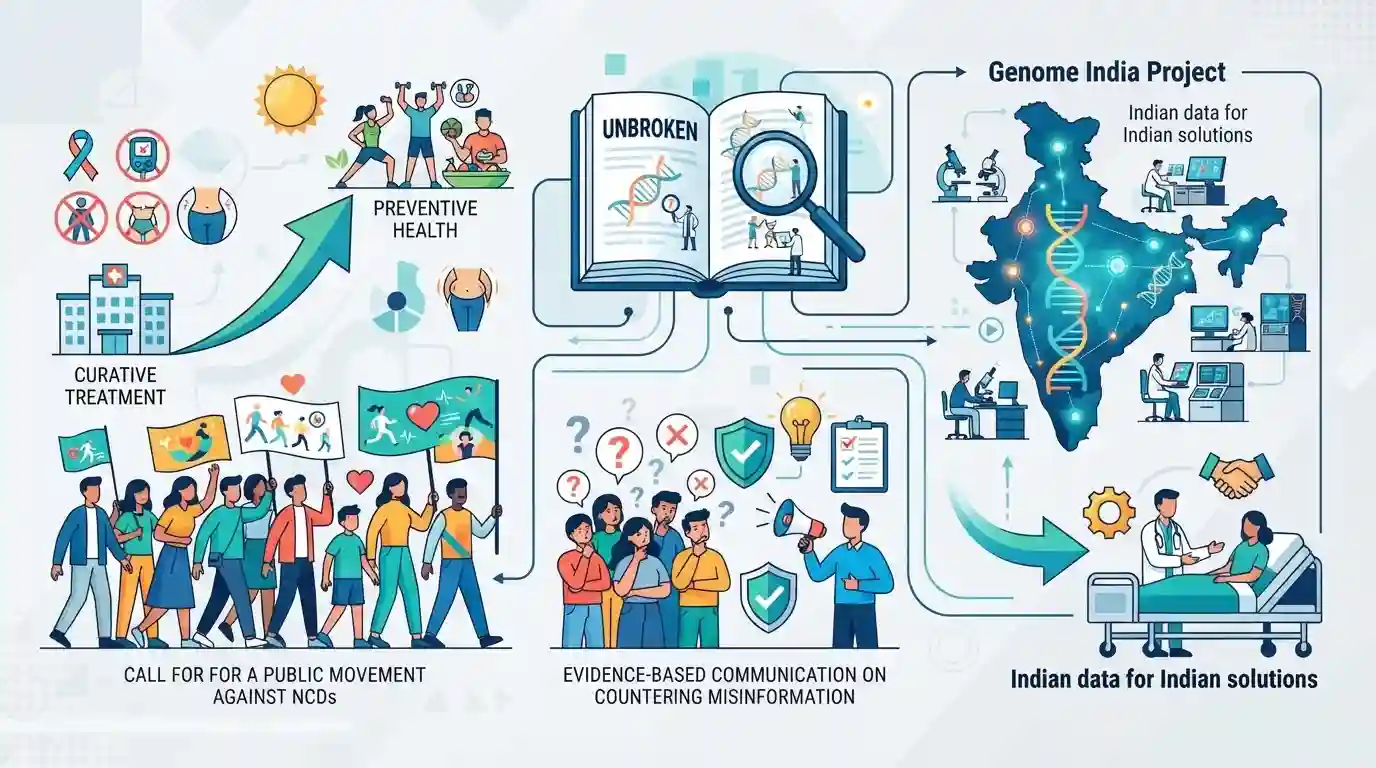
Union Minister Dr. Jitendra Singh has called for a nationwide public movement ('Jan Andolan') against Non-Communicable Diseases (NCDs) like cancer, diabetes, and obesity, shifting India's healthcare focus from curative hospitalization to early detection and preventive health. Speaking at the launch of veteran scientist Dr. Akhilesh Gupta's book, 'UNBROKEN', the Minister highlighted the threat NCDs pose to the younger population. He stressed the importance of evidence-based medical communication to combat health misinformation, championed the concept of 'Indian data for Indian solutions' through genomic initiatives like the Genome India Project, and advocated for stronger public-private partnerships to translate laboratory research into affordable bedside healthcare solutions.
Key Points
- Shift from Hospital-centric to Preventive Healthcare: Dr. Jitendra Singh called for a nationwide Jan Andolan (people's movement) to shift the focus from curative, hospital-centric care to preventive care, early detection, and lifestyle modifications to combat rising lifestyle diseases.
- Threat of NCDs to Demographic Dividend: Non-communicable diseases (NCDs) like cancer, diabetes, obesity, and fatty liver are increasingly targeting the younger, economically productive age group, posing a threat to India's demographic dividend and the 'Viksit Bharat' objective.
- Countering Health Misinformation: Emphasized the urgent need to combat widespread dietary and medical misinformation. The Minister highlighted the critical role of scientific awareness and evidence-based public health communication to prevent delayed medical interventions.
- Indian Data for Indian Solutions: Highlighted the necessity of using native genomic data through the Genome India Project to build tailor-made, affordable diagnostic and therapeutic solutions matching the genetic profiles of the Indian population.
- Public-Private Partnerships (PPP): Called for robust synergy between public research laboratories, clinical academics, and private healthcare industries to translate scientific breakthroughs into scalable, affordable commercial healthcare products.
- Book Launch Context: The address was delivered during the launch of the memoir 'UNBROKEN: My Battle with Cancer and the Will to Lead' written by veteran scientist and former DST Senior Adviser Dr. Akhilesh Gupta, emphasizing mental resilience and scientific temper in health crises.
Important Terms
Genome India Project

A pioneering national gene-mapping initiative funded by the Department of Biotechnology to sequence and catalog 10,000 human genomes from diverse ethnic populations, building a comprehensive Indian reference genome database.
UPSC context
GS Paper III (S&T - Biotechnology), testing knowledge of population genomics, precision medicine, and indigenous scientific data applications.
Ayushman Bharat
India's flagship public healthcare program comprising two components: Ayushman Arogya Mandirs for primary, preventive care, and PM-JAY providing up to ₹5 lakh per family annually for cashless secondary/tertiary hospitalization.
UPSC context
GS Paper II (Social Sector/Services relating to Health), testing policies for universal health coverage, public wellness, and social safety nets.
Department of Biotechnology (DBT)
A nodal department under India's Ministry of Science and Technology, established in 1986, responsible for administering, promoting, and regulating development, research, and commercialization in modern biology and biotechnology.
UPSC context
GS Paper III (S&T), testing institutional frameworks governing biotechnology, bio-economy policies, and national healthcare-related scientific missions.
Department of Science & Technology (DST)
A department within the Ministry of Science and Technology, established in 1971, that serves as India's nodal agency for planning, coordinating, promoting, and funding scientific research, development, and technological infrastructure.
UPSC context
GS Paper III (S&T), evaluating scientific institutional architecture, policy formulation, research funding, and international scientific cooperation in India.
Ministry of Science and Technology
The apex Indian administrative ministry responsible for formulating policies and overseeing scientific progress through its three main constituent departments: Science and Technology (DST), Biotechnology (DBT), and Scientific and Industrial Research (DSIR).
UPSC context
GS Paper II & III (Governance and S&T), testing administrative mechanisms driving national R&D, innovation ecosystems, and scientific human resource development.
Prelims Trap
The '75 by 25' initiative aims to reduce India's premature mortality from non-communicable diseases by 75% by 2025.
It actually aims to place 75 million patients with hypertension/diabetes on standard care. The 25% premature mortality reduction target is from National Health Policy 2017.
Static Concepts Connected
What is the Genome India Project (GIP)?
- Nodal Agency: Initiative under the Department of Biotechnology (DBT), Ministry of Science and Technology.
- Target Achieved: Completed whole-genome sequencing of 10,000 individuals across 83 diverse socio-ethnic groups to map genetic diversity.
- Key Repository: Data is housed at the Indian Biological Data Centre (IBDC) in Faridabad, Haryana, using supercomputer 'Brahm'.
What is India's revamped NP-NCD program?
- Scope Expansion: Renamed from NPCDCS in 2023 to integrate chronic kidney disease, COPD, and Non-Alcoholic Fatty Liver Disease (NAFLD).
- Implementation: Operates under the National Health Mission (NHM) focusing on early screening, infrastructure mapping, and health promotion.
Cross-Topic Patterns
Genomic Data Sovereignty and Healthcare
Indian biological data sharing under BIOTECH-PRIDE guidelines secures native genomic data at IBDC Faridabad, preventing biopiracy and promoting localized drug formulation.
NCDs and Demographic Dividend
The rising incidence of early-onset NCDs among India's youth risks shifting the demographic dividend into a demographic liability due to lost productivity and catastrophic health expenditure.

Genome India's sequencing milestones (IBDC repository) combined with '75 by 25' clinical targets will likely be tested in a single 2026 MCQ.
Linked PYQs · 3
Linked PYQs · 3
- 2024MainsGS2
In a crucial domain like the public healthcare system the Indian State should play a vital role to contain the adverse impact of marketisation of the system. Suggest some measures through which the State can enhance the reach of public healthcare at the grassroots level.
- 2026PrelimsGS1
Which of the following statements with regard to GenomeIndia Project is/are correct ? 1. It is a part of the Human Genome Project. 2. The project is funded by the Department of Biotechnology (DBT), Government of India. 3. Its primary aim is to build a catalogue of genetic diversity of the Indian population. Select the answer using the code given below :
- 2021MainsGS3
What are the research and developmental achievements in applied biotechnology? How will these achievements help to uplift the poorer sections of the society?
