Odisha Coastal Highway and Disaster Resilience
Source:PIB ↗
આ શા માટે મહત્વનું છે
It provides an excellent case study for Mains answers on how infrastructure projects (like Bharatmala) must balance economic objectives (tourism and trade) with disaster preparedness and environmental sustainability.
સારાંશ
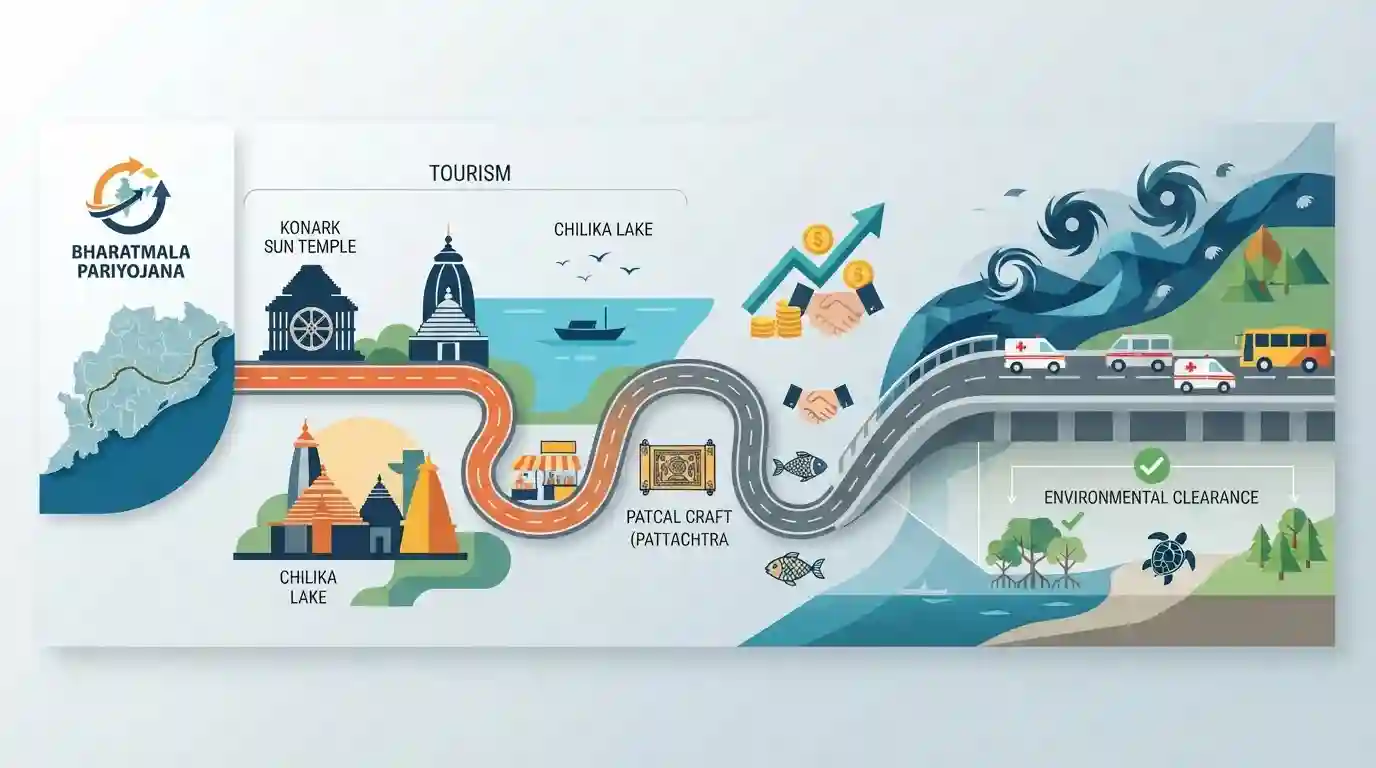
The article outlines the multifaceted significance of Odisha’s new Coastal Highway project, envisioned under the Bharatmala Pariyojana. Designed to stretch along the state's expansive coastline, the highway is poised to revolutionize both spiritual and coastal tourism by connecting major hubs like Puri, Konark, and Chilika Lake. This improved connectivity is expected to act as a significant economic multiplier for the region. Additionally, the project is framed as vital infrastructure for disaster resilience, offering a reliable evacuation and relief route during frequent tropical cyclones, while navigating the complexities of environmental clearances in ecologically sensitive coastal zones.
મુખ્ય મુદ્દા
- Odisha's New Coastal Highway is a major infrastructure initiative planned under the Bharatmala Pariyojana to enhance connectivity along the eastern coastline.
- The highway serves as a catalyst for cultural and spiritual tourism, seamlessly connecting major heritage sites like the Jagannath Temple in Puri and the Sun Temple in Konark.
- It aims to drive a 'coastal tourism revolution' by unlocking the economic potential of scenic spots such as Chilika Lake, thereby generating regional employment.
- Beyond economics, the all-weather road provides a critical lifeline for disaster management, facilitating faster evacuation and relief operations in Odisha's highly cyclone-prone coastal belt.
- The project underscores the ongoing challenge of balancing large-scale infrastructure development with environmental conservation, necessitating careful alignment near sensitive ecological zones.
મહત્વપૂર્ણ શબ્દો
Bharatmala Pariyojana

A mega highway development program by the Government of India to optimize passenger and freight movement by bridging critical infrastructure gaps through economic corridors and coastal connectivity.
UPSC context
GS Paper III: Infrastructure. Tests knowledge of national connectivity programs and their socio-economic and regional developmental impacts.
Ministry of Road Transport and Highways (MoRTH)
The apex Indian government ministry responsible for drafting and administering laws, policies, and plans related to road transport, national highways, and transport research.
UPSC context
GS Paper II: Government Ministries. Tests institutional roles and policy formulation for infrastructure and public works.
Coastal Regulation Zone (CRZ)
Coastal areas of seas, bays, and estuaries regulated under the Environment Protection Act, 1986, to restrict developmental activities and preserve fragile coastal ecosystems.
UPSC context
GS Paper III: Environment. Tests understanding of ecological conservation frameworks, zoning, and coastal development regulations.
Environment Impact Assessment (EIA)
A statutory process evaluating the potential environmental, social, and ecological impacts of proposed projects before granting government development clearances.
UPSC context
GS Paper III: Environmental Impact Assessment. Tests understanding of processes balancing economic growth with sustainable ecological conservation.
National Highways Authority of India (NHAI)
An autonomous statutory authority constituted in 1988, responsible for the development, maintenance, and management of India’s national highways network.
UPSC context
GS Paper III: Infrastructure. Tests institutional frameworks responsible for executing major national transport and logistics projects.
પ્રિલિમ્સ ટ્રેપ
The Odisha State Disaster Management Authority was established under the mandate of the Disaster Management Act, 2005.
Aspirants often assume all state disaster management authorities (SDMAs) were set up after the Disaster Management Act, 2005. In reality, OSDMA was created in 1999.
સંલગ્ન સ્થિર ખ્યાલો
What are the core structural features of Kalinga-style temple architecture?
- Three main orders: Divided into Rekha Deula (curvilinear sanctum), Pidha Deula (pyramidal assembly hall), and Khakhara Deula (barrel-roofed temple).
- Structural components: Comprises the main sanctum (Deula), the assembly hall (Jagamohana), festive hall (Natamandira), and offering hall (Bhoga-mandapa).
- Nagara sub-style: Represents a unique regional school of the northern Nagara style, featuring lavish outer carvings but plain inner walls.
What is the structural evolution and mandate of India's disaster management authorities?
- OSDMA pioneering role: Established in 1999 post-Super Cyclone, OSDMA was India's first state-level dedicated disaster management authority, pre-dating the central NDMA.
- NDMA legislative basis: The National Disaster Management Authority (NDMA) was formally established under the Disaster Management Act of 2005, chaired by the Prime Minister.
આંતર-વિષય પેટર્ન
Infrastructure vs Coastal Blue Economy
NH 316A highlights the friction between expanding trade corridors and protecting fragile Ramsar wetlands like Chilika Lake under CRZ guidelines.
Disaster governance and Sendai Framework
Utilizing climate-resilient roads for emergency evacuation demonstrates localized climate adaptation, aligning with global disaster risk reduction goals.

Mains 2026 may evaluate how linear infrastructure projects like NH 316A balance Kalinga heritage tourism with CRZ environmental clearances.
સંલગ્ન PYQ · 4
સંલગ્ન PYQ · 4
- 2021MainsGS3
“Investment in infrastructure is essential for more rapid and inclusive economic growth.” Discuss in the light of India's experience.
- 2023PrelimsGS1
With reference to India's projects on connectivity, consider the following statements: 1. East-West Corridor under Golden Quadrilateral Project connects Dibrugarh and Surat. 2. Trilateral Highway connects Moreh in Manipur and Chiang Mai in Thailand via Myanmar. 3. Bangladesh-China-India-Myanmar Economic Corridor connects Varanasi in Uttar Pradesh with Kunming in China. How many of the above statements are correct?
- 2024MainsGS3
What role do environmental NGOs and activists play in influencing Environmental Impact Assessment (EIA) outcomes for major projects in India? Cite four examples with all important details.
- 2017PrelimsGS1
Which of the following is/are famous for Sun temples? 1. Arasavalli 2. Amarakantak 3. Omkareshwar Select the correct answer using the code given below:
