APEDA Facilitates Jammu and Kashmir Cherry Export to Singapore
Source:PIB ↗
কেন এটি গুরুত্বপূর্ণ
This development provides a concrete case study for Mains GS3 on how supply chain management, post-harvest logistics, and export promotion agencies like APEDA can overcome geographical bottlenecks (e.g., in J&K) to boost farmers' income and integrate Indian horticulture into global markets.
সারসংক্ষেপ
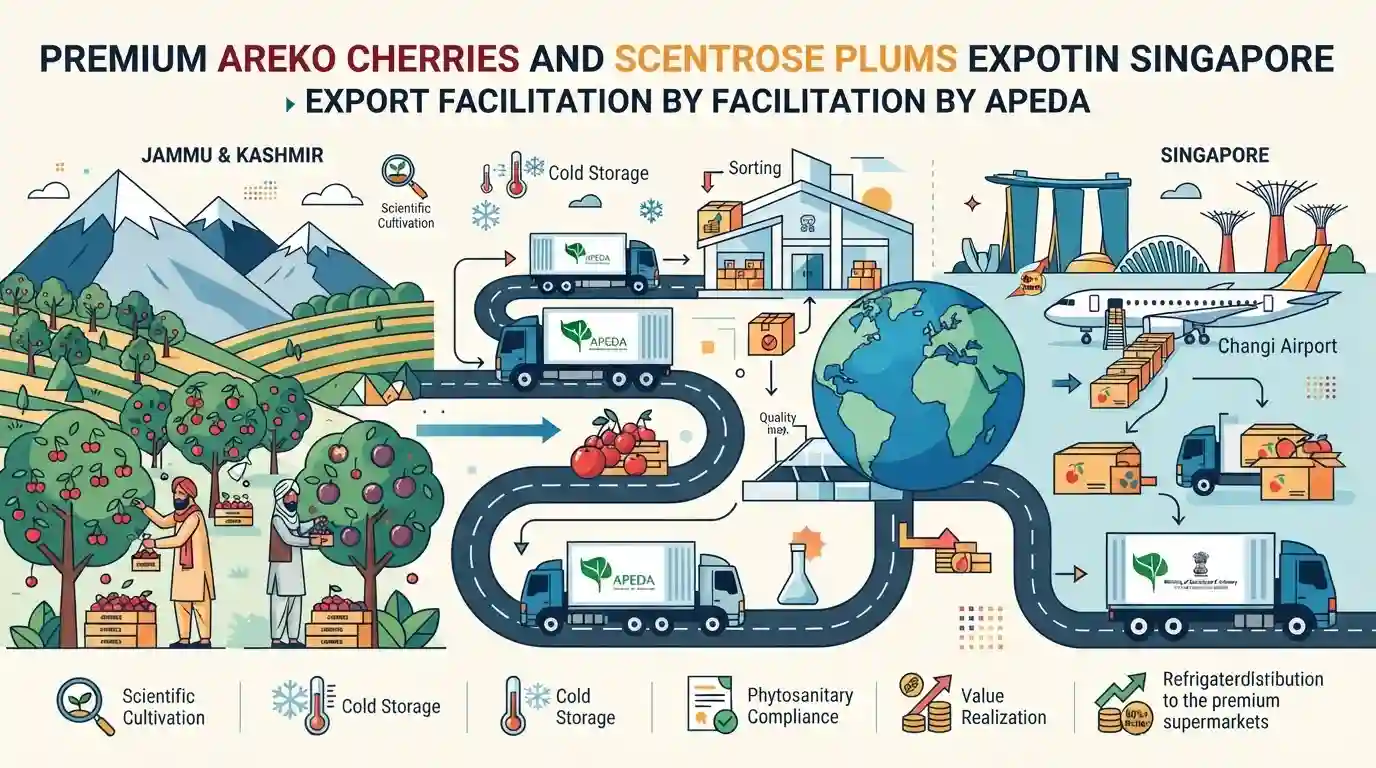
The Agricultural and Processed Food Products Export Development Authority (APEDA), under the Ministry of Commerce & Industry, has successfully facilitated the first export shipment of premium Areko Cherries and Scentrose Plums from Jammu & Kashmir to Singapore. Sourced from the Shopian and Pulwama districts, this milestone highlights ongoing efforts to integrate regional horticulture into premium global supply chains. By focusing on scientific cultivation, robust post-harvest management, and stringent phytosanitary compliance, the initiative has enabled growers to achieve significantly higher value realization—reportedly over 50% better returns. This export not only provides sustainable livelihoods for farmers but also establishes a reliable template for downstream agricultural marketing and supply chain enhancement in geographically challenging regions.
মূল বিষয়
- APEDA facilitated the first-ever export of premium Areko Cherries and Scentrose Plums from Jammu & Kashmir to Singapore.
- The fruits were sourced from the Shopian and Pulwama districts of J&K, representing a significant milestone in accessing premium global markets.
- This initiative is part of broader efforts to promote export-oriented agricultural production and encourage the adoption of scientific cultivation methods among growers.
- Robust post-harvest management and strict adherence to phytosanitary standards were crucial to the export's success, leading to over 50% higher returns for local farmers.
- The export builds on earlier successful shipments of horticultural products from the region to Middle Eastern destinations such as the UAE.
গুরুত্বপূর্ণ শব্দ
APEDA

A statutory body under the Ministry of Commerce & Industry, responsible for promoting the export of scheduled agricultural and processed food products through financial assistance, standard-setting, and market development.
UPSC context
Crucial for GS Paper 3 (Agriculture/Economy) regarding export promotion, agricultural marketing, and enhancing farmers' income.
Ministry of Commerce & Industry
The nodal government ministry formulating and implementing policies for foreign trade, industrial development, and investment. It oversees bodies like APEDA to facilitate India's integration into global agricultural supply chains.
UPSC context
Important for GS Paper 3 (Economy) concerning trade policy, export-led growth, and non-tariff measures in global trade.
Phytosanitary Compliance
Strict adherence to international plant health and food safety regulations. It ensures agricultural exports are free from pests and diseases, preventing trade rejections due to non-tariff barriers.
UPSC context
Relevant to GS Paper 3 (Agriculture), specifically addressing export bottlenecks, WTO-SPS agreements, and standardizing Indian produce globally.
Post-harvest Management
Scientific techniques applied after crop harvesting—such as grading, sorting, cold-chain storage, and specialized packaging—to prevent spoilage, extend shelf life, and maintain premium quality.
UPSC context
Central to GS Paper 3 (Food Processing & Supply Chain), addressing post-harvest losses, infrastructure gaps, and value addition.
Areko Cherries & Scentrose Plums
Premium, high-density temperate fruit varieties grown in Jammu & Kashmir. Their successful export signifies the global potential of regionally specialized, scientifically cultivated horticulture.
UPSC context
Fits GS Paper 3 (Major Crops/Cropping Patterns), highlighting high-value agriculture and the diversification of farmers' income sources.
প্রিলিমস ফাঁদ
APEDA is a statutory body functioning under the administrative control of the Ministry of Agriculture and Farmers Welfare.
Candidates frequently mistake APEDA's parent ministry due to the word 'Agricultural'; it actually operates under the Ministry of Commerce and Industry.
সংযুক্ত স্থির ধারণা
What is APEDA's mandate and statutory origin?
- Statutory Origin: Established under the APEDA Act, 1985, functioning under the Ministry of Commerce and Industry.
- Core Mandate: Promotes and develops export of scheduled products, including fruits, vegetables, meat, and processed foods.
- Organic Standards: Acts as the secretariat for the National Programme for Organic Production (NPOP) in India.
What is the WTO Sanitary and Phytosanitary Agreement?
- Core Objective: Protects human, animal, or plant life from risks associated with pests, diseases, or food additives.
- Scientific Basis: Requires trade-restrictive measures to be scientifically justified, preventing them from becoming disguised non-tariff barriers.
- National Alignment: India aligns its export quality via bodies like APEDA to meet stringent global biosecurity standards.
আন্তঃবিষয় প্যাটার্ন
Agri-exports + Act East Policy
Exporting J&K’s premium horticulture to Singapore demonstrates how integrating regional supply chains directly advances India's trade and strategic linkages with ASEAN nations.
Cold chains + Farmer Income
Perishable fruit exports highlight how advanced post-harvest logistics (like CA storage) bypass traditional middleman bottlenecks, directly addressing GS3 farm marketing and income-doubling objectives.

APEDA's statutory mandate, its administrative ministry, and SPS standards under WTO are highly likely to feature in a 2026 Prelims MCQ.
সংযুক্ত PYQ · 5
সংযুক্ত PYQ · 5
- 2025MainsGS3
Elaborate the scope and significance of supply chain management of agricultural commodities in India.
- 2023MainsGS3
How does e-Technology help farmers in production and marketing of agricultural produce? Explain it.
- 2022MainsGS3
What are the main bottlenecks in upstream and downstream process of marketing of agricultural products in India?
- 2018PrelimsGS1
With reference to organic farming in India, consider the following statements: 1. 'The National Programme for Organic Production' (NPOP) is operated under the guidelines and directions of the Union Ministry of Rural Development. 2. 'The Agricultural and Processed Food Products Export Development Authority' (APEDA) functions as the Secretariat for the implementation of NPOP. 3. Sikkim has become India's first fully organic State. Which of the statements given above is/are correct?
- 2020MainsGS3
What are the challenges and opportunities of food processing sector in the country? How can income of the farmers be substantially increased by encouraging food processing?
