National Health Authority Charts Roadmap for AB PM JAY
Source:PIB ↗
Why It Matters
The article highlights India's transition from the foundational rollout of public health insurance to advanced optimization utilizing Digital Public Infrastructure (DPI) and Artificial Intelligence. For UPSC candidates, it offers real-world examples of how technologies like NHCX and AI are solving structural bottlenecks in healthcare delivery, how cooperative federalism is leveraged through inter-state peer learning, and why the ethical balance between technological efficiency and data privacy remains critical.
Summary
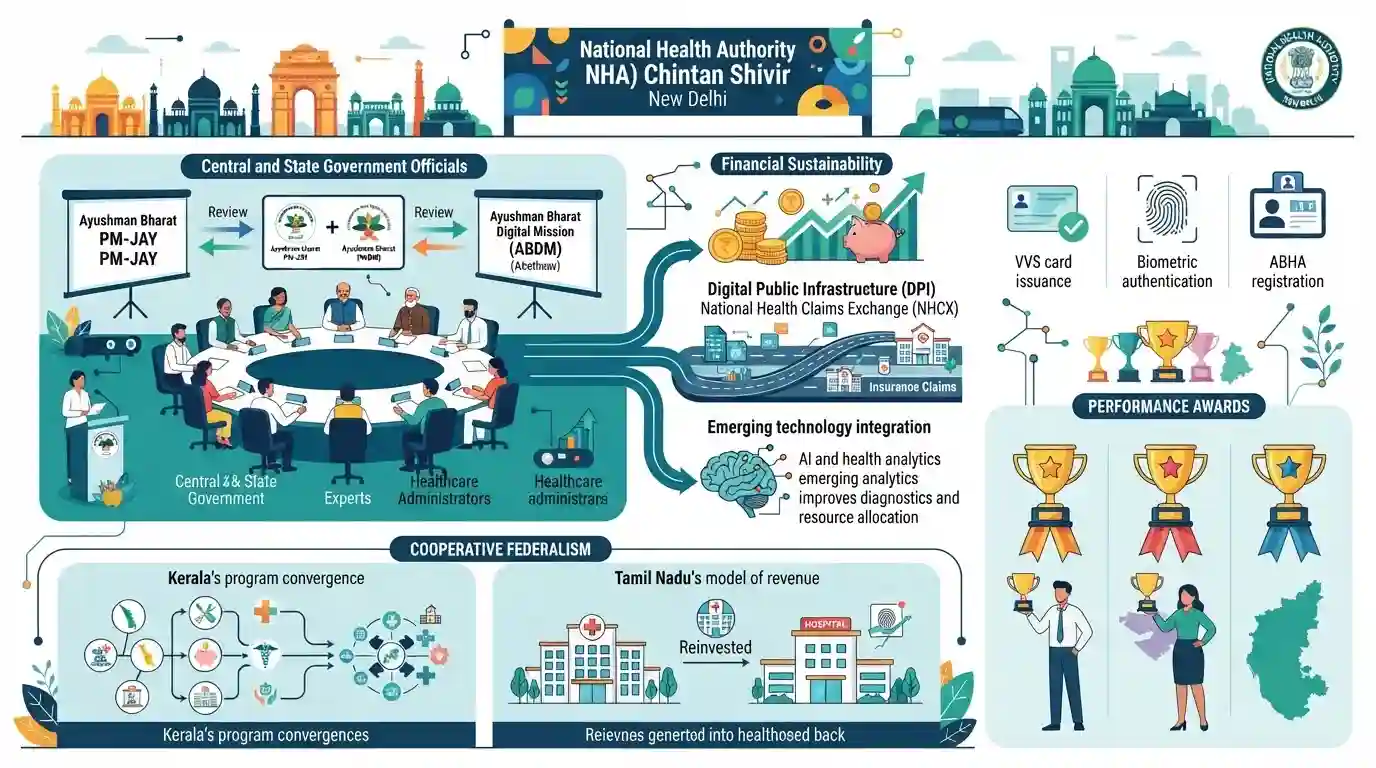
The National Health Authority (NHA) hosted a two-day Chintan Shivir (National Review Meeting) in New Delhi to review the progress of Ayushman Bharat PM-JAY and the Ayushman Bharat Digital Mission (ABDM). The meeting chartered the roadmap for future healthcare reforms, focusing on financial sustainability, digital public infrastructure (DPI) like the National Health Claims Exchange (NHCX), and integrating emerging tech like AI and health analytics into the public health sector. It showcased cooperative federalism through inter-state sharing of best practices (such as Kerala's program convergence and Tamil Nadu's claim revenue reinvestment model) and presented performance awards to various states for VVS card issuance, biometric authentication, and ABHA registration.
Key Points
- The National Health Authority (NHA) concluded a two-day National Review Meeting (Chintan Shivir) on July 17-18, 2026, in New Delhi to coordinate the next phase of reforms for AB PM-JAY and ABDM.
- Financial Sustainability & Convergence: Peer learning highlighted state-level successes, such as Kerala's convergence of state health protection programs with AB PM-JAY, and Tamil Nadu's CMCHIS model where claim revenues are systematically reinvested into strengthening public hospital infrastructure.
- National Health Claims Exchange (NHCX): Highlighted as an interoperable digital gateway to streamline claim settlements and improve cash flows for empanelled hospitals without prolonged waiting times for State Health Agency reimbursements.
- AI and Health Analytics: The NHA’s Health Analytics and AI Unit demonstrated data-driven frameworks tracking beneficiary portability and hospital utilization. AI developers (Sarvam AI) demonstrated clinical decision support tools, emphasizing the need for responsible, safe, and scalable deployment of AI in public healthcare.
- Digital Medical Education: The National Medical Commission (NMC) is actively driving ABDM integration by standardizing Hospital Management Information Systems (HMIS), expanding ABHA-linked health records, and developing an assessment dashboard for medical colleges.
- Data Governance & Trust: Smt. Punya Salila Srivastava (Union Health Secretary) emphasized that wider public adoption of digital healthcare platforms relies fundamentally on data privacy, robust cybersecurity, and the ethical use of patient data.
- Awards for Excellence: States were recognized for performance; e.g., Andhra Pradesh, Sikkim, and Lakshadweep won for highest VVS Cards per lakh population, while Uttar Pradesh excelled in ABHA creation and 'Scan and Pay' services.
Important Terms
Ayushman Bharat Pradhan Mantri Jan Arogya Yojana (AB PM-JAY)

A flagship centrally sponsored health assurance scheme that provides cashless secondary and tertiary hospitalization cover of ₹5 lakh per family annually to poor and vulnerable sections of India's population.
UPSC context
GS Paper II (Social Sector/Health, Governance). Tests understanding of flagship welfare schemes, universal health coverage, and out-of-pocket expenditure mitigation.
Ayushman Bharat Digital Mission (ABDM)
A national digital public infrastructure initiative designed to establish an integrated, interoperable digital health ecosystem in India, connecting patients, doctors, hospitals, labs, and health insurers securely.
UPSC context
GS Paper II & III (Governance, Science & Technology). Evaluates digital public infrastructure (DPI), e-governance, and tech-driven healthcare delivery.
National Health Claims Exchange (NHCX)
A standardized digital gateway developed by the NHA that securely routes health insurance claim information between healthcare providers and payers, facilitating faster, transparent, and paperless claim settlements.
UPSC context
GS Paper II & III (Health Governance, Digital Infrastructure). Assesses digital innovations in insurance, streamlining e-governance, and reducing out-of-pocket medical costs.
Ayushman Bharat Health Account (ABHA)
A unique 14-digit digital health identification number created under ABDM that securely links, stores, and enables consent-based sharing of an individual's digital health records across participating healthcare providers.
UPSC context
GS Paper II & III (Digital Governance, Health). Relevant for questions on patient-centric data systems, digital identity, and health data privacy.
National Health Authority (NHA)
The autonomous apex body under the Ministry of Health and Family Welfare responsible for implementing India's flagship health protection scheme (AB PM-JAY) and the digital health mission (ABDM).
UPSC context
GS Paper II (Health Governance / Statutory & Autonomous Bodies). Tests understanding of institutional mechanisms driving health policy and e-health strategy execution.
State Health Agencies (SHAs)
Autonomous state-level bodies established as societies or trusts to oversee and implement the Ayushman Bharat PM-JAY scheme with full operational and financial autonomy within their respective states.
UPSC context
GS Paper II (Cooperative Federalism, Health Governance). Tests decentralized implementation of national welfare schemes and the role of subnational entities.
Chief Minister's Comprehensive Health Insurance Scheme (CMCHIS)
A flagship, state-sponsored health insurance scheme of Tamil Nadu that provides cashless hospitalization coverage up to ₹5 lakh per year to low-income families, linked with the central PM-JAY scheme.
UPSC context
GS Paper II (Social Justice, Federalism). Evaluates state-level health schemes, program convergence, and fiscal reinvestment models in public healthcare.
Prelims Trap
The National Health Claims Exchange (NHCX) acts as a centralized database repository that permanently stores patients' clinical and insurance claim records.
NHCX is a digital router, not a repository. It securely exchanges data using HL7 FHIR standards without storing clinical or financial payloads, which remain encrypted end-to-end.
Static Concepts Connected
What is the structural and functional mandate of the National Health Authority (NHA)?
- Institutional Status: An attached office of MoHFW with full functional autonomy, reconstituted in 2019 from the predecessor registered society.
- Governance Structure: Governed by a Board chaired by the Union Minister of Health and Family Welfare, ensuring representation from states and key ministries.
- Apex Mandate: Responsible for designing, implementing, and running India's primary health-welfare architectures: AB PM-JAY and Ayushman Bharat Digital Mission (ABDM).
What are the core components of India’s Health Digital Public Infrastructure (DPI)?
- ABHA ID: A voluntary 14-digit identifier establishing a unified identity to enable consent-based, seamless digital health record portability across various providers.
- HFR and HPR Registries: Verified national registries for modern and traditional healthcare professionals and facilities, ensuring ecosystem-wide trust.
- NHCX Gateway: An open-specification digital gateway designed to route encrypted claim payloads between insurers and hospitals without storing patient clinical data.
Cross-Topic Patterns
Cooperative Federalism in Welfare Schemes
AB PM-JAY's success relies on state-level customization, like Kerala's program convergence, balancing regional administrative autonomy with standardized national digital health protocols.
Emerging Tech and DPDP Compliance
Integrating clinical decision-making AI in public healthcare tests the enforcement of the DPDP Act, demanding robust anonymization, strict data minimization, and user-consent frameworks.

Expect multi-statement questions testing the operational limits of ABDM (voluntary ABHA) and the functional architecture of NHCX in 2026.
Linked PYQs · 3
Linked PYQs · 3
- 2024MainsGS2
In a crucial domain like the public healthcare system the Indian State should play a vital role to contain the adverse impact of marketisation of the system. Suggest some measures through which the State can enhance the reach of public healthcare at the grassroots level.
- 2023MainsGS3
Introduce the concept of Artificial Intelligence (AI). How does Al help clinical diagnosis? Do you perceive any threat to privacy of the individual in the use of Al in healthcare?
- 2022PrelimsGS1
With reference to Ayushman Bharat Digital Mission, consider the following statements: 1. Private and public hospitals must adopt it. 2. As it aims to achieve universal health coverage, every citizen of India should be part of it ultimately. 3. It has seamless portability across the country. Which of the statements given above is/are correct?
