Aadhaar Mobile Application Crosses Forty Million Downloads
Source:PIB ↗
આ શા માટે મહત્વનું છે
This development highlights how citizen-centric e-governance tools are empowering users with direct control over their personal data. Features like biometric locking illustrate practical implementations of the Right to Privacy (Article 21) in Digital Public Infrastructure (DPI), showing a shift towards decentralized security options in India's digital governance ecosystem.
સારાંશ
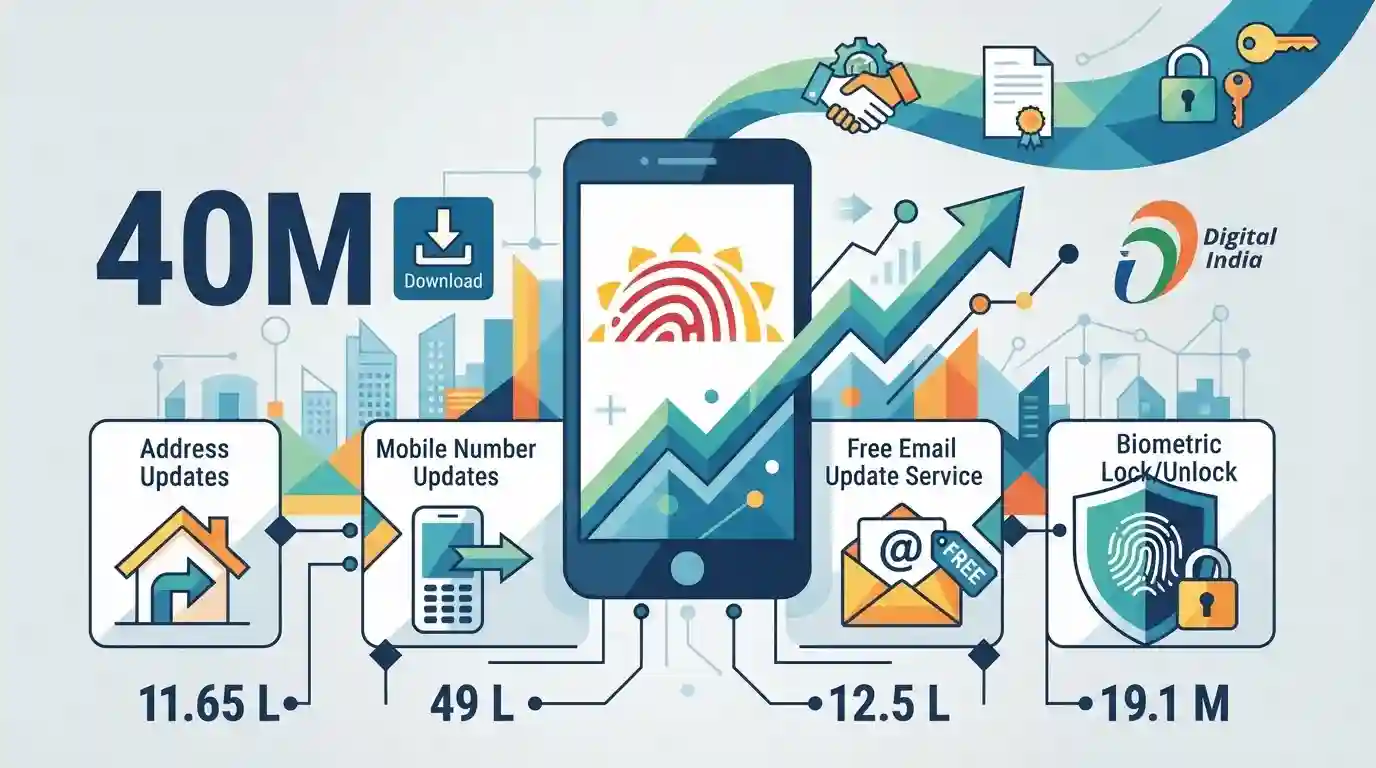
The Aadhaar mobile application reached a major milestone of 40 million downloads, indicating its success as a one-stop digital platform for identity-related services. Key features utilized by residents include address updates (11.65 lakh), mobile number updates (49 lakh), and a newly made free email update service (12.5 lakh updates). Importantly, the biometric lock/unlock feature was used over 19.1 million times, showing high awareness and use of privacy protections. This app demonstrates the interactive service model of e-governance and advances India's Digital Public Infrastructure (DPI) under the Digital India Mission.
મુખ્ય મુદ્દા
- The Aadhaar App (mAadhaar) crossed a significant milestone of 40 million (4 crore) downloads, reflecting high user adoption of digital identity services.
- Demographic updates saw massive citizen engagement, with 11.65 lakh address updates and nearly 49 lakh mobile number updates carried out directly through the app.
- The newly launched email update feature (introduced on July 1, 2026) enabled 12.5 lakh updates; UIDAI made this service free of charge on the app until December 31, 2026 (previously priced at ₹75).
- To safeguard user privacy, the Biometric Lock/Unlock feature was used over 19.1 million times, allowing users to prevent unauthorized access to their fingerprints or iris scans instantly.
- The Aadhaar App acts as a prime component of India's Digital Public Infrastructure (DPI), contributing to 'ease of living' and aligning with the 'Digital India Mission for a Viksit Bharat'.
મહત્વપૂર્ણ શબ્દો
Digital India Mission

A flagship program launched in 2015 to transform India into a digitally empowered society and knowledge economy by expanding digital infrastructure, literacy, and online public service delivery.
UPSC context
GS Paper II (e-Governance) and GS Paper III (IT & Computers); tests knowledge of digital public infrastructure and digital inclusion initiatives.
Unique Identification Authority of India (UIDAI)
A statutory authority established under the Aadhaar Act 2016, under MeitY, responsible for issuing unique 12-digit Aadhaar identity numbers to residents and managing the biometric/demographic authentication database.
UPSC context
GS Paper II (Statutory Bodies & e-Governance); evaluates administrative frameworks, governance mechanisms, and public service delivery systems.
Aadhaar Act 2016
A law providing statutory backing for the targeted delivery of subsidies, benefits, and services funded by the Consolidated Fund of India to residents via biometric-based unique digital identity verification.
UPSC context
GS Paper II (Polity & Governance) and GS Paper III; assesses understanding of welfare delivery systems and related right to privacy debates.
Ministry of Electronics and Information Technology (MeitY)
The executive ministry of the Government of India responsible for IT policy, electronics manufacturing, promotion of digital public infrastructure (DPI), e-governance, and internet and cybersecurity regulation.
UPSC context
GS Paper II (Government Policies & Interventions) and GS Paper III (Science & Tech); tests understanding of government bodies driving technological reforms.
પ્રિલિમ્સ ટ્રેપ
Aadhaar serves as a valid proof of citizenship and domicile for all registered residents.
Under Section 9 of the Aadhaar Act, 2016, Aadhaar is only proof of identity. Even foreign nationals residing in India for 182 days are eligible.
સંલગ્ન સ્થિર ખ્યાલો
What are the three core layers of India's Digital Public Infrastructure (India Stack)?
- Identity Layer: Aadhaar and e-KYC provide a universal, biometric-backed digital identity through open APIs.
- Payments Layer: UPI and Aadhaar Enabled Payment System (AePS) facilitate interoperable, real-time financial transactions.
- Data Empowerment: DigiLocker and Account Aggregators enable secure, consent-driven sharing of personal and financial data.
What is the statutory and legal basis of the Aadhaar system?
- Statutory backing: UIDAI is a statutory body established under the Aadhaar Act, 2016, functioning under the Ministry of Electronics and Information Technology (MeitY).
- Deactivation: Once issued, an Aadhaar number is not inherently permanent; it can be temporarily deactivated or permanently omitted by UIDAI under specific regulations.
- Judicial boundaries: The Supreme Court (Puttaswamy case) upheld Aadhaar for welfare delivery but struck down mandatory linkages for bank accounts and mobile connections, emphasizing proportionality.
આંતર-વિષય પેટર્ન
DPI as a Diplomatic Tool
India's push to export open-source identity and payment systems (like modular Aadhaar) to the Global South is an emerging soft-power theme in GS-2 International Relations.
Privacy vs. Welfare Delivery
The balance between using biometric authentication to curb PDS leakages (JAM trinity) and protecting Article 21 privacy rights remains a staple GS-2 governance debate.

Expect a multi-statement prelims question in 2026 linking Aadhaar's open APIs, DPI architecture, and user-consent frameworks.
સંલગ્ન PYQ · 3
સંલગ્ન PYQ · 3
- 2024MainsGS2
e-governance is not just about the routine application of digital technology in service delivery process. It is as much about multifarious interactions for ensuring transparency and accountability. In this context evaluate the role of the 'Interactive Service Model' of e-governance.
- 2018PrelimsGS1
The identity platform 'Aadhaar' provides open "Application Programming Interfaces (APIs)". What does it imply? 1. It can be integrated into any electronic device. 2. Online authentication using iris is possible. Which of the statements given above is/are correct?
- 2021PrelimsGS1
'Right to Privacy' is protected under which Article of the Constitution of India?
