Operation Sindoor Highlights Indigenous Defence Readiness Surge
Source:PIB ↗
Why It Matters
The article provides concrete data and policy examples of India's evolving national security doctrine. It connects proactive counter-terrorism operations with the structural economic shift toward defence self-reliance (Aatmanirbhar Bharat), highlighting crucial themes like indigenous defence production, MSME innovation, and shifting Indo-Pacific defence diplomacy which are central to GS3 (Security/Economy) and GS2 (IR) syllabi.
Summary
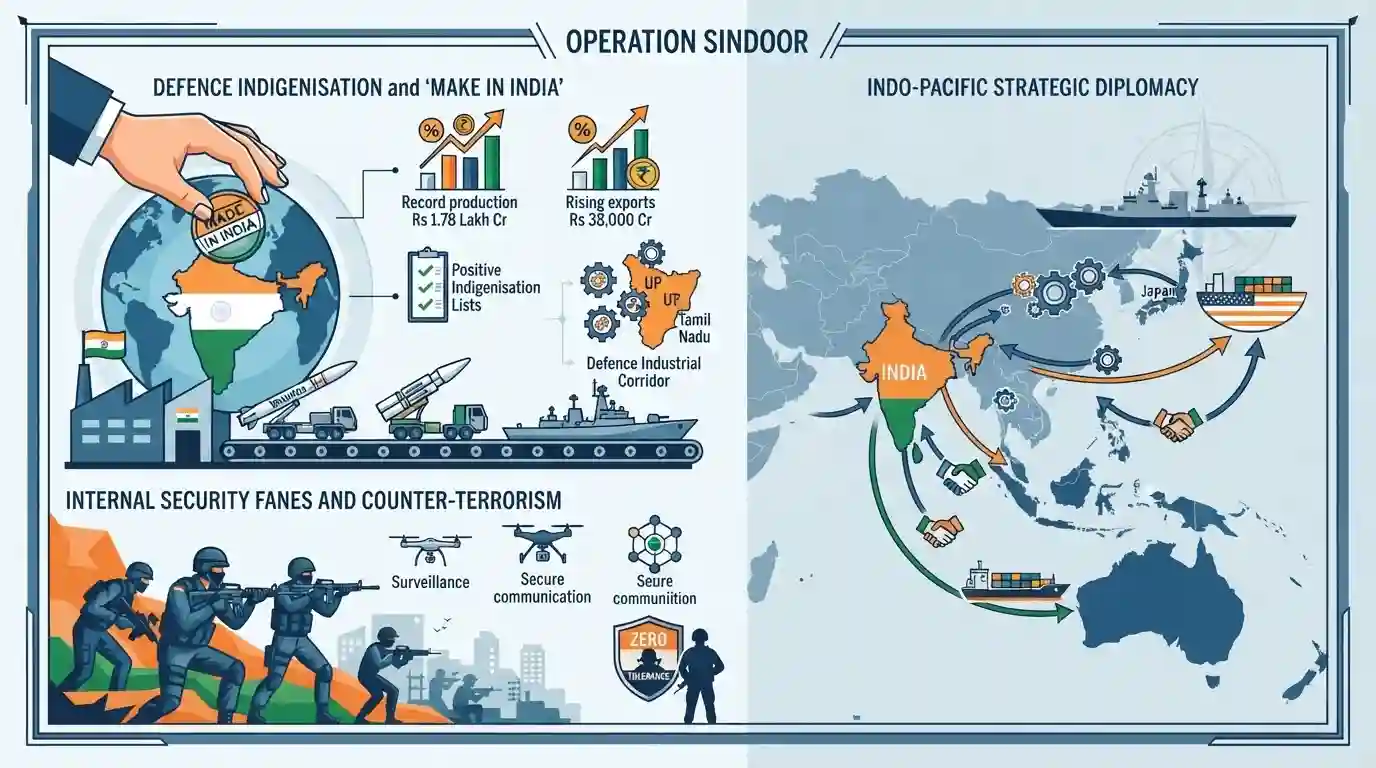
Defence Minister Rajnath Singh hailed "Operation Sindoor" as a testament to India’s enhanced defence preparedness, reflecting a proactive 'zero tolerance' stance against terrorism through the successful use of indigenous platforms like Akash and BrahMos. The operation underscores the success of sweeping reforms aimed at 'Aatmanirbharta' (self-reliance) in the defence sector. Key achievements include record annual defence production of ~Rs 1.78 lakh crore, exports surpassing Rs 38,000 crore, the notification of Positive Indigenisation Lists, and the establishment of Defence Industrial Corridors in Uttar Pradesh and Tamil Nadu. The government is strongly backing defence start-ups through iDEX and the ADITI scheme, while structural reforms like the corporatisation of the Ordnance Factory Board (OFB) have boosted efficiency. Simultaneously, India is reinforcing its strategic posture in the Indo-Pacific, transitioning from traditional strategic cooperation to deeper technical and industrial collaboration as a key node in global defence supply chains.
Key Points
- Operation Sindoor successfully demonstrated India's proactive counter-terrorism capabilities and 'zero-tolerance' policy, utilizing advanced indigenous systems like Akash Teer, Akash missiles, and BrahMos.
- A sweeping transformation toward defence self-reliance is evidenced by 'Positive Indigenisation Lists' (restricting imports) and the earmarking of 75% of the modernization budget for domestic procurement.
- India's defence manufacturing achieved record figures with ~Rs 1.78 lakh crore in production and Rs 38,000 crore in exports, targeting Rs 3 lakh crore and Rs 50,000 crore respectively by 2029.
- Innovation ecosystems are thriving through initiatives like iDEX and the ADITI scheme, driving over Rs 2,400 crore in approved procurements from start-ups and MSMEs.
- Defence diplomacy in the Indo-Pacific is shifting toward industrial integration, technical cooperation, and integration into global defence supply chains.
Important Terms
Operation Sindoor

A May 2025 military campaign involving precise strikes on terrorist infrastructure in Pakistan and PoK. It demonstrated India's technological self-reliance by effectively deploying indigenous platforms like Akash and BrahMos against asymmetric threats.
UPSC context
GS-3 (Internal Security). Highlights India's proactive counter-terrorism doctrine and the operational success of indigenous defence technologies.
Positive Indigenisation Lists
Progressive Ministry of Defence notifications that bar the import of specified weapons, platforms, and components after fixed deadlines, mandating their exclusive procurement from domestic industry to promote self-reliance.
UPSC context
GS-3 (Indigenisation of Technology). Central to 'Atmanirbhar Bharat', it directly addresses the UPSC topic of reducing import dependency in defence.
ADITI Scheme
Acing Development of Innovative Technologies with iDEX (ADITI) offers grants up to Rs 25 crore to start-ups. It aims to develop critical deep-tech strategic technologies and bridge capability gaps for the Armed Forces.
UPSC context
GS-3 (Defence Technology). Crucial for questions on defence start-up ecosystems, innovation, and indigenous R&D under 'Make in India'.
Ordnance Factory Board (OFB) Corporatisation
A major defence reform that dismantled the historic OFB, converting its 41 factories into seven 100% government-owned Defence Public Sector Undertakings (DPSUs) to boost autonomy, competitive efficiency, and defense exports.
UPSC context
GS-3 (Security & Economy). Tests knowledge on structural defence reforms, public sector restructuring, and steps taken to boost domestic defence manufacturing.
Prelims Trap
Positive Indigenisation Lists are lists of foreign equipment permitted for import to fast-track modernizing the armed forces.
These lists actually do the opposite: they ban the import of listed items, mandating that they must be procured from domestic manufacturers.
Static Concepts Connected
What is the 'Buy (Indian-IDDM)' category under the Defence Acquisition Procedure?
- Highest Priority: Positioned at the top of the procurement hierarchy under the Defence Acquisition Procedure (DAP) to promote indigenous design.
- Content Requirement: Mandates a minimum of 50% Indigenous Content (IC) if designed indigenously, or 60% if the design is foreign.
What is the structure and purpose of the iDEX framework?
- Nodal Executive: Launched by the Ministry of Defence and managed by the Defence Innovation Organisation (DIO), a non-profit company.
- Target Audience: Engages start-ups, MSMEs, and individual innovators to build deep-tech solutions for Indian military requirements.
Cross-Topic Patterns
Defence clusters as regional economic drivers
The choice of nodes in Tamil Nadu and Uttar Pradesh DICs aligns national defense manufacturing goals with regional industrial corridors, leveraging pre-existing MSME ecosystems.
Defence exports as strategic diplomacy
Transitioning from an importer to an exporter of systems like BrahMos enables India to deepen security partnerships in Southeast Asia, reinforcing its Act East policy.

Prelims 2026 may test technical differences between Akash Teer, ADITI funding mechanisms, and specific geographical nodes of UP & TN DICs.
Linked PYQs · 3
Linked PYQs · 3
- 2025MainsGS3
Terrorism is a global scourge. How has it manifested in India? Elaborate with contemporary examples. What are the counter measures adopted by the State? Explain.
- 2014MainsGS3
Foreign Direct Investment (FDI) in the defence sector is now set to be liberalized. What influence this is expected to have on Indian defence and economy in the short and long run?
- 2020MainsGS2
What is the significance of Indo-US defence deals over Indo-Russian defence deals? Discuss with reference to stability in the Indo-Pacific region.
