DOLR and RBIH Integrate Land Governance with Unified Lending
Source:PIB ↗
Why It Matters
This development is highly relevant for GS-3 (Agriculture and Economy) and GS-2 (E-Governance). It exemplifies how Digital Public Infrastructure and modernized land records (Bhu-Aadhaar) can resolve systemic issues in agricultural finance, such as high transaction costs, lack of formal credit access, and loan fraud, directly addressing the UPSC theme of leveraging technology for rural empowerment.
Summary
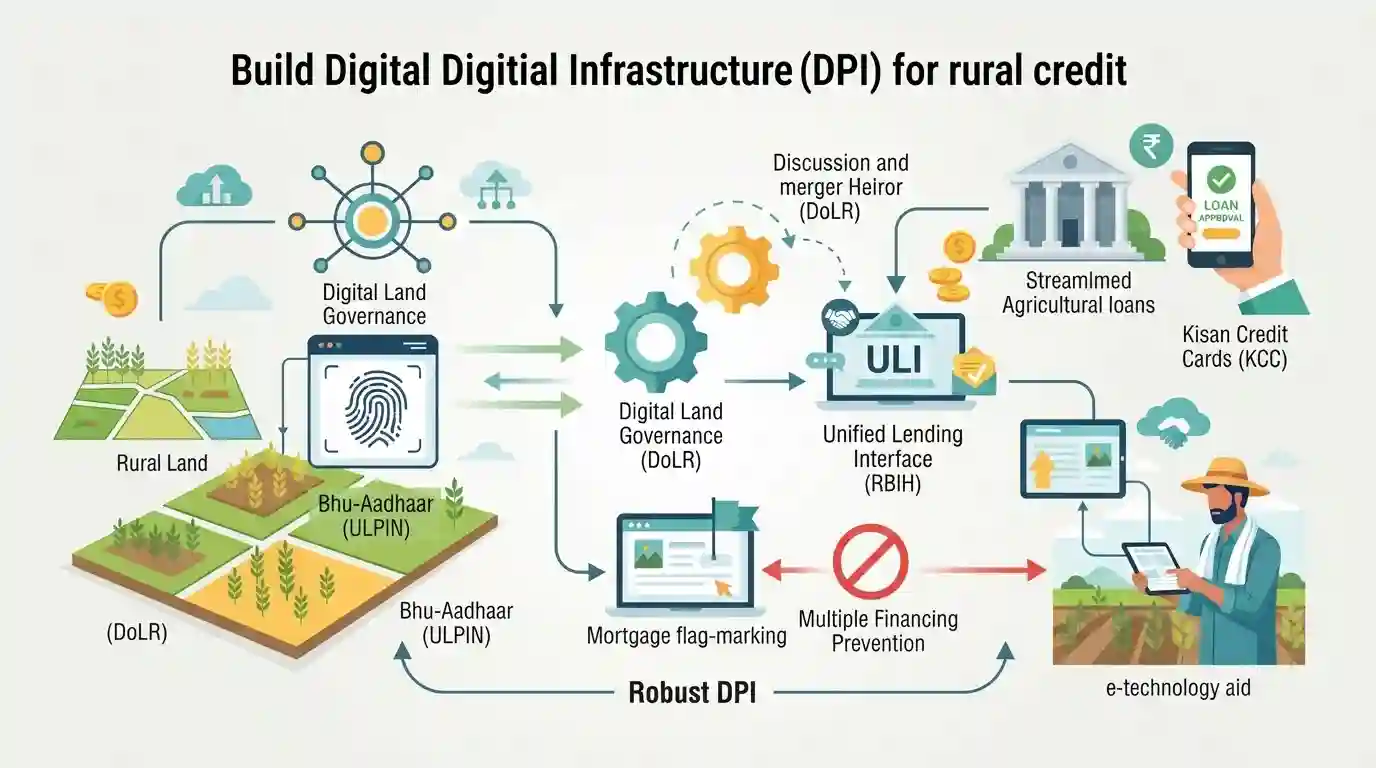
The Department of Land Resources (DoLR) and the RBI Innovation Hub (RBIH) have initiated discussions to merge digital land governance with the Unified Lending Interface (ULI) to create a robust Digital Public Infrastructure (DPI) for rural credit. This integration aims to streamline the issuance of Kisan Credit Cards (KCC) and agricultural loans by using interoperable digital land records. Furthermore, the expansion of ULPIN (Bhu-Aadhaar) will help implement mortgage flag-marking to prevent multiple financing against a single land parcel, thereby reducing risks, enhancing transparency, and promoting financial inclusion in rural areas.
Key Points
- The Department of Land Resources and RBI Innovation Hub are collaborating to integrate digital land governance with the Unified Lending Interface (ULI) to facilitate consent-based credit delivery.
- The convergence aims to speed up the digital delivery of Kisan Credit Cards (KCC) and other agricultural loans, significantly reducing transaction costs and processing times.
- The system will leverage ULPIN (Bhu-Aadhaar) to enable mortgage flag-marking, which prevents fraud and multiple financing on the same parcel of land.
- By establishing authenticated and interoperable digital land records, the initiative transforms land into a trusted digital asset, driving rural financial inclusion.
Important Terms
Unified Lending Interface (ULI)

An RBI-backed digital platform enabling consent-based sharing of borrower data (like land records, credit history, and taxes) with lenders to simplify credit evaluation and speed up loan disbursements.
UPSC context
GS Paper III (Economy & Digital Infrastructure); tests understanding of financial technology, credit inclusion, and formalization.
Kisan Credit Card (KCC)
A credit delivery mechanism introduced in 1998 by NABARD and RBI to provide farmers with timely, cost-effective formal credit for crop production and agricultural needs.
UPSC context
GS Paper III (Agriculture & Economic Development); tests knowledge of rural credit channels and crop production financing.
ULPIN (Bhu-Aadhaar)
A 14-digit alphanumeric code assigned to each surveyed land parcel, generated from its precise geographic coordinates to act as a unique digital identifier.
UPSC context
GS Paper III (Land Reforms & Agriculture Technology); tests knowledge of land records digitization and resource management.
Department of Land Resources (DoLR)
A department under the Ministry of Rural Development executing land reforms, modernization of land records, and watershed development initiatives to bolster land productivity.
UPSC context
GS Paper II (Ministries & Policies) and GS Paper III (Land Reforms); tests state capacity and administrative modernization.
Ministry of Rural Development
The Union ministry responsible for rural socio-economic growth, poverty reduction, livelihood security, and the execution of flagship rural infrastructure and employment schemes.
UPSC context
GS Paper II (Welfare Schemes & Governance); tests comprehension of rural poverty alleviation and central welfare strategies.
RBI Innovation Hub (RBIH)
A wholly-owned subsidiary of the RBI launched to foster financial sector innovation and promote ecosystem collaboration for frictionless finance and financial inclusion.
UPSC context
GS Paper III (Banking & Fintech); tests insight into digital public infrastructure and financial technology policy.
Prelims Trap
DILRMP is implemented as a Centrally Sponsored Scheme with a cost-sharing ratio between the Centre and States.
DILRMP was restructured as a 100% centrally funded Central Sector Scheme in 2016, meaning states do not share any financial burden for its implementation.
Static Concepts Connected
What is the Unique Land Parcel Identification Number (ULPIN) or Bhu-Aadhaar?
- Structure: A 14-digit unique alphanumeric identifier assigned to every surveyed land parcel in India.
- Methodology: Generated using the longitude and latitude coordinates of the land parcel based on geo-referenced cadastral maps.
- Objective: Acts as a single authority of truth to prevent land fraud, facilitate easy transaction tracking, and enable seamless link to financial services.
What are the key features and evolution of the Kisan Credit Card (KCC) scheme?
- Origin: Launched in 1998 based on the recommendations of the R.V. Gupta Committee to deliver flexible and simplified credit to farmers.
- Coverage: Covers short-term crop loans, post-harvest expenses, produce marketing loans, consumption requirements, and asset maintenance.
- Expansion: Extended in 2018-19 to include working capital requirements for fisheries and animal husbandry farmers.
Cross-Topic Patterns
DPI and credit-risk mitigation in agriculture
Merging land registries with financial rails (like ULI) converts physical land into a verifiable digital asset, minimizing bad loans and rural credit fraud.
Federalism and land record standardization
Since land is a State subject, central initiatives like ULPIN require voluntary state-level database integration, testing the limits of cooperative federalism.

UPSC 2026 may link ULI, ULPIN, and AgriStack to test the structural integration of agricultural credit and land e-governance.
Linked PYQs · 5
Linked PYQs · 5
- 2024MainsGS2
e-governance is not just about the routine application of digital technology in service delivery process. It is as much about multifarious interactions for ensuring transparency and accountability. In this context evaluate the role of the 'Interactive Service Model' of e-governance.
- 2023MainsGS2
e-governance, as a critical tool of governance, has ushered in effectiveness, transparency and accountability in governments. What inadequacies hamper the enhancement of these features ?
- 2020MainsGS2
The emergence of Fourth Industrial Revolution (Digital Revolution) has initiated e-Governance as an integral part of government". Discuss.
- 2014MainsGS3
In the villages itself no form of credit organization will be suitable except the cooperative society. -All India Rural Credit Survey. Discuss this statement in the background of agricultural finance in India. What constraints and challenges do financial institutions supplying agricultural finance face? How can technology be used to better reach and serve rural clients?
- 2022MainsGS3
Is inclusive growth possible under market economy ? State the significance of financial inclusion in achieving economic growth in India.
