Vikram 1 Launch Marks Milestone for Indian Private Space Sector
Source:PIB ↗
ఇది ఎందుకు ముఖ్యం
Private sector entry into India's space ecosystem, governed by IN-SPACe and Indian Space Policy 2023, is a high-priority topic for both Prelims and Mains. Recent UPSC Prelims (2026) featured specific questions on startups like Skyroot, Agnikul Cosmos, and the role of IN-SPACe, while Mains regularly tests achievements in Space Science & Technology and socio-economic development (GS3). This article provides crucial up-to-date figures, FDI limits, and startup milestones for high-scoring fodder.
సారాంశం
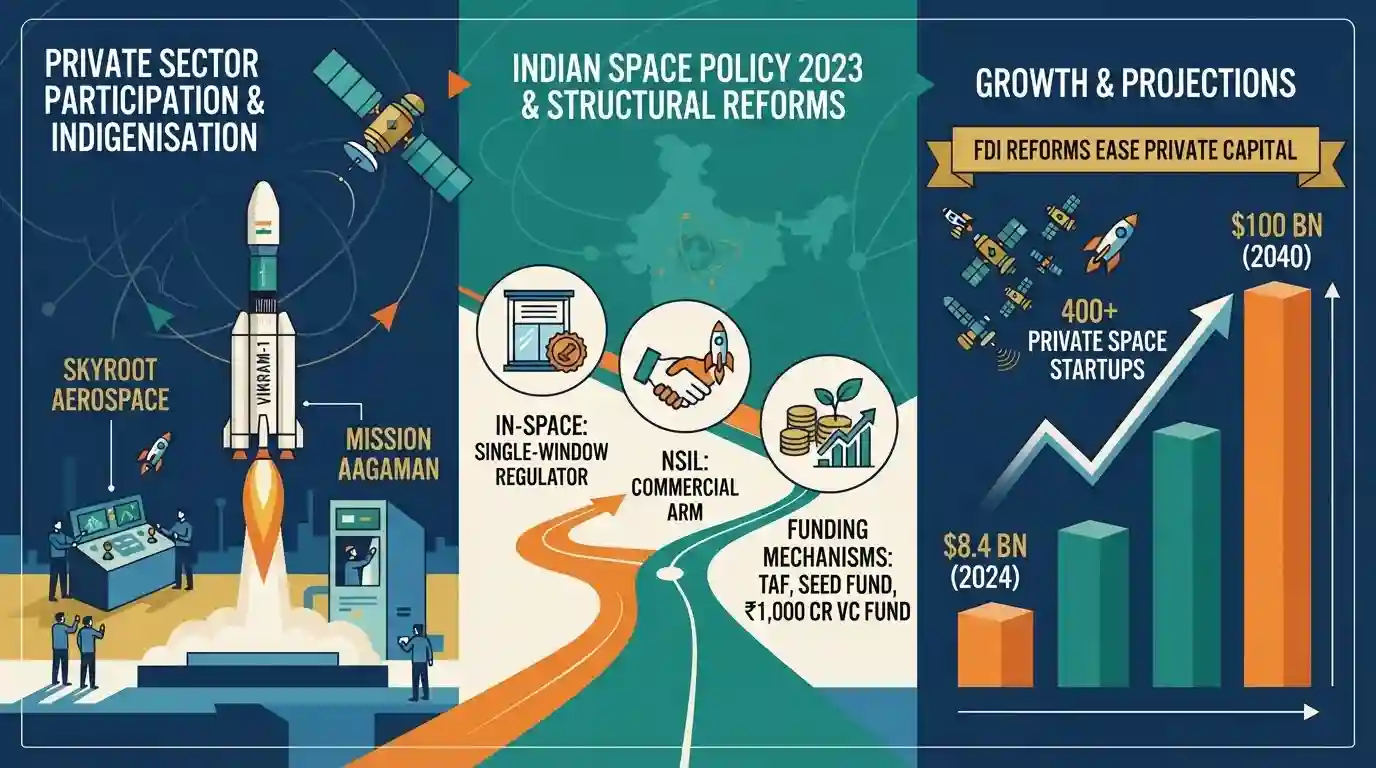
The article details India's rapidly transforming space sector, highlighting the upcoming launch of Vikram-1—the nation's first privately developed orbital launch vehicle by Skyroot Aerospace under 'Mission Aagaman'. Facilitated by the landmark Indian Space Policy 2023, the sector has seen profound structural changes, including a single-window regulator (IN-SPACe), a commercial arm (NSIL), dedicated funding mechanisms (such as the TAF, Seed Fund, and a ₹1,000 Cr Venture Capital Fund), and a liberalised FDI policy designed to ease the entry of private capital. India's private space startups have surged to over 400 in 2026, with the overall space economy projected to grow from $8.4 billion to $100 billion by 2040.
ముఖ్య అంశాలు
- Vikram-1 & Mission Aagaman: Developed by Skyroot Aerospace, Vikram-1 is India's first privately developed orbital launch vehicle (LEO payload capacity: 350 kg) featuring an all-carbon composite structure and a 3D-printed liquid engine. Scheduled for launch under 'Mission Aagaman' to deploy multiple customer payloads, including a robotic debris-capturing arm called 'Embrace'.
- Indian Space Policy 2023: Formally allows Non-Government Entities (NGEs) to operate across the entire space value chain, including launch services, satellite manufacturing, and downstream applications. This policy has driven the expansion of the space startup ecosystem from a single startup in 2014 to over 400 in 2026.
- Institutional Role of IN-SPACe: Operates as an autonomous, single-window regulator for both government and private space activities. Key achievements include facilitating $150M in venture investments in CY 2025, executing technology transfer agreements, and administering critical financial tools like the Seed Fund (grants up to ₹1 crore), the ₹1,000 crore Venture Capital Fund, and the ₹500 crore Technology Adoption Fund.
- NSIL's Commercial Mandate: Serves as ISRO's commercial arm. NSIL has launched 141 satellites (138 international, 3 domestic) by July 2026, increased commercial revenue tenfold, and overseen major technology transfers, such as the ₹511 crore 10-year transfer of SSLV technology to HAL in February 2026.
- Liberalised FDI Policy: Up to 100% FDI is permitted under a tiered structure to attract global investments: up to 74% automatic route for satellites and user segments; up to 49% automatic route for launch vehicles and spaceports; and 100% automatic route for satellite components and subsystems.
- Key Startup Milestones: Notable achievements include Vikram-S (India's first private rocket, Mission Prarambh, Nov 2022); Agnikul Cosmos launching Agnibaan SOrTeD from the private 'Dhanush' launchpad (featuring the world's first single-piece 3D-printed semi-cryogenic engine, Agnilet, in May 2024); and Pixxel-led PPPs for Earth Observation constellations.
ముఖ్యమైన పదాలు
Indian Space Policy 2023

A comprehensive framework introduced to reform India’s space sector by encouraging private sector participation across the entire space value chain, augmenting capabilities, and defining the distinct roles of ISRO, IN-SPACe, and NSIL.
UPSC context
Crucial for GS Paper III (Space Technology). Highlights the shift from a state-monopoly to a privatized, commercially-driven space ecosystem.
IN-SPACe (Indian National Space Promotion and Authorization Centre)
An autonomous, single-window nodal agency under the Department of Space mandated to regulate, promote, and authorize non-governmental entities to undertake commercial space activities in India.
UPSC context
Tests knowledge of space sector regulators in GS III (Institutions & Tech). It oversees permissions for private rocket launches.
Mission Aagaman
The July 2026 maiden orbital test flight of Vikram-1 by Skyroot Aerospace, marking India’s first successful deployment of a privately developed orbital launch vehicle into space.
UPSC context
Highly relevant for GS III (Science & Tech Current Affairs). Exemplifies the successful indigenization of private space flight capabilities.
Technology Adoption Fund (TAF)
A ₹500-crore fund launched by IN-SPACe to financially assist Indian space startups and MSMEs in translating early-stage space technologies into commercially viable products.
UPSC context
Important for GS III (Indigenisation of Technology). Demonstrates government mechanisms for scaling deep-tech innovation and overcoming funding gaps.
NewSpace India Limited (NSIL)
The commercial arm of ISRO, responsible for manufacturing space systems on commercial principles, transferring technologies to the private sector, and marketing India's space products globally.
UPSC context
Significant for GS III. Differentiates commercial space operations from regulatory (IN-SPACe) and research (ISRO) functions.
Mission Prarambh
India’s first-ever private suborbital rocket launch mission, successfully conducted by Skyroot Aerospace in November 2022 to launch the Vikram-S sounding rocket.
UPSC context
Foundational milestone for GS III. It was the historical precursor to full private orbital launches like Mission Aagaman.
ప్రిలిమ్స్ ఉచ్చు
100% FDI is permitted under the automatic route for all sub-sectors of the Indian space industry, including launch vehicles.
Only satellite components/subsystems enjoy 100% automatic FDI. Launch vehicles and spaceports are capped at 49% automatic, while satellite manufacturing and operations are capped at 74% automatic.
అనుసంధానమైన స్థిర భావనలు
What is the structural division between IN-SPACe and NSIL under India's space ecosystem?
- IN-SPACe mandate: Acts as a single-window, autonomous nodal agency under the Department of Space to authorize, promote, and regulate private space activities (NGEs).
- NSIL mandate: Operates as a commercial CPSE to commercialize ISRO's R&D, handle commercial launches, and execute technology transfers (like SSLV) to Indian private industry.
How do semi-cryogenic engines differ from conventional cryogenic engines?
- Propellant configuration: Cryogenic engines use Liquid Hydrogen (fuel) and Liquid Oxygen (oxidizer). Semi-cryogenic engines substitute Liquid Hydrogen with refined Kerosene (Aviation Turbine Fuel).
- Storage advantage: Kerosene is liquid at ambient temperatures, eliminating the complex cryogenic storage systems required for liquid hydrogen (-253°C), simplifying launchpad operations.
- Thrust and density: Semi-cryogenic fuel is denser, allowing for smaller, lighter fuel tanks while delivering high thrust, although cryogenic engines still have a higher overall specific impulse.
అంతర-అంశ నమూనాలు
Outer Space and International Law
India's domestic space privatization must align with its liabilities under the Outer Space Treaty (1967) and the Liability Convention, where the state remains liable for private actors' space mishaps.
3D Printing in Defense and Aerospace
The indigenization of 3D-printed rocket engines mirrors India's broader dual-use technology strategy, directly impacting missile defense, aerospace manufacturing, and advanced metallurgy under domestic patent regimes.

2026 Prelims will likely test the specific tiered FDI limits in space sub-sectors alongside the functional divide between NSIL and IN-SPACe.
అనుసంధాన PYQలు · 2
అనుసంధాన PYQలు · 2
- 2026PrelimsGS1
Consider the following statements with regard to involvement of private entities in India's space programme : 1. The Indian National Space Promotion and Authorisation Centre (IN-SPACe) is an autonomous agency formed to facilitate participation of private entities. 2. Agnikul Cosmos launched the world's first flight using 3D-printed rocket engine. 3. Skyroot Aerospace has developed liquid fuel for GSLV. Which of the statements given above is/are correct ?
- 2016MainsGS3
Discuss India's achievements in the field of Space Science and Technology. How the application of this technology has helped India in its socio-economic development?
