Startup Recognition Framework Revised for Deep Tech and Cooperatives
Source:PIB ↗
Why It Matters
This revision updates the landmark Startup India policy by aligning eligibility with the current economic scale, structurally supporting capital-intensive deep-tech sectors, and incorporating cooperative models. It is directly relevant to GS Paper 3 questions on industrial growth, technological innovation, and rural development frameworks.
Summary
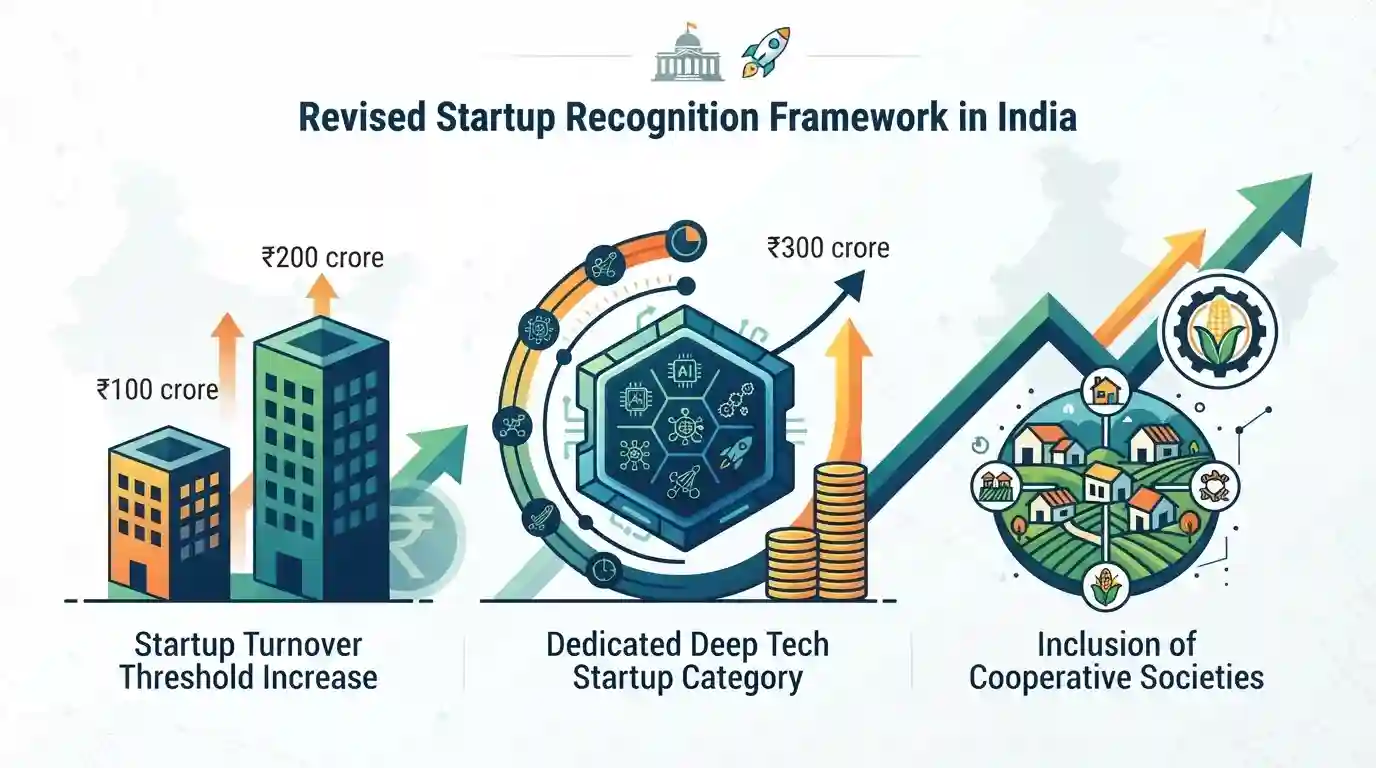
The Government of India has revised the Startup Recognition Framework under the Startup India Action Plan. Key changes include increasing the startup turnover threshold from ₹100 crore to ₹200 crore, creating a dedicated 'Deep Tech Startup' category with an extended age limit (up to 20 years) and higher turnover limit (₹300 crore), and extending startup recognition eligibility to cooperative societies under both central and state legislations to foster grassroots and rural innovation.
Key Points
- Enhanced Turnover Threshold: The turnover limit for startup recognition has been raised from ₹100 crore to ₹200 crore to support businesses across various maturity levels and lifecycle stages.
- Specialized 'Deep Tech Startup' Category: A dedicated category for Deep Tech ventures has been created. Understanding their long gestation periods and high research-intensity, the eligibility age limit has been extended from 10 to 20 years, and the turnover limit has been increased to ₹300 crore.
- Inclusion of Cooperatives: To drive innovation in agriculture, rural development, and community-based enterprises, cooperative societies (both Multi-State and State/UT-registered) are now eligible for startup recognition.
- Policy Alignment: These updates follow extensive stakeholder consultations and aim to enable patient capital flow, support breakthrough technologies, and promote inclusive economic growth at the grassroots level.
Important Terms
Department for Promotion of Industry and Internal Trade (DPIIT)

A nodal department under the Ministry of Commerce and Industry responsible for formulating industrial policies, promoting internal trade, coordinating foreign direct investment, and administering startup recognition.
UPSC context
GS Paper III (Indian Economy), testing institutional frameworks, industrial development, and ease of doing business interventions.
Startup India Action Plan
A flagship policy launched in 2016 aimed at building a robust ecosystem for nurturing innovation, providing tax benefits, funding support, and simplifying regulatory compliance for eligible startups.
UPSC context
GS Paper III (Employment and Growth), evaluating government interventions to promote entrepreneurship, innovation, and technological development.
Multi-State Cooperative Societies Act, 2002
An Act of Parliament that regulates cooperative societies with objects not confined to one state, promoting democratic control, voluntary membership, and self-reliance across multiple states.
UPSC context
GS Paper II (Governance and Devolution), testing federal legislations and institutional reforms in the cooperative and rural sector.
Ministry of Commerce & Industry
The Union Ministry administering internal trade, industrial development, international trade negotiations, intellectual property rights, and bodies like the DPIIT to foster economic growth.
UPSC context
GS Paper III (Economic Development), evaluating the administrative framework, policy implementation, and trade promotion strategies.
State and Union Territory Cooperative Acts
Regional legislations passed by individual states and union territories in India to register, regulate, and supervise cooperative societies operating within their respective geographic boundaries.
UPSC context
GS Paper II (Federalism), assessing state-level cooperative laws, grassroots administration, and local economic development structures.
Prelims Trap
Only cooperative societies registered under the central Multi-State Cooperative Societies Act, 2002 are eligible for startup recognition.
The revision explicitly includes cooperative societies registered under both central (Multi-State) and state/UT-level legislations to drive rural innovation.
Static Concepts Connected
What features distinguish 'Deep Tech' from conventional tech startups?
- Scientific Foundation: Built on fundamental scientific discoveries or tangible engineering breakthroughs rather than minor process or business-model innovations.
- Capital Gestation: Suffers from a long R&D "valley of death," requiring patient, long-term capital before generating commercial revenues.
- IP Intensity: Generates substantial, hard-to-replicate intellectual property and patents, creating high barriers to entry for competitors.
What is the constitutional and legislative framework governing Cooperative Societies in India?
- Constitutional Status: The 97th Constitutional Amendment (2011) inserted Part IXB and made forming cooperatives a fundamental right under Article 19(1)(c).
- Seventh Schedule: State-registered cooperatives fall under the State List (Entry 32), while multi-state cooperatives fall under the Union List (Entry 44).
- Administrative Control: Governed by the Ministry of Cooperation (established 2021) to streamline the cooperative sector, distinct from the Ministry of Commerce.
Cross-Topic Patterns
Cooperatives + Agri-Tech scaling
Extending startup benefits to cooperative societies enables Primary Agricultural Credit Societies (PACS) to easily integrate and deploy capital-intensive agri-tech innovations at the grassroots.
Deep Tech + Patent Lifecycles
Aligning Deep Tech recognition (20 years) with standard Indian patent lifecycles (20 years) ensures continuous state support and tax exemptions during the critical developmental phases.

Revised DPIIT startup definitions—specifically the 20-year Deep Tech window and cooperative eligibility—will likely feature in Prelims 2026.
Linked PYQs · 3
Linked PYQs · 3
- 2014MainsGS3
In the villages itself no form of credit organization will be suitable except the cooperative society. -All India Rural Credit Survey. Discuss this statement in the background of agricultural finance in India. What constraints and challenges do financial institutions supplying agricultural finance face? How can technology be used to better reach and serve rural clients?
- 2023MainsGS3
Faster economic growth requires increased share of the manufacturing sector in GDP, particularly of MSMEs. Comment on the present policies of the Government in this regard.
- 2019PrelimsGS1
Atal Innovation Mission is set up under the
