Telecom Sector Reforms and TRAI Quality Standards to Expand 5G Reach
Source:PIB ↗
Why It Matters
Telecom infrastructure forms the backbone of India's digital economy. Understanding how legislative, financial, and procedural ease-of-doing-business reforms (such as RoW, SACFA clearances, and AGR adjustments) directly impact technical deployment and service delivery is highly relevant for both GS2 (regulatory bodies and grievance redressal) and GS3 (infrastructure, investment, and S&T development).
Summary
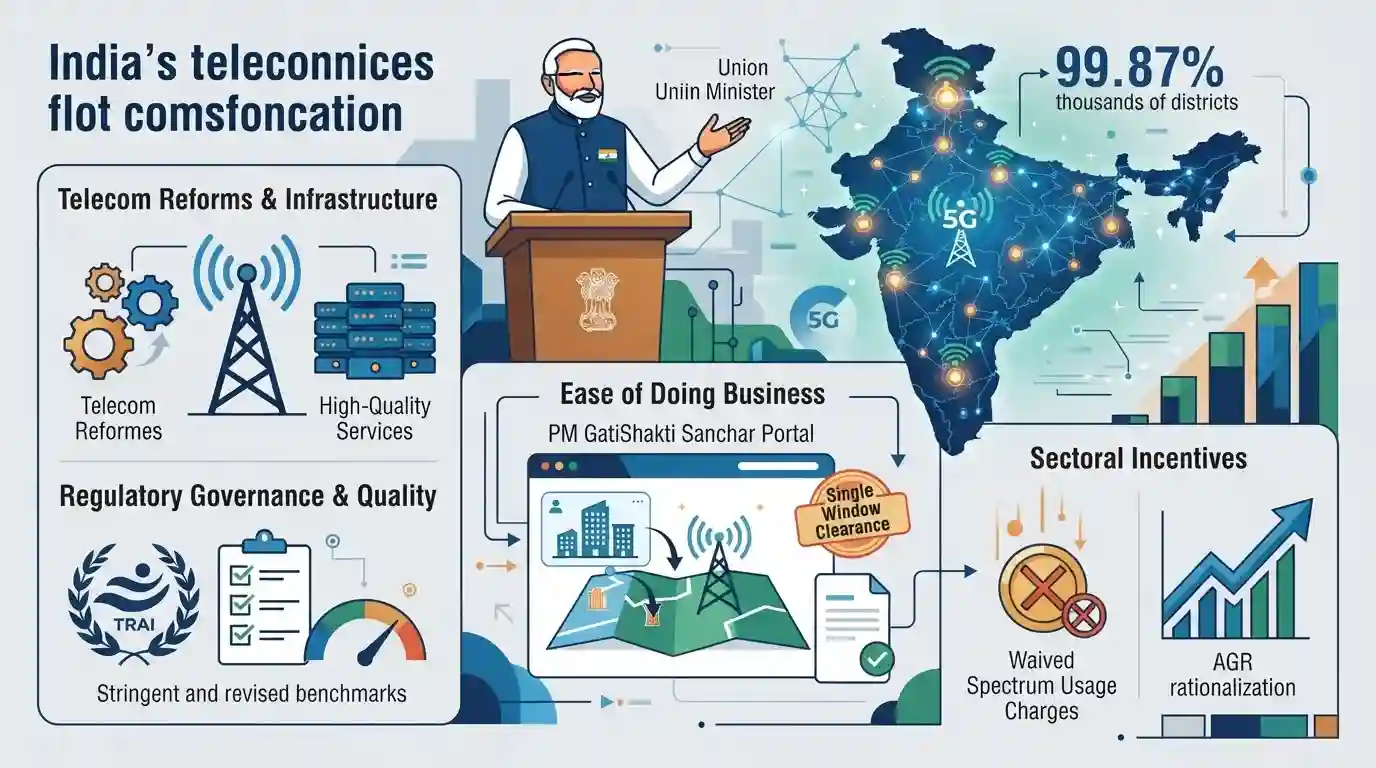
The Union Minister of Communications highlighted the government's commitment to expanding high-quality telecom services and accelerating 5G infrastructure. Backed by stringent Quality of Service (QoS) benchmarks revised by TRAI, the sector is being reformed through Adjusted Gross Revenue (AGR) rationalization, waiver of Spectrum Usage Charges, and procedural simplifications like the PM GatiShakti Sanchar portal and Right of Way (RoW) adjustments, facilitating 5G coverage across 99.87% of Indian districts.
Key Points
- TRAI has tightened Quality of Service (QoS) benchmarks—including call drop rates, packet loss, and service downtime—with a glide path designed to align Indian telecom standards with global norms.
- India has achieved one of the fastest 5G rollouts globally, with 5G services now active in 776 out of 777 districts (99.87% coverage) and over 5.18 lakh Base Transceiver Stations (BTSs) installed.
- Key structural and financial reforms supporting this expansion include the rationalization of Adjusted Gross Revenue (AGR) definitions, bank guarantees, interest rates, and the elimination of Spectrum Usage Charges (SUC) for spectrum acquired from 2022 onwards.
- Infrastructure bottlenecks are being systematically resolved through simplified SACFA clearances, the integration of the PM GatiShakti Sanchar portal, standardizing Right of Way (RoW) Rules, and permitting the time-bound use of street furniture for small cell deployments.
- CPGRAMS is actively used as a citizen feedback and complaint lodging mechanism to monitor, report, and redress telecom service deficiencies in direct coordination with Telecom Service Providers (TSPs).
Important Terms
PM GatiShakti Sanchar portal

A centralized single-window portal that streamlines Right of Way (RoW) approvals for telecommunication service and infrastructure providers to lay optical fiber and erect mobile towers, facilitating faster 5G rollout.
UPSC context
GS Paper II (e-Governance) and GS Paper III (Infrastructure); tests policies promoting ease of doing business and digital inclusion.
Right of Way (RoW) Rules
Regulatory framework notified under the Telecommunications Act to simplify, standardize, and expedite permissions for telecom operators to install overground or underground infrastructure on public and private properties.
UPSC context
GS Paper III (Infrastructure); tests understanding of digital connectivity reforms, federal coordination, and procedural ease in national infrastructure development.
Standing Advisory Committee on Radio Frequency Allocations (SACFA)
A high-level advisory committee under the Ministry of Communications responsible for frequency allocation, formulating the National Frequency Allocation Plan, and issuing site clearances for all wireless installations.
UPSC context
GS Paper III (Science & Technology); tests technical governance of telecom spectrum and institutional safety mechanisms against interference.
Telecom Regulatory Authority of India (TRAI)
A statutory body established under the TRAI Act, 1997, responsible for regulating telecom services, protecting consumer interests, ensuring fair competition, and recommending spectrum management policies.
UPSC context
GS Paper II (Regulatory Bodies); tests institutional functions, regulatory challenges, and reform measures in India’s telecom sector.
Department of Telecommunications (DoT)
A department under the Ministry of Communications that coordinates developmental, policy, and licensing functions for telecom services, working in tandem with TRAI to implement national telecom policies.
UPSC context
GS Paper II (Government Departments); tests executive governance, policy implementation, and administrative reforms in India's digital ecosystem.
Centralized Public Grievance Redress and Monitoring System (CPGRAMS)
A 24/7 online portal developed by DARPG that enables citizens to lodge, track, and appeal grievances related to public service delivery against all Central and State government authorities.
UPSC context
GS Paper II (e-Governance/Accountability); tests administrative mechanisms for citizen-centric governance, grievance redressal, and accountability.
Prelims Trap
Digital Bharat Nidhi retains the exclusive mandate of the USOF to fund only rural and remote telecom connectivity.
The Telecommunications Act 2023 expanded the DBN's scope to explicitly include funding for indigenous telecom R&D (5G/6G/IoT) and skill development, moving beyond the USOF's rural-only focus.
Static Concepts Connected
How does the Digital Bharat Nidhi (DBN) differ from the erstwhile USOF?
- Expanded Mandate: Funds indigenous R&D (5G/6G), pilot projects, and skill development, whereas USOF focused primarily on rural connectivity.
- Statutory Basis: Established under Chapter V of the Telecommunications Act, 2023, replacing the telegraph-era regulatory framework.
- Funding Channel: Funded by a 5% Universal Service Levy on AGR, routing through the Consolidated Fund of India.
What is the institutional division of powers between TRAI and TDSAT?
- TRAI Mandate: Regulates telecom tariffs, sets Quality of Service benchmarks, and provides non-binding policy recommendations to the government.
- TDSAT Adjudication: Created via a 2000 amendment to separate regulatory duties from dispute-settlement functions to prevent administrative conflict of interest.
- Judicial Appeal: Resolves disputes between government/licensees and service providers, with final appeals lying directly before the Supreme Court.
Cross-Topic Patterns
Telecom Infrastructure + Federal Governance
The PM GatiShakti Sanchar Portal integrates state-level clearances under uniform Right of Way rules, resolving historic frictions between municipal authorities and central telecom policies.
Street Furniture + Urban Local Finances
Deploying 5G small cells on municipal street infrastructure establishes new non-tax revenue channels for cash-strapped Urban Local Bodies while expediting network densification.

The transition of USOF to Digital Bharat Nidhi and its expanded mandate for telecom R&D is highly likely to feature in UPSC 2026.
Linked PYQs · 3
Linked PYQs · 3
- 2019PrelimsGS1
In India, which of the following review the independent regulators in sectors like telecommunications, insurance, electricity, etc.? 1. Ad Hoc Committees set up by the Parliament 2. Parliamentary Department Related Standing Committees 3. Finance Commission 4. Financial Sector Legislative Reforms Commission 5. NITI Aayog Select the correct answer using the code given below.
- 2023MainsGS3
What is the status of digitalization in the Indian economy? Examine the problems faced in this regard and suggest improvements.
- 2021MainsGS3
“Investment in infrastructure is essential for more rapid and inclusive economic growth.” Discuss in the light of India's experience.
