Ease of doing business regulatory reforms and Jan Vishwas Act
Source:PIB ↗
Why It Matters
Ease of Doing Business is a cornerstone of India's macroeconomic strategy to attract FDI, boost manufacturing capability (Make in India), and formalize the economy. Understanding the evolution from archaic regulations to digital, trust-based frameworks (like NSWS and Jan Vishwas Act) is essential for GS2 (Governance/E-Governance) and GS3 (Economy/Industrial Growth).
Summary
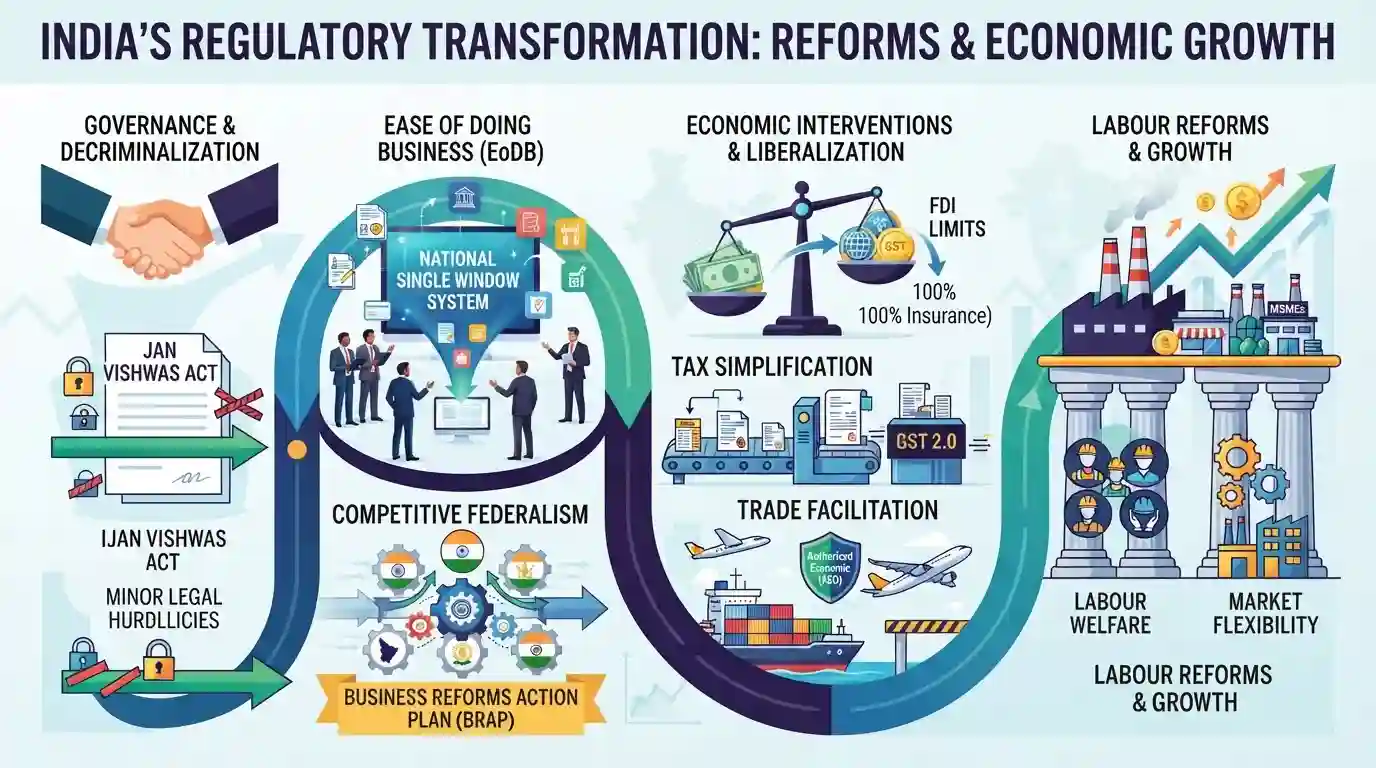
India’s ongoing regulatory transformation, as highlighted in recent policy initiatives and the Union Budget, focuses on significantly enhancing the Ease of Doing Business (EoDB) environment. The government has undertaken structural reforms across multiple dimensions, including the decriminalization of minor offenses through the Jan Vishwas Act, the operationalization of the National Single Window System (NSWS) for seamless administrative clearances, and the rollout of the Business Reforms Action Plan (BRAP) to encourage competitive federalism among States. Economic interventions involve liberalizing Foreign Direct Investment (FDI) limits—such as allowing up to 100% FDI in insurance—alongside tax simplifications under GST 2.0 and trade facilitation measures like the Authorized Economic Operator (AEO) scheme. Furthermore, the push to implement the four consolidated Labour Codes aims to balance labor welfare with market flexibility, thereby aiming to boost the manufacturing sector and MSME growth.
Key Points
- The Union Budget FY 2026-27 prioritizes Ease of Doing Business (EoDB) through a massive regulatory transformation, aiming to reduce compliance burdens on businesses.
- The Jan Vishwas Act plays a pivotal role in decriminalizing minor, procedural offenses across multiple statutes, shifting towards monetary penalties and a trust-based governance model.
- The National Single Window System (NSWS) acts as a unified digital portal to streamline regulatory approvals, clearances, and registrations across Central and State ministries.
- FDI policies have been further liberalized, including permitting up to 100% FDI in the insurance sector to boost capital inflow and deepen the financial market.
- Implementation of the four consolidated Labour Codes seeks to modernize industrial relations, enhance social security, and provide greater operational flexibility to the manufacturing sector and MSMEs.
- The Business Reforms Action Plan (BRAP) fosters competitive federalism by ranking States and UTs on their successful implementation of business-facilitation measures.
Important Terms
Jan Vishwas (Amendment of Provisions) Act

A legislative reform that amends around 80 central laws to decriminalize minor, procedural violations, replacing criminal imprisonment with proportionate civil penalties and administrative enforcement to reduce compliance burdens.
UPSC context
GS Paper II (Governance) and Paper III (Economy); tests understanding of regulatory overcriminalization, governance reforms, and trust-based administration.
National Single Window System (NSWS)
A unified digital platform launched by the Ministry of Commerce and Industry that serves as a one-stop shop for investors to identify and apply for various regulatory clearances and approvals across central and state departments.
UPSC context
GS Paper III (Indian Economy & Industry); tests comprehension of administrative digitization, bureaucratic simplification, and investment facilitation policies.
Business Reforms Action Plan (BRAP)
An annual assessment and ranking of Indian States and Union Territories by DPIIT, designed to promote competitive federalism by evaluating and driving progress in the implementation of business regulatory reforms.
UPSC context
GS Paper II (Federalism) and Paper III (Economy); tests knowledge of federal dynamics, sub-national investment environments, and ease of doing business.
Labour Codes
A major reform consolidating 29 complex historical central labour laws into four simplified codes—Wages, Industrial Relations, Social Security, and Occupational Safety—to streamline compliance, improve worker welfare, and attract industrial investment.
UPSC context
GS Paper III (Employment & Economy); tests critical analysis of structural reforms, balancing worker social security with manufacturing flexibility, and federal implementation.
Authorized Economic Operator (AEO) Scheme
A trust-based customs partnership scheme under the World Customs Organization framework that designates compliant international trading businesses as secure partners, granting them expedited clearances, simplified procedures, and lower transaction costs.
UPSC context
GS Paper III (Trade & Infrastructure); tests understanding of trade facilitation, export promotion, customs simplification, and global supply chains.
Department for Promotion of Industry and Internal Trade (DPIIT)
A nodal department under the Ministry of Commerce and Industry responsible for formulating industrial policy, facilitating foreign direct investment, promoting internal trade, supporting the startup ecosystem, and improving ease of doing business.
UPSC context
GS Paper III (Economy & Industry); tests knowledge of industrial policy formulation, investment promotion, institutional frameworks, and business reforms.
Prelims Trap
Under the 100% automatic route FDI in insurance, there are no domestic residency conditions required for key managerial positions.
While 100% FDI is allowed under the automatic route, safeguards mandate that at least one key senior executive (such as the Chairperson, MD, or CEO) must be a resident Indian citizen.
Static Concepts Connected
What distinguishes a 'fine' from a 'civil penalty' in regulatory jurisprudence?
- Judicial vs. Administrative: Fines are imposed by courts after criminal prosecution; penalties are levied by administrative authorities without judicial trials.
- Nature of Offence: Fines apply to criminal/criminalized acts; penalties apply to civil, procedural, or minor regulatory non-compliances.
- Resolution Speed: Adjudicating civil penalties avoids clogging courts and speeds up compliance resolution for businesses.
What are the core focus areas of India's four consolidated Labour Codes?
- Code on Wages: Universalizes minimum wage provisions and timely payment across all employments, eliminating gender disparities.
- Industrial Relations Code: Enhances business flexibility by raising the retrenchment threshold to 300 workers while regulating trade unions.
- Social Security Code: Integrates existing welfare schemes and extends safety nets to gig, platform, and unorganized sector workers.
Cross-Topic Patterns
Competitive Federalism and Grassroots Governance
The shift from state-level BRAP to localized D-BRAP directly links national investment-facilitation goals with 73rd/74th Constitutional Amendment-led local governance reforms.
Labour Codes + Gig Economy Welfare
Consolidating labor laws connects industrial manufacturing growth with constitutional social security rights for platform workers, reflecting a changing welfare state model.

A 2026 question may test the intersection of 100% Insurance FDI safeguards, D-BRAP metrics, and the legal definition of 'civil penalties'.
Linked PYQs · 5
Linked PYQs · 5
- 2016MainsGS3
Justify the need for FDI for the development of the Indian economy. Why there is gap between MOUs signed and actual FDIs? Suggest remedial steps to be taken for increasing actual FDIs in India.
- 2024MainsGS3
Discuss the merits and demerits of the four 'Labour Codes' in the context of labour market reforms in India. What has been the progress so far in this regard?
- 2023MainsGS3
Faster economic growth requires increased share of the manufacturing sector in GDP, particularly of MSMEs. Comment on the present policies of the Government in this regard.
- 2016PrelimsGS1
India's ranking in the 'Ease of Doing Business Index' is sometimes seen in the news. Which of the following has declared that ranking?
- 2019PrelimsGS1
Which one of the following is not a sub-index of the World Bank's 'Ease of Doing Business Index'?
