India-US Trade Deal Impact on Agriculture and Farmers Protection
Source:PIB ↗
Why It Matters
Highlights the balancing act in international trade negotiations where India seeks greater market access for its exports (like textiles and spices) while protecting sensitive domestic sectors like dairy and staple agriculture. It is highly relevant for GS3 questions on the impact of bilateral agreements on the Indian economy, WTO agriculture issues, and farmers' welfare.
Summary
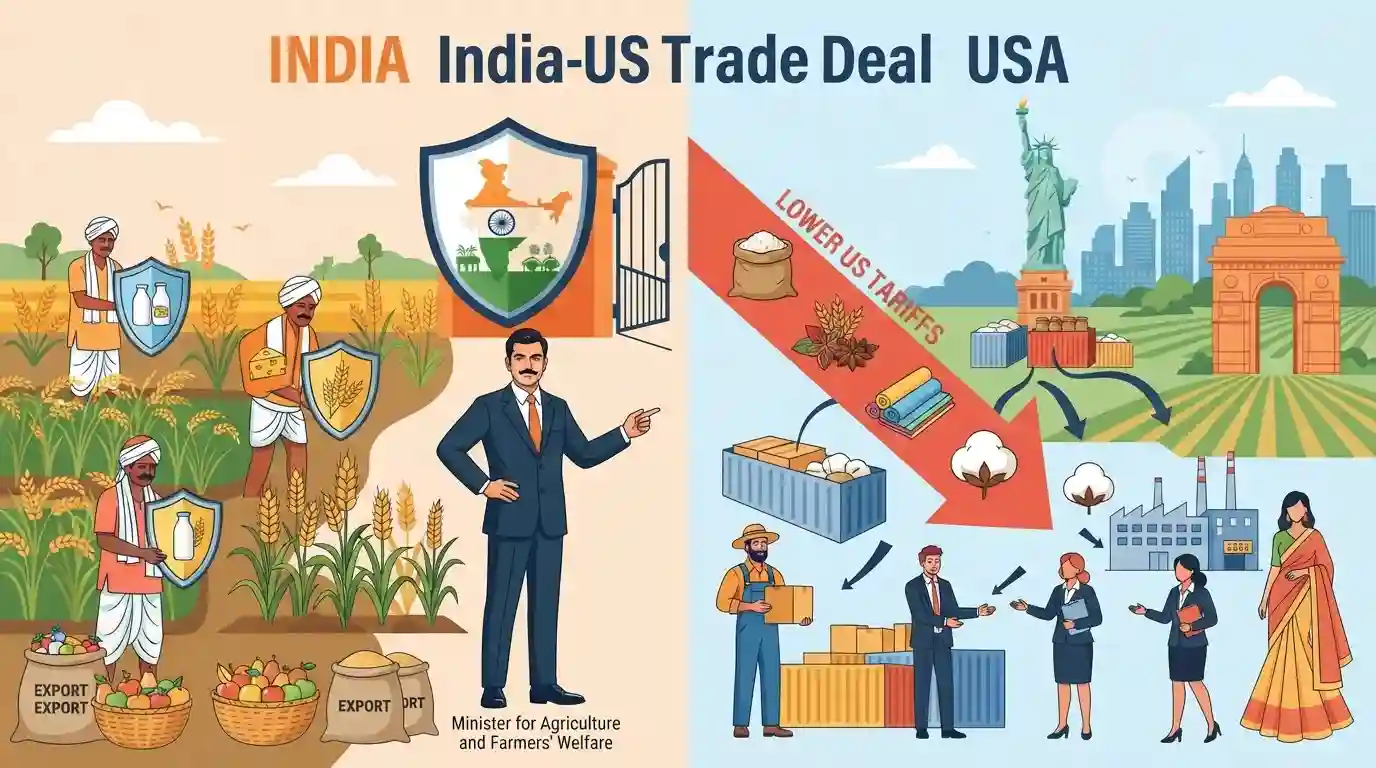
Union Minister for Agriculture and Farmers' Welfare, Shivraj Singh Chouhan, has addressed concerns regarding the recent India-US Trade Deal, assuring that it fully protects Indian agricultural and dairy interests. He emphasized that essential domestic products, including staples, fruits, and millets, will not face disruptive competition from US imports. Instead, the agreement provides a strategic advantage for India by lowering US tariffs on key Indian exports such as rice, spices, and textiles. This tariff reduction is particularly expected to benefit domestic cotton farmers by boosting the textile sector's export capabilities.
Key Points
- Union Agriculture Minister Shivraj Singh Chouhan assured that the India-US Trade Deal fully safeguards the interests of Indian farmers and the domestic agriculture sector.
- Domestic staples, fruits, major crops, millets, and dairy products are protected from sudden or disruptive entry by US products.
- The agreement lowers tariffs on Indian exports to the US, aiming to boost the export of commodities like rice, spices, and textiles.
- Indian cotton farmers are expected to benefit significantly due to the projected increase in textile exports facilitated by the deal.
Important Terms
India-US Trade Deal

A bilateral economic arrangement aimed at lowering tariff barriers, expanding market access, and addressing trade disputes between India and the US while safeguarding key domestic interests.
UPSC context
GS Paper II (Bilateral Relations) & GS Paper III (Indian Economy); tests understanding of strategic partnerships and trade diplomacy.
Interim Trade Agreement
A transitional bilateral trade pact that reduces tariffs on select goods and establishes a framework for cooperation, preceding a comprehensive Free Trade Agreement (FTA).
UPSC context
GS Paper II & III; tests knowledge of international trade frameworks, stages of trade agreements, and bilateral economic diplomacy.
Sensitive Sector
A vital segment of a country’s economy, such as agriculture or dairy, protected in trade negotiations using tariffs or exclusions to safeguard rural livelihoods and food security.
UPSC context
GS Paper III (Indian Economy & Agriculture); tests ability to analyze domestic socio-economic protections within international trade agreements.
Tariff Rate Quotas
A trade policy mechanism that allows a specified quantity of a product to be imported at a lower tariff rate, while imports exceeding this quota face much higher duties.
UPSC context
GS Paper III (External Sector & Agriculture); tests understanding of import regulation tools under international trade regimes.
Bilateral Trade Agreement
An economic treaty between two sovereign nations to ease trade restrictions, lower tariffs, and foster mutual economic cooperation.
UPSC context
GS Paper II (Bilateral Groupings) & GS Paper III (External Sector); tests grasp of bilateral economic negotiations and foreign trade policies.
Prelims Trap
The India-US Trade Deal mandates reciprocal duty-free access for all agricultural commodities and dairy products.
The deal explicitly excludes sensitive sectors like dairy, wheat, and rice to protect marginal farmers. India retains high tariffs on mass staples while giving concessions only on niche/high-value imports.
Static Concepts Connected
What is the difference between Bound and Applied Tariffs under the WTO?
- Bound Tariff: The absolute maximum tariff rate a WTO member officially commits not to exceed for a specific product.
- Applied Tariff: The actual, current tariff rate charged at the border. It can be lower than the bound rate, but never higher.
- India's Strategy: India maintains a wide gap between bound (often 100%+) and applied (approx 36-39%) agricultural tariffs to protect its farmers from global price shocks.
Why is India's dairy sector uniquely sensitive to international Free Trade Agreements?
- Smallholder Dominance: Over 70% of Indian dairy households are marginal farmers or landless laborers owning just 1 to 3 milch animals, acting as their primary social security.
- Subsidy Disparity: Western nations heavily subsidize their industrial-scale dairy farming. Opening Indian markets risks import dumping, decimating the rural livelihoods of millions.
Cross-Topic Patterns
Agri-Textile Export Linkages
Tariff reductions on textiles in US markets directly boost upstream domestic cotton farmers. UPSC often links industrial export policies with their agricultural raw material outcomes in Mains GS3.
Bilateral Deals Bypassing WTO Paralysis
With the WTO's Appellate Body paralyzed, countries are increasingly using bilateral trade frameworks to resolve longstanding agricultural disputes (like the US-India poultry/blueberry dispute) outside of multilateral mechanisms.

Expect a 2026 Prelims statement contrasting India's high agricultural tariff bindings under WTO with its bilateral exclusion lists.
Linked PYQs · 4
Linked PYQs · 4
- 2023MainsGS3
What are the direct and indirect subsidies provided to farm sector in India? Discuss the issues raised by the World Trade Organization (WTO) in relation to agricultural subsidies.
- 2020MainsGS3
What are the challenges and opportunities of food processing sector in the country? How can income of the farmers be substantially increased by encouraging food processing?
- 2019PrelimsGS1
Among the agricultural commodities imported by India, which one of the following accounts for the highest imports in terms of value in the last five years?
- 2015PrelimsGS1
The terms 'Agreement on Agriculture', 'Agreement on the Application of Sanitary and Phytosanitary Measures' and 'Peace Clause' appear in the news frequently in the context of the affairs of the
