SHANTI Act and private sector participation in Indian nuclear energy
Source:PIB ↗
Why It Matters
Historically, the nuclear sector in India has been tightly state-controlled. The transition toward allowing license-free R&D for peaceful uses under the SHANTI Act is a significant policy shift that could democratize nuclear research, attract private capital, and help India scale up its clean, base-load power capacity to meet its net-zero emission commitments.
Summary
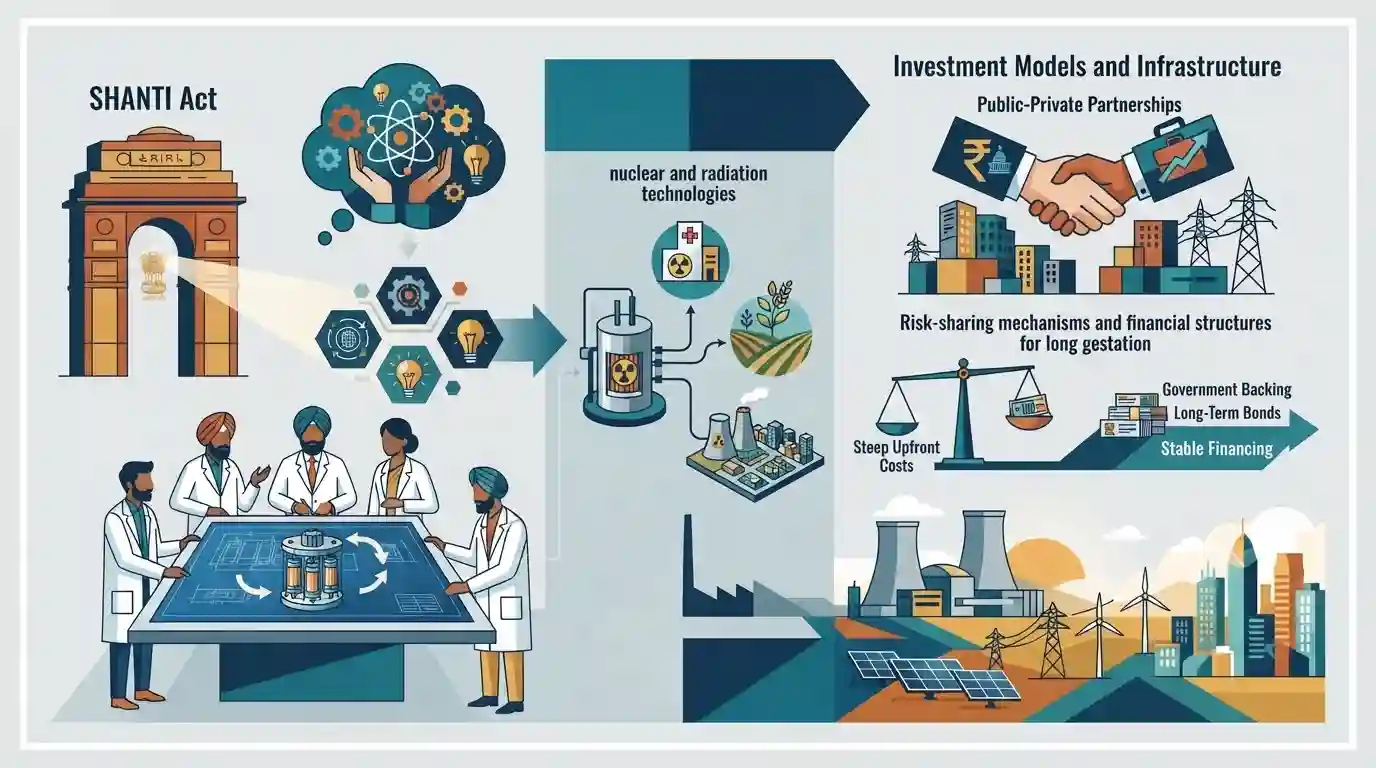
The PIB release details India's strategy to expand its nuclear energy footprint under the legislative framework of the SHANTI Act. This Act enables license-free research, development, and design of peaceful nuclear and radiation technologies to stimulate innovation and reactor deployment. Additionally, the government is focusing on creating risk-sharing mechanisms and financial structures to offset the steep upfront costs and long gestation liabilities associated with nuclear infrastructure projects.
Key Points
- The SHANTI Act permits any individual or entity to carry out research, development, design, and innovation in nuclear energy and radiation for peaceful uses without needing a prior license.
- The primary objective of this regulatory easing is to promote R&D, stimulate private/academic innovation, and accelerate the deployment of next-generation reactor technologies in India.
- The government is evaluating robust risk-sharing mechanisms and financial instruments to address the high upfront capital expenditures (capex) and long-term liabilities characteristic of nuclear energy projects.
- These measures aim to insulate developers and stakeholders from high-risk, long-gestation timelines, facilitating structured investment in the civilian nuclear sector.
Important Terms
SHANTI Act, 2025

A landmark legislation that overhauls India's nuclear governance by permitting private sector participation, establishing a revised liability framework, granting statutory status to the AERB, and targeting 100 GW capacity by 2047.
UPSC context
GS Paper III (Infrastructure: Energy); tests understanding of legislative reforms, private participation, and liability in nuclear power.
Department of Atomic Energy
An Indian government department, under the direct charge of the Prime Minister, responsible for nuclear power technology development, radiation applications, and basic research in atomic energy.
UPSC context
GS Paper III (Science and Technology); tests knowledge of institutional frameworks governing India's three-stage nuclear power programme.
Atomic Energy Regulatory Board
India's nuclear safety regulatory body, granted statutory status under the SHANTI Act, 2025, tasked with enforcing safety standards and regulating ionizing radiation and nuclear installations.
UPSC context
GS Paper III (Infrastructure: Energy); tests understanding of nuclear safety regulation, regulatory independence, and institutional frameworks.
Nuclear Energy Mission
A policy initiative announced in the Union Budget 2025–26, aiming to scale India's nuclear power capacity to 100 GW by 2047 to support the clean energy transition and net-zero goals.
UPSC context
GS Paper III (Infrastructure: Energy); tests awareness of national targets, strategic energy security, and clean energy transition policies.
Prime Minister's Office
The administrative body providing secretarial assistance to the Prime Minister of India, holding ultimate administrative oversight over strategic portfolios like the Department of Atomic Energy.
UPSC context
GS Paper II (Executive/Governance); tests understanding of executive machinery and institutional oversight of strategic sectors.
Prelims Trap
Under the Patents Act, 1970, inventions relating to atomic energy are strictly non-patentable under all circumstances.
The SHANTI Act 2025 amended Section 4 of the Patents Act, removing the absolute ban and allowing patent grants for peaceful, civilian nuclear technologies.
Static Concepts Connected
What was the controversial 'Right of Recourse' under the CLND Act, 2010?
- Operator Liability: The 2010 Act originally channeled absolute primary liability for any nuclear damage to the operator (historically NPCIL).
- Supplier Recourse: Section 17(b) uniquely allowed operators to sue suppliers for defective equipment or materials, which heavily deterred global and domestic nuclear suppliers.
- Global Alignment: By eliminating automatic supplier liability, the new SHANTI Act aligns India's nuclear regime with the international Convention on Supplementary Compensation (CSC) framework.
What is the mandate and evolving status of the Atomic Energy Regulatory Board (AERB)?
- Executive Origins: Created via a 1983 executive order, AERB historically lacked full statutory independence, operating under the administrative umbrella of the Department of Atomic Energy (DAE).
- Statutory Upgrade: The SHANTI Act formally grants AERB full, independent statutory status, a long-standing demand to separate nuclear regulation from nuclear power generation.
- Core Mandate: It oversees safety regulations to ensure the use of ionizing radiation and nuclear energy does not pose undue risks to public health and the environment.
Cross-Topic Patterns
Nuclear Privatization & Net Zero 2070
Shifting from a strict state monopoly to allowing 49% FDI and private joint ventures is a vital policy lever to secure the massive capital required for India's 2070 Net Zero decarbonization targets.
IPR Amendments in Strategic Technologies
Altering Section 4 of the Patents Act bridges domestic R&D with global innovation, mirroring past reforms where India balanced strategic security with commercial intellectual property incentives.

A 2026 prelims multi-statement question will likely contrast the repealed CLNDA 2010 'Right of Recourse' with the SHANTI Act's FDI enablers.
Linked PYQs · 3
Linked PYQs · 3
- 2020PrelimsGS1
In India, why are some nuclear reactors kept under "IAEA Safeguards" while others are not?
- 2017MainsGS3
Give an account of the growth and development of nuclear science and technology in India. What is the advantage of fast breeder reactor programme in India?
- 2014MainsGS3
Explain how Private Public Partnership arrangements, in long gestation infrastructure projects, can transfer unsustainable liabilities to the future. What arrangements need to be put in place to ensure that successive generations' capacities are not compromised?
