Non-fossil fuel installed power capacity and energy transition targets
Source:PIB ↗
Why It Matters
The article provides concrete, official data regarding India's non-fossil fuel capacity progress, distinguishing between 'installed capacity percentage' and 'actual energy generation'—a common point of confusion in UPSC mains exams. It introduces critical new technological and legislative terms, such as the SHANTI Act 2025, Bharat Small Reactors (BSRs), ASHVINI joint venture, and Battery Energy Storage Systems (BESS) VGF funding, which are highly relevant for Prelims conceptual/factual questions and Mains answers on energy transition, S&T indigenisation, and climate commitments.
Summary
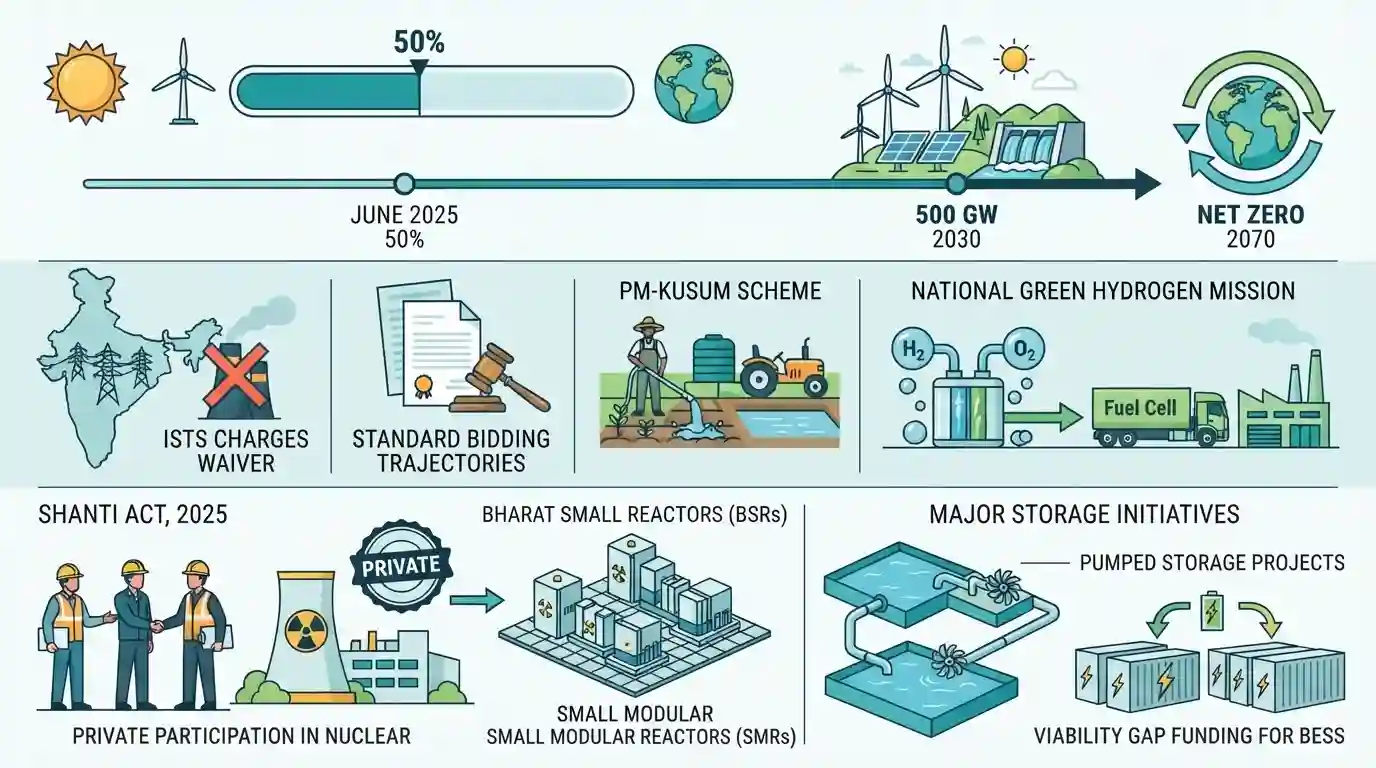
This PIB release outlines India's progress and policy framework for achieving 500 GW of non-fossil fuel power capacity by 2030 and Net Zero Emissions by 2070. Remarkably, India achieved 50% of its installed electricity capacity from non-fossil sources in June 2025—five years ahead of its Paris Agreement NDC target. It highlights significant policy initiatives, including waivers for Inter-State Transmission System (ISTS) charges, standard bidding trajectories, and schemes like PM-KUSUM and the National Green Hydrogen Mission. It also details the launch of the SHANTI Act, 2025 to enable private participation in nuclear energy, the development of Bharat Small Reactors (BSRs) and Small Modular Reactors (SMRs), and major storage initiatives including Pumped Storage Projects and Viability Gap Funding for Battery Energy Storage Systems (BESS).
Key Points
- India reached a landmark milestone in its energy transition by achieving 50% of its installed electricity capacity from non-fossil fuel sources in June 2025, more than five years ahead of its NDC targets under the Paris Agreement.
- As of December 31, 2025, India's total installed power capacity stood at 5,13,730 MW, consisting of 51.93% (2,66,788 MW) non-fossil fuel sources and 48.07% (2,46,942 MW) fossil fuel sources. Solar is the largest non-fossil contributor at 26.44% (135,810 MW), followed by Wind at 10.61% (54,511 MW) and Hydro at 9.91% (50,915 MW).
- The government has enacted the Sustainable Harnessing and Advancement of Nuclear energy for Transforming India (SHANTI) Act, 2025, to allow both public and private sector participation in nuclear energy, aiming for a target of 100 GW nuclear capacity by 2047.
- A dedicated Nuclear Energy Mission (₹20,000 crore) has been launched to develop at least five indigenously designed Small Modular Reactors (SMRs) by 2033. This is complemented by 'Bharat Small Reactors' (BSRs) of 220 MW capacity utilizing India's Pressurized Heavy Water Reactor (PHWR) technology.
- The NPCIL and NTPC joint venture, ASHVINI, has been formed to accelerate the construction of nuclear power plants. On fuel security, new uranium discoveries have extended the life of the Jaduguda mine by over 50 years, and milestones in the Prototype Fast Breeder Reactor (PFBR) closed fuel cycle are supporting long-term fuel availability.
- To address grid stability, a 30 GWh Battery Energy Storage Systems (BESS) VGF scheme (budget of Rs 5,400 Cr from the Power System Development Fund) was approved in June 2025, alongside 10 Pumped Storage Projects (PSPs) totaling 11,870 MW currently under construction.
- The Renewable Consumption Obligation (RCO) has been introduced till 2029-30 under the Energy Conservation Act, 2001, carrying penalties for non-compliance and mandating RE consumption, including decentralized RE.
Important Terms
Nationally Determined Contributions (NDCs)

Non-binding climate action plans submitted by countries under the Paris Agreement to reduce greenhouse gas emissions and adapt to climate impacts, updated every five years.
UPSC context
GS Paper III (Environment). Tests international climate agreements, India's decarbonization targets, and global mitigation strategies.
PM-KUSUM
A flagship solar scheme launched in 2019 that aims to ensure energy security for Indian farmers by promoting solar pumps and solarizing grid-connected agricultural feeders.
UPSC context
GS Paper III (Agriculture & Infrastructure). Evaluates agricultural water-energy nexus policies, subsidies, and clean energy generation.
PM Surya Ghar Muft Bijli Yojana
A ₹75,021 crore scheme launched in February 2024 aiming to install rooftop solar systems and provide up to 300 units of free monthly electricity to 1 crore households.
UPSC context
GS Paper III (Energy/Infrastructure). Examines efforts to boost distributed solar capacity and promote domestic manufacturing.
National Green Hydrogen Mission
A ₹19,744 crore mission approved in 2023 to develop India's green hydrogen ecosystem, targeting an annual production capacity of 5 million metric tonnes by 2030.
UPSC context
GS Paper III (Science & Tech/Environment). Crucial for industrial decarbonization, fuel alternatives, and technological indigenization.
Sustainable Harnessing and Advancement of Nuclear energy for Transforming India (SHANTI) Act, 2025
Landmark legislation enacted in December 2025 that overhauls India's nuclear governance, replacing the 1962 Atomic Energy Act to permit private sector participation under sovereign oversight.
UPSC context
GS Paper III (Science & Tech/Nuclear Technology). Tests strategic policy shifts, private infrastructure investments, and energy transition.
Prelims Trap
"India now generates over 50% of its total electricity from non-fossil fuel sources."
India achieved 50% in installed *capacity*, not actual electricity *generation*. Because renewables have a lower Plant Load Factor (PLF), fossil fuels still dominate actual power generated.
Static Concepts Connected
What is India's three-stage nuclear power programme?
- Stage 1 (PHWRs): Uses natural uranium to produce electricity and plutonium-239 as a byproduct. BSRs are based on this indigenous technology.
- Stage 2 (FBRs): Uses mixed oxide fuel (plutonium-239 and natural uranium). Surrounds the core with a thorium blanket to breed uranium-233.
- Stage 3 (AHWRs): Aims to use a thorium-uranium-233 cycle, leveraging India's vast thorium reserves to achieve long-term energy independence.
How do Pumped Hydro and BESS differ in grid balancing?
- Pumped Storage: Uses gravity by pumping water to a higher elevation during off-peak hours and releasing it during peak demand. Highly suited for long-duration storage.
- Battery Systems (BESS): Uses chemical batteries (like Li-ion) to store power. Offers extremely fast response times for short-to-medium duration grid frequency regulation and is modular.
Cross-Topic Patterns
Nuclear Liability & Private Capital
The shift from CLNDA 2010 to the SHANTI Act 2025 aligns India's nuclear liability with global norms, finally unblocking domestic private participation and operationalizing the 49% FDI cap.
Grid Stability & Energy Storage
As non-fossil capacity hits 50%, grid intermittency becomes the primary bottleneck, making Viability Gap Funding for Battery Energy Storage (BESS) and Pumped Hydro critical syllabus overlaps.
NDC Targets vs Actual Generation
While India overachieved its Paris NDC capacity targets, the Plant Load Factor (PLF) reality means coal remains absolutely central to actual baseload generation.

Expect a 2026 Prelims question on the SHANTI Act contrasting BSRs (indigenous PHWR tech) with SMRs (light water tech) and FDI rules.
Linked PYQs · 3
Linked PYQs · 3
- 2025MainsGS3
Write a review on India's climate commitments under the Paris Agreement (2015) and mention how these have been further strengthened in COP26 (2021). In this direction, how has the first Nationally Determined Contribution intended by India been updated in 2022?
- 2022MainsGS3
Do you think India will meet 50 percent of its energy needs from renewable energy by 2030 ? Justify your answer. How will the shift of subsidies from fossil fuels to renewables help achieve the above objective ? Explain.
- 2020PrelimsGS1
In India, why are some nuclear reactors kept under "IAEA Safeguards" while others are not?
