TCS survey highlights mainstream adoption of physical AI
Source:The Hindu ↗
কেন এটি গুরুত্বপূর্ণ
The transition to 'Physical AI' represents a major evolutionary phase of the Fourth Industrial Revolution (Industry 4.0). Understanding this shift is essential for analyzing technological employment, manufacturing-led growth, the future of labor, and industrial infrastructure modernization under GS-3 (Science & Tech and Economy).
সারসংক্ষেপ
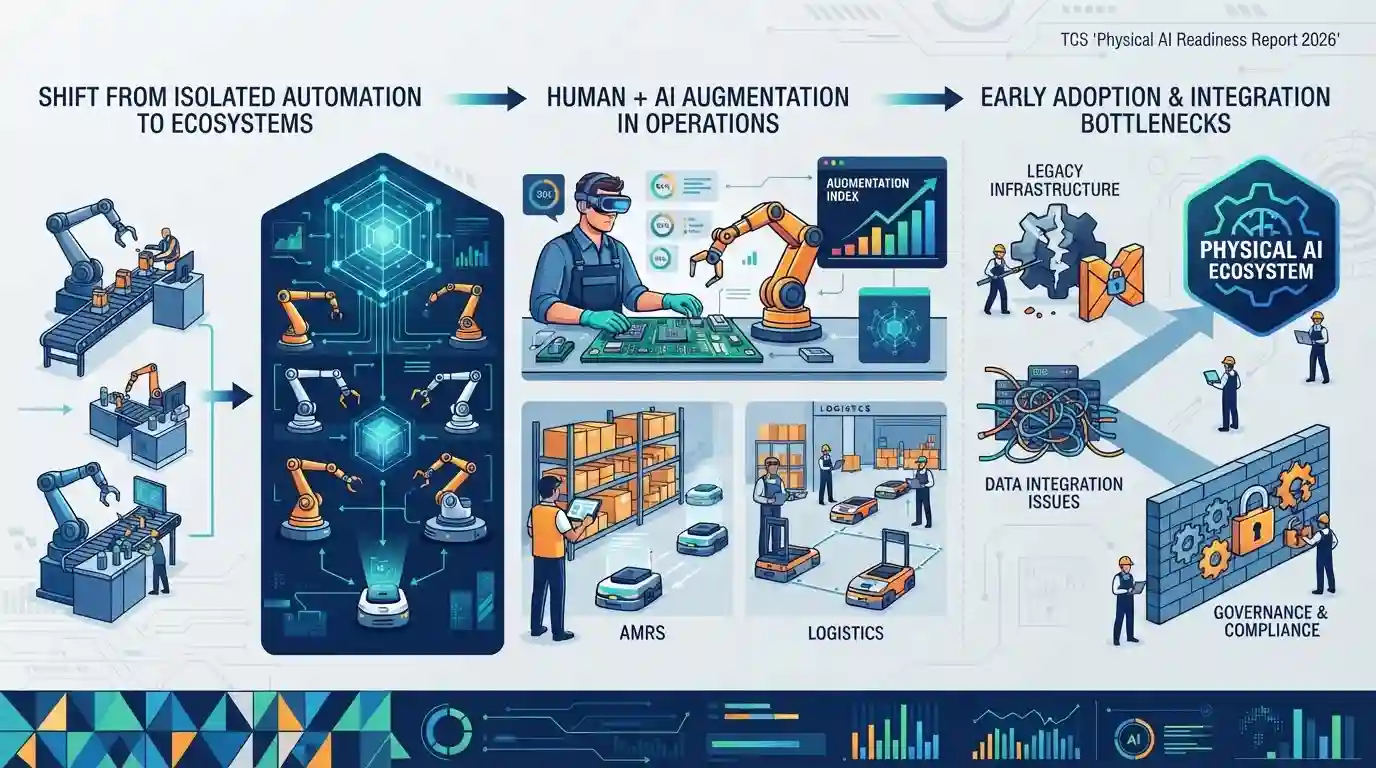
Tata Consultancy Services' (TCS) 'Physical AI Readiness Report 2026' reveals that physical artificial intelligence is becoming mainstream in manufacturing, transitioning from isolated automation to comprehensive physical AI ecosystems. The report outlines a shift towards a 'Human + AI' operating model where intelligent systems augment, rather than replace, human labor on shop floors, particularly in warehouse operations, manufacturing, and logistics. However, despite long-term investment commitments, global adoption remains in an early, uneven stage, facing bottlenecks like legacy infrastructure, data integration, and governance [1.1].
মূল বিষয়
- Evolution to Physical AI Ecosystems: Manufacturing is transitioning from standalone automation to integrated physical AI systems where machines sense, adapt, and act in real-time on the shop floor [1.1].
- The 'Human + AI' Operating Model: Rather than job replacement, companies are embracing a human-centric augmentation approach to enhance workforce safety, efficiency, and productivity in complex or hazardous environments [1.1].
- Uneven Deployment Status: The technology is in its infancy; 68% of manufacturers report zero active deployment or only experimental stages, and only 9% have scaled pilots to full operations [1.1].
- Determinants of Scale: The report highlights that technological adoption depends heavily on data integration, legacy systems modernization, workforce capability, ethics/governance, and defined accountability [1.1].
- Major Impact Areas: Warehouse operations (77%), assembly/manufacturing (75%), and logistics/material movement (72%) are predicted to experience the most significant transformation [1.1].
- Advanced Multimodal Partnerships: Industry players (such as TCS partnering with Google Cloud) are leveraging multimodal reasoning models (like Gemini) to enable smarter and safer robotic workflows on physical shop floors [1.1].
গুরুত্বপূর্ণ শব্দ
Physical Artificial Intelligence

Artificial intelligence integrated into physical machinery (like robots) that allows systems to autonomously perceive, reason, and act in real-world, dynamic environments.
UPSC context
GS Paper III (Science & Technology) - Core development and applications of emerging technologies like robotics and AI.
Industry 4.0
The Fourth Industrial Revolution, characterized by the integration of digital technologies—such as IoT, AI, big data, and cloud computing—into physical manufacturing and industrial processes.
UPSC context
GS Paper III (Economy & S&T) - Industrial modernization, manufacturing growth, and digital transformation initiatives in India.
Human-AI Augmentation
A cooperative work model where artificial intelligence systems assist and enhance human capabilities, improving productivity and safety rather than completely replacing human labor.
UPSC context
GS Paper III (S&T and Economy) - Impact of technological automation on employment and future workforce skills.
Tata Consultancy Services (TCS)
A leading Indian multinational information technology services and consulting company, serving as a pioneer in digital innovation and global software exports.
UPSC context
GS Paper III (Economy) - Development of the services sector, digital public infrastructure, and IT exports.
Google Cloud
A suite of cloud computing services and infrastructure provided by Google, supporting enterprise-grade AI deployment, data analytics, and modern software-driven applications.
UPSC context
GS Paper III (S&T) - Infrastructure requirements for digital services, cloud security, and technological partnerships.
প্রিলিমস ফাঁদ
Physical AI implementations aim to entirely eliminate human labor on manufacturing shop floors through autonomous, zero-human robotic systems.
The industry is actively shifting toward a collaborative 'Human + AI' augmentation model, where systems enhance workforce safety and productivity rather than pursuing absolute job replacement.
সংযুক্ত স্থির ধারণা
What are the core components of Industry 4.0?
- Cyber-Physical Systems: Integrate physical processes with computation and networking, allowing real-time monitoring and decentralized decisions.
- Internet of Things: Connects machines, sensors, and devices to exchange data and optimize industrial workflows.
- Cognitive Computing: Applies AI and machine learning to analyze massive datasets for predictive maintenance and smart automation.
What is India's National Mission on Interdisciplinary Cyber-Physical Systems (NM-ICPS)?
- Nodal Agency: Implemented by the Department of Science and Technology (DST) to build a robust national CPS ecosystem.
- Four Pillars: Focuses on technology development, human resource development, technology business incubation, and international collaborations.
- Key Objectives: Targets critical sectors like agriculture, water management, healthcare, smart cities, and advanced manufacturing.
আন্তঃবিষয় প্যাটার্ন
AI labor dynamics + Demographic Dividend
The shift to Human-AI collaboration models directly impacts India's manufacturing employment, demanding a rapid transition from basic vocational training to advanced cognitive-physical skill development.
Industrial IoT + Kinetic Cyber Warfare
Physical AI systems create tangible kinetic vulnerabilities, transitioning digital cyber threats into physical safety hazards. This links GS-3 industrial modernization directly with critical infrastructure security.

GS3 Mains 2026 may evaluate 'Human-AI augmentation' as a balanced solution for Make in India 2.0 without triggering mass job displacement.
সংযুক্ত PYQ · 2
সংযুক্ত PYQ · 2
- 2015MainsGS3
What are the areas of prohibitive labour that can be sustainably managed by robots ? Discuss the initiatives that can propel research in premier research institutes for substantive and gainful innovation.
- 2023MainsGS3
Introduce the concept of Artificial Intelligence (AI). How does Al help clinical diagnosis? Do you perceive any threat to privacy of the individual in the use of Al in healthcare?
